


Losing a tooth changes more than your smile. It changes how you chew, how you speak, and for many patients, how confidently they show up in photos, meetings, and everyday life. If you are searching for how to fix missing teeth without implants, the good news is that implants are not the only path to a complete, attractive smile.
For the right patient, non-implant solutions can restore appearance quickly, improve bite function, and keep treatment simpler. The best option depends on where the tooth is missing, how many teeth are involved, the condition of the surrounding teeth and gums, and how much permanence you want from the result.
How to fix missing teeth without implants: your main options
When implants are off the table, dentists usually look at three directions: dental bridges, removable dentures, and cosmetic reshaping strategies for very specific cases. Each option solves a different problem, and each comes with its own trade-offs.
A lot of patients assume non-implant treatment means compromising on aesthetics. That is not always true. Modern materials, digital planning, and well-designed restorations can create a very refined result, especially when the treatment is planned with smile balance in mind rather than just filling a gap.
Dental bridges
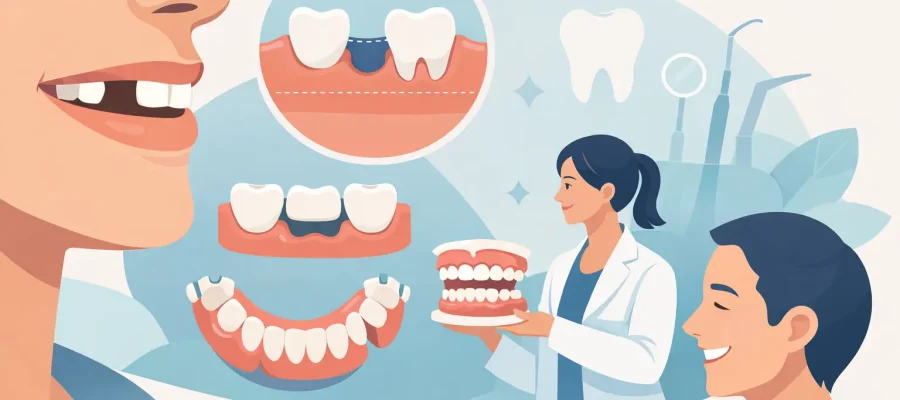
A dental bridge is one of the most established ways to replace a missing tooth without surgery. It works by anchoring an artificial tooth to the natural teeth on either side of the space. If those neighboring teeth already need crowns, a bridge can be especially efficient because it restores the gap and strengthens the adjacent teeth in one treatment plan.
For patients who want a fixed solution, bridges often feel like the closest alternative to implants. They do not come out, they can look very natural, and they restore chewing better than many removable options. In aesthetic zones, the shape, shade, and contour can be tailored to blend into a smile design rather than stand out as a repair.
The trade-off is tooth preparation. Traditional bridges usually require the supporting teeth to be reshaped for crowns. If those teeth are perfectly healthy and untouched, some patients hesitate for that reason. Still, if the support teeth are heavily filled, worn, or already crowned, a bridge can be a smart and elegant choice.
Maryland bridges
A Maryland bridge is a more conservative variation, usually used for front teeth. Instead of full crowns on adjacent teeth, it uses small wings bonded to the back of nearby teeth. This means less drilling and a more minimal approach.
It can be a strong option for younger patients or for those who want to preserve as much natural tooth structure as possible. The limitation is durability under pressure. Maryland bridges are typically better in low-bite-force areas and are not ideal in every case. If your bite is heavy or the missing tooth sits in a high-stress position, your dentist may recommend a stronger fixed option.
Partial dentures
If several teeth are missing in different areas, a partial denture can restore them without placing implants or preparing multiple neighboring teeth for bridgework. Partial dentures are removable and designed to fit around the remaining natural teeth.
This is often the most practical option when patients want a lower-cost entry point or when the mouth needs a broader rehab strategy over time. A well-made partial can improve appearance and function quickly, which matters for patients with upcoming events, travel schedules, or a desire to avoid surgery.
That said, removable appliances do feel different from fixed teeth. Some patients adapt fast. Others never love the sensation. They also require daily removal and cleaning, and over time they may need adjustments as the mouth changes.
Full dentures
When all teeth in the upper or lower arch are missing, full dentures remain a valid non-implant treatment. They have improved dramatically in appearance, and with good planning, they can support lip shape, facial balance, and a cleaner smile line.
The biggest advantage is simplicity. Full dentures avoid surgery, can be completed relatively quickly, and can provide a major visual transformation. For patients who are not candidates for implants due to medical factors, budget, bone loss, or personal preference, they can still be life-changing.
The trade-off is stability, especially in the lower jaw. Full dentures do not feel like natural teeth or fixed restorations. Some patients are very happy with them, while others find movement, pressure points, or chewing limitations frustrating. Expectations matter here. The right denture can look beautiful, but it behaves differently from fixed teeth.
When cosmetic dentistry can help close the gap
Not every small space needs a literal tooth replacement. In certain smile design cases, especially around the front teeth, cosmetic dentistry may create the appearance of a complete smile by redistributing space with veneers or crowns. This is only appropriate when the spacing, bite, and tooth proportions allow it.
For example, if a patient has a congenitally missing lateral incisor or a very small gap pattern, a dentist may reshape the neighboring teeth to create a balanced smile line. This is a highly planned aesthetic approach, not a shortcut. The result depends on facial proportions, gum symmetry, and precise design.
This option will not work for most missing back teeth because those areas carry more chewing load and require functional replacement. But in selective front-tooth cases, it can produce a polished result with strong cosmetic impact.
How to choose the right non-implant solution
The right answer is rarely just about replacing the tooth. It is about matching the treatment to your timeline, your bite, and the level of permanence you want.
If you want a fixed result and the neighboring teeth need restoration anyway, a bridge often makes the most sense. If you need to replace multiple teeth across the mouth, a partial denture may be the more practical route. If your concern is mainly cosmetic and limited to the front, smile design may open options that feel more refined than a standard replacement.
Budget matters too, but so does maintenance. A lower upfront cost can come with more adjustments, more movement, or shorter lifespan. A higher-end bridge or aesthetic restoration may cost more initially but feel better integrated into daily life. This is where planning makes all the difference.
What the treatment process usually looks like
Patients often expect non-implant treatment to be basic. In reality, the better the result needs to look, the more exact the planning should be.
It starts with digital imaging, bite analysis, and an evaluation of the surrounding teeth and gums. Your dentist checks whether the support teeth are strong enough for a bridge, whether gum contours will look natural around a replacement tooth, and whether the bite allows long-term stability.
From there, the restoration is designed around both function and appearance. For visible teeth, shade selection, tooth length, edge shape, and smile symmetry all matter. In premium clinics, this planning may include digital smile previews so the patient can see the direction before treatment begins.
The preparation stage depends on the chosen method. A bridge requires shaping the support teeth if it is a traditional design. A removable prosthesis requires impressions or digital scans to build a secure fit. Cosmetic reshaping cases often need a wax-up or digital mock-up to test proportions before final placement.
Then comes fitting and refinement. This is where pressure points, bite balance, speech, and smile aesthetics are adjusted. The best non-implant restorations do not just fill a space. They sit naturally in the face and function predictably under real daily use.
How long do these options last?
It depends on the solution and on how well it is maintained. Bridges can last many years with strong hygiene and regular care. Partial and full dentures typically need more maintenance, relines, or replacement over time as the gums and bone shift. Cosmetic solutions can be durable, but only when they are used in the right case.
This is one reason expert case selection matters so much. A treatment that is cheaper or faster on day one can become frustrating if it was not the right biomechanical choice. Good dentistry is not only about what can be done. It is about what will still be working and looking good years later.
Is fixing missing teeth without implants worth it?
For many patients, absolutely. If you want to avoid surgery, reduce treatment complexity, or move faster toward a finished smile, non-implant options can deliver a strong result. At DRGO Smile Clinic, this kind of planning is approached the same way premium aesthetic cases are approached – with precision, speed, and a clear visual endpoint.
The key is choosing a solution that fits your real priorities instead of chasing a one-size-fits-all answer. Some patients want the most fixed option possible. Others want the fastest route to a confident smile before a major event. Others simply want function back without extending treatment into surgery and healing.
Missing teeth should not force you into a single treatment path. The best plan is the one that restores your comfort, suits your lifestyle, and gives you a smile you are ready to use without hesitation.