


A cracked front tooth before a wedding. A missing molar before a big presentation. A smile that looks fine on video calls but not in close-up photos. This is usually when the question becomes real: dental implants versus crowns – which treatment actually gives you the result you want?
The answer depends on one thing first. Are you trying to save a tooth, or replace one that is already missing or beyond repair? Crowns and implants can both transform a smile, but they solve different problems. Choosing well means looking past the headline and focusing on structure, appearance, timing, and long-term value.
Dental implants versus crowns: the core difference
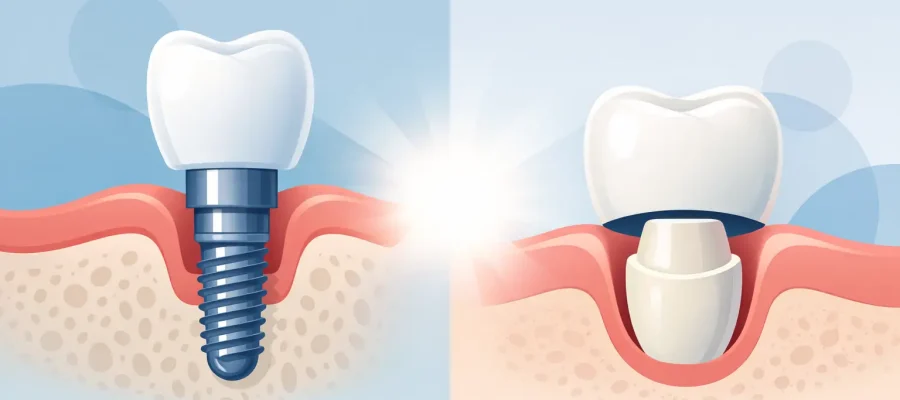
A crown is a custom-made cap placed over an existing tooth. It restores shape, strength, and appearance when the natural tooth is still present but damaged, heavily filled, worn down, root canal treated, or cosmetically compromised.
A dental implant replaces a missing tooth from the root up. A small titanium post is placed into the jawbone, allowed to integrate, and then restored with a crown on top. If the tooth is gone, a crown alone cannot solve that. It needs a foundation.
This distinction matters because many patients compare them as if they are interchangeable. Usually, they are not. If your tooth can be saved predictably, a crown may be the more conservative choice. If the tooth is missing, fractured below the gumline, or failing in a way that cannot be stabilized, an implant may be the cleaner long-term solution.
When a crown is the smarter choice
A crown makes sense when the root is healthy and the tooth still has enough structure to support restoration. Think of it as rebuilding rather than replacing. For patients who want fast cosmetic and functional improvement, crowns are often attractive because treatment can move quickly and the visible result is immediate.
This is especially true for front teeth and smile-zone cases where aesthetics matter as much as strength. Modern ceramic options can deliver excellent translucency, color matching, and symmetry. In the right hands, a crown can blend so naturally that it disappears into the smile.
Crowns are also typically less invasive than implants. There is no surgical placement into bone, no healing period for osseointegration, and often less total treatment time. If the tooth is restorable, preserving natural biology is usually a strong starting point.
That said, a crown is only as good as the tooth underneath it. If the remaining tooth is weak, repeatedly infected, deeply cracked, or structurally compromised, placing a crown may only delay a larger problem. In those cases, speed today can become retreatment later.
Best scenarios for crowns
Crowns are often ideal when a tooth is broken but not lost, after root canal treatment, for severe wear from grinding, or when a cosmetic upgrade is needed along with reinforcement. They are also common in smile makeover planning, where multiple teeth are reshaped for harmony and balance.
When an implant is the better investment
If the tooth is missing, an implant is often the premium restorative answer because it replaces what matters under the surface, not just what shows above the gumline. That root-level support helps maintain bone, stabilizes chewing, and avoids placing extra stress on neighboring teeth.
This is one of the biggest differences in the dental implants versus crowns decision. A crown protects what remains. An implant rebuilds what was lost.
Implants are particularly valuable when you do not want to trim healthy adjacent teeth to support a bridge, or when you want a fixed solution that feels more independent and durable. For many international patients choosing treatment around a major life event or long-term lifestyle upgrade, that independence matters. They are not just buying a repair. They are buying confidence, function, and fewer compromises.
Implants also perform well in cases of single missing teeth, multiple missing teeth, and full-arch rehabilitation. With modern planning, 3D imaging, and guided surgery, outcomes can be highly precise. In select cases, immediate implant protocols can also shorten the path to a fixed smile.
Best scenarios for implants
Implants are often the right move when a tooth has already been extracted, is non-restorable, has failed repeatedly despite prior work, or when bone preservation and long-term stability are priorities. They are also a strong option for patients who want the most tooth-independent replacement possible.
Aesthetics: which looks better?
For most patients, this is the question behind every other question.
A beautifully made crown on a healthy natural tooth can look exceptional. So can an implant crown. The better-looking option is not decided by the label. It is decided by planning, materials, gum architecture, bite design, and whether the clinical situation supports a natural-looking finish.
In the front of the mouth, details matter more. Gum symmetry, emergence profile, tooth proportion, and light reflection all show. If a natural tooth can be saved and has stable gum tissue, a crown may offer very refined aesthetic control. If the tooth must be removed, implant aesthetics can still be excellent, but they require careful management of bone and soft tissue from day one.
This is why digital planning is so valuable. A 3D preview, smile design analysis, and precise shade strategy reduce guesswork and help patients see where the final result is going before treatment begins.
Longevity and maintenance
Both implants and crowns can last for many years, but they fail for different reasons.
Crowns may need replacement because of decay around the margins, fracture, cement issues, or changes in the underlying tooth. The restoration may still look fine while the tooth beneath it weakens. That is why proper preparation, fit, and bite balance matter.
Implants do not get cavities, but they are not maintenance-free. They can fail because of poor integration, overload, peri-implant tissue problems, or inadequate hygiene. Success is strongly tied to case selection, surgical precision, and aftercare.
In practical terms, implants often offer stronger long-term independence when replacing a missing tooth. Crowns often offer excellent value when preserving a salvageable one. The smarter option is usually the one that fits the biology, not the one that sounds more advanced.
Time, surgery, and recovery
If speed is your top priority, crowns usually win.
A crown can often be prepared and delivered much faster than an implant, especially in clinics with CAD/CAM workflows and in-house design systems. For travelers or patients working around a tight schedule, that matters. A fast result without sacrificing precision is a major advantage.
Implants usually require more stages. Even with immediate placement, healing and integration still guide the final timeline. Some patients can receive an immediate temporary tooth or even fixed provisional teeth in full-arch cases, but the final restoration still follows biological rules.
So if you need the quickest route for a damaged but restorable tooth, a crown may be ideal. If you need to replace a missing tooth correctly and want the strongest structural solution, the longer path of an implant may be worth it.
Cost versus value
Crowns usually cost less upfront than implants. That is one reason many patients start there. But price alone is not the smartest filter.
The better question is what you are paying for over time. If a crown preserves a healthy tooth for many years, it can be an excellent investment. If a badly compromised tooth receives a crown, then fails and needs extraction, implant placement, and additional grafting later, the lower starting price loses its appeal.
Implants generally involve higher initial cost because they include surgery, implant components, imaging, planning, and the final crown. But they also replace the full unit rather than just the visible portion. In many cases, especially for missing teeth, that broader reconstruction justifies the price.
For international patients, value also includes logistics. Compressed treatment planning, clear sequencing, digital previews, and coordinated travel support can make a premium treatment path more efficient and more predictable. That is part of the decision too.
How dentists actually decide
The best treatment plan is not built around preference. It is built around diagnosis.
A dentist will look at whether the tooth is present, how much structure remains, whether infection exists, how the bite functions, what the bone quality is like, and what level of aesthetic change you want. They also consider your timeline, budget, habits like clenching or smoking, and whether this is a single-tooth issue or part of a full smile redesign.
At a clinic like DRGO Smile Clinic, this decision is often made with digital imaging and smile planning rather than rough estimates. That creates a very different patient experience. You are not choosing in the dark. You are choosing from a planned result.
So which should you choose?
If your tooth is still healthy enough to save, a crown is often the elegant move. It is faster, less invasive, and can deliver impressive cosmetic refinement.
If the tooth is missing or cannot be saved with confidence, an implant is usually the stronger long-term play. It restores support, protects bone, and gives you a replacement that functions more like a real tooth.
The right choice is not about picking the more expensive option or the faster one. It is about matching the treatment to the biology and the outcome you want. A confident smile looks effortless, but the best ones are engineered carefully from the start.