


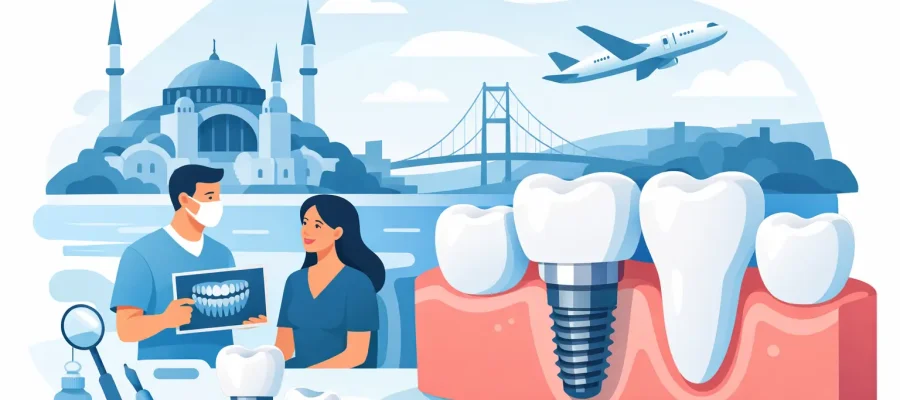
A missing tooth changes more than a photo. It can affect how you chew, how clearly you speak, and whether you instinctively cover your mouth when you laugh. For international patients comparing options, dental implants in Turkey: a complete guide should begin with one question: can the clinic deliver a stable, natural-looking result with a plan you can understand before you board a flight?
The right implant journey is not about finding the fastest procedure or the lowest quote. It is about detailed diagnostics, experienced surgical care, quality materials, and a travel plan that gives your treatment the time it needs. Turkey can offer exceptional value and advanced dental technology, but outcomes depend on the clinic, your oral health, and the treatment protocol chosen for you.
What a Dental Implant Actually Replaces
A dental implant is a small titanium or ceramic post placed in the jawbone to replace a missing tooth root. Once it is stable, a custom crown is attached above the gumline. The visible result should look, feel, and function much like a natural tooth.
For one missing tooth, treatment usually involves one implant and one crown. For several missing teeth, implants may support a bridge rather than replacing every tooth individually. Patients with a full arch of failing or missing teeth may be candidates for fixed full-arch solutions such as All-on-4 or All-on-6, where a carefully planned number of implants supports a full set of fixed teeth.
The key distinction is important: an implant is the foundation, while the crown or bridge is the tooth you see. A premium result depends on both. Surgical precision matters below the gumline, while smile design, bite balance, color, and material choice matter above it.
Are You a Candidate for Implants?
Most healthy adults with missing teeth can be considered for implant treatment, but candidacy is never determined from a photo alone. A proper remote consultation may help establish the likely pathway, yet final approval requires an in-person examination and 3D imaging.
Your dentist will assess bone volume, gum health, bite forces, remaining teeth, and the location of nerves and sinuses. Bone loss is common after a tooth has been missing for years, especially in the back of the upper jaw. This does not automatically rule out implants. It may mean a bone graft, sinus lift, or a different implant position is needed before or during placement.
Smoking, uncontrolled diabetes, active gum disease, teeth grinding, and certain medications can affect healing and long-term success. These factors call for careful planning, not rushed promises. If you grind your teeth, for example, you may need a protective nightguard after treatment. If gum disease is active, it should be controlled before implants are placed.
Dental Implants in Turkey: A Complete Guide to the Timeline
The timeline depends on whether you need a straightforward single implant, additional surgical work, or a full-arch transformation. A clinic that gives every patient the same schedule is not necessarily being efficient. It may be overlooking the biology of healing.
Before You Travel
Your journey should begin with a structured consultation. You will typically share recent X-rays or CBCT scans if available, medical history, photos, and details about what you want to change. The clinic should then explain the proposed treatment, possible alternatives, estimated visit schedule, and what is included in the quoted package.
A digital smile plan can be especially valuable when implant treatment is combined with veneers, crowns, or a wider smile makeover. It helps align the restorative work with your facial features and expectations rather than treating each tooth in isolation.
Your First Visit: Planning and Surgery
After a clinical examination and 3D CBCT scan, the dentist confirms the final treatment plan. This is where precision becomes real: the team checks bone density, implant angulation, bite, gum contours, and the condition of surrounding teeth.
The implant placement procedure is performed under local anesthesia, with sedation options depending on the clinic and your needs. Many patients are surprised by how manageable the procedure feels. Mild swelling, tenderness, or bruising can occur afterward, particularly when multiple implants, extractions, or grafting are involved.
In selected cases, an immediate temporary tooth or fixed temporary bridge can be placed on the same day. This can be an excellent solution for front teeth or full-arch cases, but it is not appropriate for everyone. Immediate loading requires sufficient initial implant stability, favorable bite conditions, and disciplined aftercare.
Healing and the Final Teeth
Implants need time to integrate with the jawbone, a process called osseointegration. For many patients, this means returning after a healing period of roughly three to six months for final crowns or a final full-arch bridge. Some cases follow a shorter or longer schedule depending on bone quality, grafting, and healing response.
At the final visit, your dentist records precise impressions or digital scans, checks the shape and shade of the teeth, and evaluates your bite. A temporary is not simply swapped for a final restoration. The final stage should include careful try-ins and refinements so your teeth feel natural when you speak and chew.
Why Turkey Is Popular for Implant Dentistry
Patients travel to Istanbul for a combination of experienced clinicians, modern laboratories, digital workflows, and pricing that can be more accessible than comparable private treatment in the United States. The savings often reflect differences in operating costs, not a reason to compromise on clinical standards.
For many international patients, the appeal is also logistical. An all-inclusive treatment plan can coordinate airport transfers, hotel accommodation, interpreter support, clinic appointments, and local guidance around your recovery schedule. That structure removes much of the uncertainty from dental travel, especially when you are arranging a multi-visit treatment from another country.
At DRGO Smile Clinic, implant planning can be integrated with Digital Smile Design and restorative treatment, so the surgical plan and final aesthetic result are considered together. That matters if you are replacing missing teeth while also improving the shape, color, or symmetry of your visible smile.
How to Compare Implant Clinics Beyond the Price
A quote is only useful when you know what it covers. Ask which implant system will be used, what material is planned for the crown or bridge, whether 3D imaging is included, and whether temporary teeth are part of the plan. Also ask about bone grafting, sinus lift procedures, medications, hotel arrangements, transfers, follow-up care, and the cost of any additional work found after examination.
Look for a clinic that can show clear case planning and explain who will perform each stage. Implant treatment may involve an oral surgeon, prosthodontist, restorative dentist, and dental technician. That team approach is particularly valuable for full-mouth reconstruction, where function and aesthetics have to work together.
Before committing, request answers to these practical questions:
- What implant brand and restoration material are included in my treatment plan?
- Will I receive a CBCT scan and a written clinical plan before surgery?
- Is immediate loading clinically suitable for my case, or will I need a healing period?
- What happens if I need a graft, sinus lift, or additional treatment after the in-person exam?
- How will aftercare and communication be handled once I return home?
Be cautious with clinics that guarantee an implant result without reviewing your health history and 3D scan. A confident clinic should be transparent about what is predictable, what may change after diagnostics, and why.
Choosing Between All-on-4, All-on-6, and Individual Implants
There is no universal “best” option. All-on-4 may be suitable for patients seeking fixed full-arch teeth with fewer implants and can sometimes avoid more extensive grafting. All-on-6 uses additional implants, which may offer broader support when anatomy and bone volume allow. Individual implants can be ideal when you have only one or a few missing teeth and healthy neighboring teeth.
The right solution depends on your bone, bite, facial goals, budget, and the condition of your remaining teeth. Saving healthy natural teeth is often preferable to extracting them for a full-arch bridge. Conversely, when many teeth are unstable, painful, or repeatedly failing, a full-arch plan can provide a more predictable fresh start.
Recovery, Aftercare, and Long-Term Results
Plan for a quieter first few days after surgery. Follow your dentist’s instructions on medication, oral hygiene, smoking, alcohol, and food. Soft foods are usually recommended initially, and you should avoid placing heavy chewing pressure on temporary teeth.
Long-term implant care is straightforward but non-negotiable. Brush carefully, use the cleaning tools recommended for your restoration, attend regular hygiene visits, and wear a nightguard if prescribed. Implants cannot decay, but the gums and bone around them can become inflamed without consistent care.
Your best next step is a consultation built around your scan, health history, and smile goals. A well-designed implant plan should leave you feeling informed before you travel and confident each time you smile afterward.