


You do not book a flight for implant treatment just to hear, “Come back in six months with no teeth.” If you are considering immediate implants, the real question is not whether speed is possible. It is how the timeline actually works, where the shortcuts stop, and what you can realistically expect to leave with.
For the right patient, same-day treatment can mean implant placement and fixed temporary teeth in a single visit. That is a major upgrade in comfort, appearance, and confidence. But it is not magic. It is a planned surgical and prosthetic sequence built around bone quality, gum condition, bite design, and precision diagnostics.
What the same day dental implant timeline really means
A same day dental implant timeline usually refers to immediate implant placement with a temporary restoration delivered on the same day, or within 24 to 72 hours depending on the case. It does not always mean your final zirconia or ceramic teeth are delivered that day.
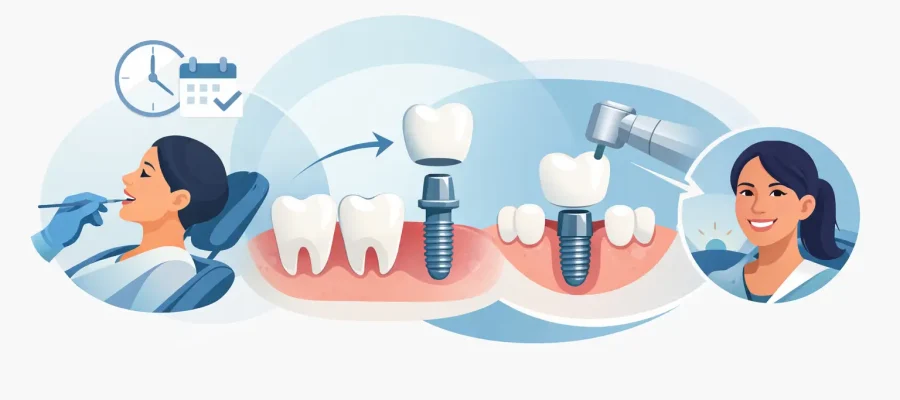
That distinction matters. In many cases, the implant is placed immediately after extraction, then a fixed temporary bridge or temporary crown is attached so you do not spend your healing period with a visible gap or a removable denture. The final prosthetic phase comes later, after the implant integrates with bone and the soft tissue settles into a stable shape.
For international patients, this timeline is especially attractive because it compresses the most visible part of treatment. You travel, complete diagnostics and surgery, and return home with teeth that look presentable and function carefully while healing begins.
Who is a strong candidate for same-day implants
The best results come from careful case selection. Same-day implants work best when there is enough healthy bone to stabilize the implant at placement. The gum tissue should also be manageable, and infection, if present, must be controlled.
Single-tooth cases can be ideal when the surrounding teeth and bite allow the temporary tooth to stay out of heavy pressure. Full-arch cases such as All-on-4 or All-on-6 can also be excellent candidates because the load is distributed across multiple implants and the full arch is engineered as one restoration.
It depends more than most patients expect on bite forces, smoking history, uncontrolled diabetes, active gum disease, and parafunctional habits like grinding. If primary stability is not strong enough at surgery, a skilled implant team may still place the implants but delay the fixed temporary teeth for safety. Speed matters, but implant stability matters more.
Before you travel: the planning phase
The timeline often begins before you land in Istanbul. Photos, panoramic imaging, and medical history review help the clinic determine whether same-day treatment is realistic. In more advanced planning, a CBCT scan and digital smile design are used to map bone, implant position, and the shape of the temporary restoration.
This pre-arrival stage is where premium implant care separates itself from rushed dentistry. The goal is to reduce surprises. If extractions, bone grafting, sinus lift, or a full-arch conversion are likely, your treatment plan should reflect that from the start.
For image-conscious patients, planning is not just surgical. It is aesthetic. Tooth proportions, smile line, lip support, and facial balance all affect how the temporary and final teeth are designed.
Day 1: scans, consultation, and final approval
The first in-clinic day is usually diagnostic and design-heavy. You arrive, complete a clinical exam, take any required 3D scans, and confirm the final treatment plan with the implant surgeon and restorative team.
This is where your timeline becomes personal rather than generic. A single front tooth replacement follows a different flow than a full-arch case with extractions and immediate loading. If digital planning confirms strong implant positioning and good bone support, same-day surgery moves forward.
For patients using a medical travel package, this stage is often much easier than expected. Transfers, translation support, and tightly scheduled appointments remove the dead time that usually makes complex treatment feel chaotic.
Day 1 or 2: extraction, implant placement, and temporary teeth
This is the part most people mean when they ask about the same day dental implant timeline. If a failing tooth is being removed, extraction is completed as gently as possible to preserve bone and gum architecture. The implant is then placed into the site or into a carefully prepared position in the jaw.
If the implant achieves strong primary stability, a temporary crown or temporary fixed bridge may be attached right away. In full-arch cases, multiple implants are placed and connected to a provisional bridge that gives you fixed teeth immediately.
You can expect this temporary phase to look dramatically better than a missing-tooth situation, but it is still a healing restoration. It may be adjusted to protect the implants from overload. That means your temporary teeth are designed for appearance and controlled function, not for chewing steak on day two.
The first 72 hours: what recovery usually feels like
Most patients are surprised that the discomfort is more manageable than the anticipation. Swelling, mild bruising, pressure, and tenderness are common in the first two to three days, especially in full-arch surgery or multiple extractions.
The biggest adjustment is usually not pain. It is learning how to protect the new implants. You will likely be asked to follow a soft-food diet, avoid heavy biting on the temporary restoration, and keep the area extremely clean using the aftercare protocol provided by your clinic.
Speech can feel slightly different for a few days, particularly with a new full-arch bridge. This usually improves quickly as your tongue and lips adapt.
The next few months: healing and integration
The implant itself needs time to fuse with the bone. This process, called osseointegration, usually takes around three to six months depending on your biology, the number of implants, and whether grafting was involved.
This is the stage patients sometimes underestimate because the dramatic visual problem has already been solved. The temporary teeth are in place, your smile looks complete, and life feels normal again. But the bone is still healing, and the long-term success of the case depends on respecting that biology.
During this period, the gums also mature around the restoration. That is important for both aesthetics and hygiene. A polished final result is not just about the implant integrating. It is also about shaping the soft tissue so the final crown or bridge looks natural and cleans easily.
When do you get the final teeth?
For most cases, the final prosthetic phase happens after healing is confirmed. In a single-tooth implant, this may mean a custom abutment and final ceramic crown. In a full-arch case, it may mean a stronger, more refined bridge in zirconia or another high-performance material.
The exact timing depends on stability and tissue response. Some patients are ready sooner, while others need more healing time. If bone grafting or sinus lift was part of the treatment, the final timeline can extend further.
That is why honest clinics do not promise the same calendar for every patient. Fast treatment is possible, but predictable treatment is better.
Same-day vs traditional implant timing
Traditional implant treatment often involves extraction, a healing delay, implant placement, another healing delay, and then final restoration. Same-day treatment compresses the sequence by combining extraction and implant placement, then adding immediate temporary teeth when conditions are right.
The advantage is obvious. You reduce time without teeth, avoid a drawn-out appearance gap, and often complete the most demanding treatment phase in one trip. For international patients with a business schedule, event date, or public-facing role, that can be the deciding factor.
The trade-off is that same-day protocols require stricter planning and better case control. Not everyone qualifies, and not every site should be loaded immediately. A premium result comes from knowing when to move fast and when not to.
Why the clinic and workflow matter so much
A same-day dental implant timeline succeeds when surgery, prosthetics, imaging, and design are coordinated as one system. If those elements are fragmented, delays and compromises become more likely.
That is why advanced clinics build immediate implant treatment around 3D diagnostics, digital planning, and in-house restorative workflows. At DRGO Smile Clinic, the goal is not simply to place implants quickly. It is to engineer a fixed, aesthetic, travel-friendly result with as much certainty as possible from the first scan.
For patients flying in for treatment, that coordinated model matters. You want a team that can manage your smile, your surgery, and your schedule with the same level of precision.
What to ask before you book
Ask whether you are being quoted for implants only or for implants plus same-day temporary teeth. Ask whether your case is likely to need grafting, whether full healing is required before the final prosthetic phase, and how many trips are expected.
You should also ask what happens if intraoperative stability is lower than planned. The best answer is not a sales answer. It is a clinical one. Sometimes the safest move is to change the loading protocol on the day of surgery.
That does not mean your treatment failed. It means your team is protecting the long-term result instead of forcing a promise your biology cannot support.
If you are choosing treatment around a wedding, filming schedule, speaking event, or major life milestone, build in time. Same-day implants can transform your smile fast, but the smartest timeline always leaves room for precision. That is where confidence starts to feel permanent.