


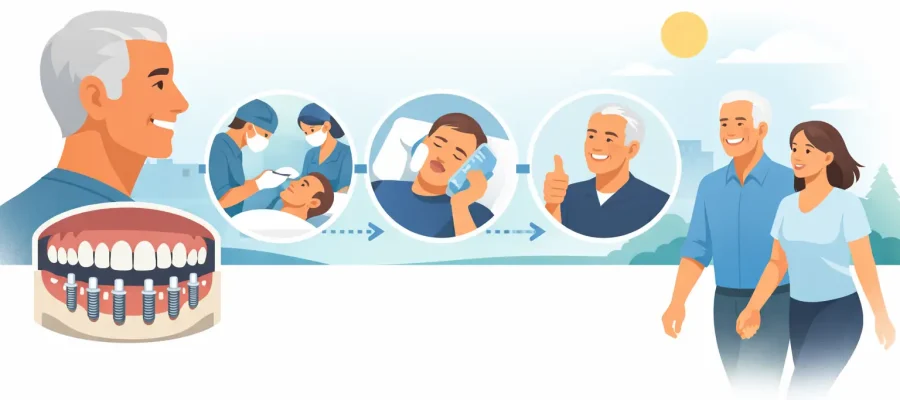
You can spot the moment most full-arch implant patients stop asking about the surgery and start asking about day three, week two, and when they will feel normal again. That is why an all on 6 recovery patient story matters more than a generic procedure overview. People considering fixed full-arch teeth want to know what healing actually feels like, how fast life returns, and whether the result justifies the first difficult days.
For many international patients, the decision is not only clinical. It is personal, visual, and time-sensitive. They may be coming in before a wedding, a public appearance, a business launch, or simply because they are tired of planning life around removable dentures, hiding their smile, or managing failing teeth. Recovery becomes the part of the journey that feels least predictable, so a clear patient story can replace fear with something much more useful – a realistic timeline.
An all on 6 recovery patient story from day one
Imagine a patient in their late 40s who has spent years dealing with advanced tooth loss, repeated dental work, and the social fatigue that comes with unstable teeth. They choose All-on-6 because they want fixed teeth, stronger support across the arch, and a treatment plan that is engineered for both function and appearance. Their goal is simple: leave with a confident smile and a recovery plan they can actually manage.
The first day is usually more emotional than painful. Surgery itself is controlled carefully, and most patients are surprised by how little they feel during the procedure compared with how much they feared beforehand. What stands out immediately after treatment is pressure, numbness, and swelling starting to build rather than sharp pain. When temporary fixed teeth are placed, there is also a powerful sense of relief. For patients who have lived with damaged or missing teeth, seeing a full smile again can be the turning point.
That does not mean day one is easy. Talking feels awkward. The mouth feels unfamiliar. Eating is limited. Energy drops quickly after surgery, especially for travelers who have also dealt with flights, hotel check-in, and the stress of anticipation. The best recovery starts with accepting that the first 24 hours are for rest, medication, hydration, and keeping movement minimal.
What the first 72 hours really feel like
The biggest misconception about All-on-6 recovery is that pain is the main problem. For most patients, swelling and tightness are the more noticeable issues. The face can feel puffy, the jaw may feel stiff, and sleeping flat is rarely comfortable. Ice packs, prescribed medications, and a structured aftercare routine make a real difference here.
By day two, many patients say they feel better mentally than physically. The uncertainty is gone because they know the procedure is complete, but inflammation usually peaks around this stage. Speech may still sound slightly different. Smiling can feel tight. Looking in the mirror can be reassuring one moment and confronting the next, especially if the patient expected to feel instantly normal.
This is where a well-managed treatment pathway matters. Patients do better when they know that swelling, mild bruising, and pressure are normal parts of recovery, not signs that something has gone wrong. Precision planning helps reduce trauma, but healing is still biology. Even when the process is fast, the body needs time.
By day three, many patients notice the first clear improvement. Swelling starts to settle. Medication needs often reduce. Confidence rises because the mouth starts to feel less foreign. They are still eating soft foods and following strict hygiene instructions, but the recovery curve begins to turn in the right direction.
Week one: the adjustment phase
The first week is less about pain and more about adaptation. Patients are learning how to clean around the temporary bridge, how to speak with more confidence, and how to chew carefully without overloading the implants. This stage requires discipline.
A patient in a strong recovery phase usually describes a mix of excitement and caution. They love the look of the smile, but they are aware that the implants are still integrating with bone beneath the surface. That is the trade-off with immediate fixed teeth. You get immediate aesthetic and functional improvement, but you must respect the healing phase to protect the long-term result.
Soft food is one of the biggest challenges. Most people do not realize how often they bite unconsciously until they are told not to. Foods need to be gentle, easy to swallow, and low risk for pressure on the new restoration. Patients who follow this closely tend to have a smoother experience than those who test their limits early.
Oral hygiene also becomes non-negotiable. Full-arch implant restorations are not maintained like natural teeth, but they still need meticulous care. A patient who had previously struggled with failing teeth often finds this surprisingly motivating. For the first time in years, maintenance feels worth the effort because the smile already looks like the version they wanted.
The emotional side of an all on 6 recovery patient story
The physical timeline is only half the story. Emotionally, recovery often moves in phases. Before treatment, the dominant feeling is anxiety. Right after treatment, it becomes relief. In the first week, impatience usually takes over.
Patients who have invested in aesthetic dentistry and traveled internationally for care often expect a polished, almost cinematic transformation. They do get a dramatic result, but healing still has its unglamorous moments. Dry lips, swelling, cautious eating, and temporary speech changes are part of the process. The difference is that these moments are temporary, while the shift in confidence can be immediate.
Many patients describe their first social interaction after treatment as a milestone. It may be a video call, a selfie, a dinner with family, or simply smiling without covering their mouth. That is often when the procedure stops feeling like a medical event and starts feeling like a life upgrade.
Weeks two to six: looking better, healing deeper
This is the stage where patients can look significantly improved while still healing internally. Externally, they often seem ready. Swelling has mostly resolved. The smile looks natural in photos. Daily life feels easier. But osseointegration, the process of the implants bonding with the jawbone, is still ongoing.
That gap between appearance and biology is important. A patient may feel confident enough to return to work, travel, and social events, but they still need to avoid habits that put too much force on the restoration. Hard foods, clenching, and ignoring follow-up instructions can compromise a result that otherwise looks excellent.
This is also when patients start appreciating the design side of treatment. With a well-planned All-on-6 case, the temporary teeth do more than fill a gap. They restore facial support, smile line balance, and a cleaner dental silhouette. For image-conscious patients, that visual change matters just as much as chewing comfort.
What patients usually say was easier than expected
Most patients are surprised that the procedure itself is not the hardest part. The waiting, the worrying, and the pre-treatment discomfort are often worse than the surgery day. They also tend to say that having fixed temporary teeth immediately changes their mindset. Instead of feeling like they are in a long dental process, they feel like they have already crossed into a new version of themselves.
Travel logistics can also be easier than expected when the treatment journey is organized properly. For international patients, having transfers, scheduling, and on-site support handled well reduces stress at exactly the moment they need calm and clarity. That concierge layer does not replace clinical quality, but it makes recovery feel more controlled.
What patients say was harder than expected
The diet is usually the biggest surprise. Even highly motivated patients can get frustrated with soft foods after several days. Sleeping comfortably can also take time, especially in the first few nights. And while the temporary smile looks impressive, some patients need a short adjustment period before it feels fully like their own face again.
There is also a mental shift required. Patients who have lived with unstable teeth often want to test their new smile right away. They want to bite into something crisp, laugh without thinking, and forget dental problems completely. That freedom is the goal, but good outcomes depend on respecting the transition period.
The longer view after All-on-6
A strong all on 6 recovery patient story does not end when swelling goes down. The real success shows up in ordinary moments: ordering food without hesitation, speaking clearly in meetings, taking photos from any angle, and not thinking about teeth all day. That is the value of a full-arch restoration done with planning, precision, and a recovery protocol patients can actually follow.
At DRGO Smile Clinic, that journey is designed to feel predictable from the first digital plan to the final smile outcome. The best patient stories are not the ones that promise a perfect, effortless recovery. They are the ones that show a truthful path – a few demanding days, a few careful weeks, and then a visible return to comfort, confidence, and control.
If you are considering All-on-6, do not ask only how the surgery works. Ask how recovery will fit your real life, your travel schedule, and your expectations. The right story to hear is not the one with zero discomfort. It is the one where the short-term healing period clearly leads to a smile that changes how you live.