


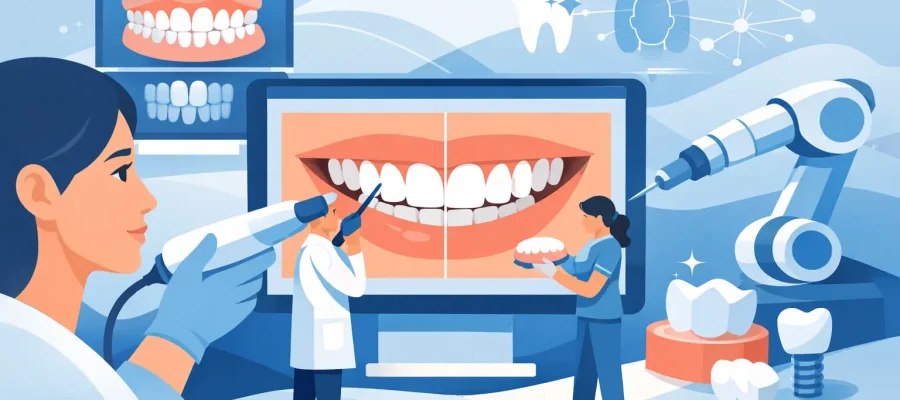
A smile makeover used to begin with a mirror, a shade guide, and a patient trying to imagine the final result. Now, it can begin with a high-resolution scan and a 3D preview of your future smile before treatment starts. That is how digital dentistry is changing smile makeovers: it replaces guesswork with a plan you can see, discuss, and refine.
For international patients traveling for veneers, crowns, implants, or a full Hollywood Smile, that difference matters. A beautiful result is only part of the decision. You also want clarity on what will happen, how long it will take, what your teeth may look like, and whether the treatment plan fits your schedule. Digital workflows make those answers more precise.
How Digital Dentistry Is Changing Smile Makeovers
Digital dentistry brings together intraoral scanning, facial photography, 3D imaging, smile-design software, and CAD/CAM manufacturing. Rather than relying only on traditional impressions and manual communication between the dentist and lab, the team works from a detailed digital record of your teeth, gums, bite, and facial proportions.
The goal is not to make every smile identical. It is to engineer a smile that looks balanced on your face, works with your bite, and fits the level of brightness, shape, and character you want. Some patients want a highly polished, camera-ready Hollywood Smile. Others want subtle refinement that still looks completely natural in a boardroom, at a wedding, or in everyday photos.
Digital tools give the dentist and patient a shared visual language. You can point to the length of the front teeth, the curve of the smile, the amount of gum showing, or the desired shade. Those details become part of a measurable treatment plan rather than a vague preference.
The first change: impressions become digital scans
Traditional impression material can be uncomfortable, and even a small distortion may affect the fit of a veneer, crown, or bridge. An intraoral scanner captures thousands of images of the teeth and combines them into a detailed 3D model. It is faster, cleaner, and easier for many patients than conventional impressions.
For a smile makeover, scan data helps the clinical team evaluate spacing, crowding, tooth wear, old restorations, bite relationships, and gum contours. It also gives the dental laboratory an exact digital starting point for designing restorations.
Accuracy does not mean a scan alone guarantees a perfect result. The dentist still needs to assess tooth structure, gum health, jaw function, and the way your lips move when you speak and smile. Digital records improve the process, but experienced clinical judgment remains the foundation.
The second change: you can preview the direction before committing
Digital Smile Design turns measurements and facial analysis into a proposed smile layout. Photos and videos are used alongside the 3D scan to assess tooth proportions, symmetry, lip line, and how much tooth display is visible at rest and during a full smile.
This is especially valuable for patients considering multiple veneers or crowns. Instead of choosing a generic “white and straight” result, you can review a design created around your own features. The conversation becomes specific: Should the central incisors be longer? Is the shade too bright? Do the teeth need softer edges? Would gum contouring create better balance?
A digital preview is a planning tool, not a final promise. Natural teeth, gum response, bite forces, and healing can influence the finished result. But it gives patients far more confidence than choosing from before-and-after photos alone.
From Digital Plan to a Real Smile
The strongest digital smile makeovers follow a disciplined sequence. Technology speeds up communication and production, but it should never skip the clinical checks that protect the health and longevity of the result.
Planning the right treatment, not just the fastest one
A scan may show that veneers are appropriate for healthy teeth with cosmetic concerns such as discoloration, small gaps, uneven edges, or mild shape irregularities. In other cases, zirconium crowns may offer better coverage for heavily restored or structurally weakened teeth.
For missing teeth, 3D imaging can help plan implant placement around available bone, sinus position, and nerve pathways. Patients who need full-arch rehabilitation may be candidates for immediate fixed teeth with All-on-4 or All-on-6 treatment, but candidacy depends on bone quality, infection control, bite forces, and overall health.
The fastest option is not automatically the best option. A patient with active gum disease may need periodontal care before cosmetic restorations. Someone who grinds their teeth may need a night guard and a more conservative design. A premium smile makeover should be designed to look exceptional on day one and function responsibly afterward.
Trying the design in the mouth
A digital design can often be translated into a physical mock-up, allowing you to see a proposed shape directly on your teeth. This try-in stage is where a plan becomes personal. You can assess the smile in natural light, speak with it, and decide whether it feels like you.
For many patients, this is the most reassuring part of the journey. A beautiful digital rendering is useful, but a temporary mock-up gives real-world feedback on length, volume, speech, and overall presence. Adjustments can be made before final ceramic restorations are created.
CAD/CAM makes precision faster
CAD/CAM stands for computer-aided design and computer-aided manufacturing. Once the final design is approved, restorations can be designed digitally and milled from high-quality ceramic blocks or zirconia. This supports highly accurate margins, controlled contours, and consistent communication between the dentist and laboratory.
For selected cases, CAD/CAM can make one-visit crowns possible. That can be a major advantage for travelers with limited time in Istanbul. More complex cases, including extensive veneer work, gum treatment, implant restorations, or full-mouth rehabilitation, may still require multiple appointments and a carefully planned stay.
Speed is valuable when it is earned through preparation. The better the scans, design, bite records, and clinical coordination, the fewer surprises occur during fitting.
Better Communication for Patients Traveling Abroad
A smile makeover involves many decisions, and distance can make those decisions feel harder. Digital records make it easier to review your case before travel, coordinate across specialties, and arrive with a clearer understanding of the proposed journey.
At DRGO Smile Clinic, the digital workflow is paired with a concierge experience designed for international patients. That means treatment planning is supported by practical details too: appointment coordination, accommodation, transfers, and multilingual assistance. When your timeline is organized around scans, design approval, preparation, try-in, and final placement, the travel experience becomes far less stressful.
Digital communication also improves continuity after treatment. Your scans, images, and treatment records create a baseline that can be useful for follow-up care with your home dentist. If a restoration ever needs review, accurate records make it easier to explain exactly what was done.
What Digital Dentistry Cannot Replace
There is a temptation to treat technology as a shortcut to instant perfection. It is not. A 3D smile simulation cannot diagnose every biological issue, predict every healing response, or replace the hands-on skill needed to prepare teeth conservatively and place restorations precisely.
The material choice still matters. E-Max veneers can provide exceptional translucency and natural beauty in the right case, while zirconia may be better suited to areas that require greater strength. Whitening may improve natural enamel but will not change the color of existing crowns or veneers. Gum aesthetics can transform a smile line, but the treatment must respect periodontal health.
The best clinics use digital dentistry to make care more transparent, not to oversell what is possible. Ask to understand the condition of your natural teeth, how much preparation is required, what maintenance your restorations need, and what happens if you grind, chip, or stain your teeth over time.
The New Standard Is Confidence Before the Final Appointment
Digital dentistry has changed the emotional side of smile makeovers as much as the technical side. Patients no longer need to wait until the final reveal to know the general direction of their new smile. They can participate in the design, see the proposed outcome, and make informed choices before permanent work begins.
That visibility is powerful for anyone investing in a signature smile. Whether you are preparing for a major event, stepping in front of a camera, rebuilding confidence after dental damage, or simply ready to stop hiding your teeth, the right digital plan gives your transformation a stronger starting point.
A remarkable smile makeover should never feel like a leap of faith. It should feel like a carefully designed decision – one that respects your health, your time, your face, and the life you plan to live with your new smile.