


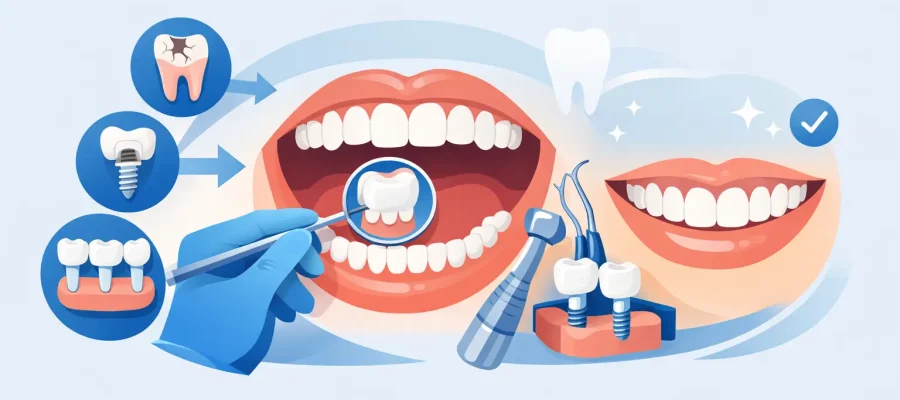
A full mouth restoration is not one treatment. It is a carefully sequenced plan for rebuilding function, aesthetics, and bite stability when multiple teeth, gums, or restorations need attention at once. If you are researching the step-by-step process of full mouth restoration, you are likely not looking for a basic cleaning or a single crown. You want a clear path to strong teeth, a balanced smile, and a result that looks intentional from every angle.
For many international patients, the biggest question is not whether they need treatment. It is how the process is organized, how long it takes, and how predictable the outcome can be. The right clinic makes this feel engineered, not improvised.
Who needs a full mouth restoration?
This type of treatment is usually recommended when several issues overlap. You may have worn-down teeth, failing crowns, missing teeth, bite collapse, gum asymmetry, old dental work that no longer matches, or bone loss that affects implant planning. Some patients come in because they are in pain. Others are driven by appearance. Most have both functional and cosmetic goals, even if one concern feels more urgent.
A full mouth restoration can include veneers, crowns, implants, bridges, gum contouring, whitening, bone grafting, or full-arch systems like All-on-4 or All-on-6. The exact mix depends on what is healthy, what can be preserved, and what needs to be replaced. That is why no serious clinic should promise a final treatment plan before diagnostics.
The step-by-step process of full mouth restoration
Step 1: Consultation and case assessment
The first stage is about diagnosis, not sales. A proper consultation looks at your teeth, gums, jaw relationship, facial proportions, and medical history. If you are traveling for treatment, this often begins remotely with photos, videos, and a description of your concerns, then moves into a full in-clinic exam once you arrive.
This is where your priorities become part of the plan. Some patients want the brightest possible Hollywood Smile. Others want a natural luxury result that does not read as obvious dental work. Some need fixed teeth fast because they have an event, filming schedule, or public-facing role. The planning should reflect that.
Step 2: Digital scans, imaging, and bite analysis
This is the stage that turns opinion into precision. Digital intraoral scans, panoramic imaging, and often CBCT 3D scans reveal the condition of roots, bone levels, sinus anatomy, and existing restorations. Bite analysis shows whether the teeth are meeting correctly or whether years of grinding and wear have changed the vertical dimension.
This matters more than many patients realize. A smile can look white and straight at first glance, but if the bite is unstable, crowns chip, veneers fracture, and jaw tension can continue. In complex cases, function has to lead aesthetics, not the other way around.
Step 3: Treatment planning and smile design
Once diagnostics are complete, the case is mapped in sequence. This is where the full mouth restoration stops feeling abstract. You can see which teeth can be saved, which need replacement, whether gum reshaping is needed, and whether the case should be staged over one trip or more than one.
Digital Smile Design is especially useful here because it allows you to preview tooth shape, proportions, and smile line before definitive work begins. For image-conscious patients, this is often the moment confidence rises. You are not agreeing to a vague concept. You are reviewing a planned result.
There are trade-offs, and a good plan explains them clearly. For example, preserving natural teeth is usually the priority when those teeth are structurally reliable. But if several teeth are fractured, infected, heavily worn, or repeatedly failing, replacing them may offer more predictability. Speed is also a factor. Immediate solutions are possible in many cases, but not every mouth is a candidate for every accelerated protocol.
Step 4: Preparatory treatment
Before the visible transformation begins, the foundation has to be stabilized. This may include deep cleaning, treating gum inflammation, extractions of non-restorable teeth, root canal therapy, or removing failing crowns and bridges. If implants are part of the plan, bone grafting or sinus lift procedures may be recommended when bone volume is limited.
Patients sometimes want to skip this phase because it does not feel glamorous. But this stage protects the final result. Beautiful restorations placed onto unhealthy foundations rarely stay beautiful for long.
Step 5: Surgical phase, if implants are needed
If teeth are missing or must be removed, implant surgery may be the next step. Depending on bone quality, infection levels, and case design, implants can sometimes be placed immediately after extraction. In full-arch cases, fixed temporary teeth may also be delivered quickly so the patient does not leave without a smile.
This is one of the biggest advantages of a modern, high-efficiency clinic. When diagnostics, surgery, prosthetics, and digital planning are coordinated tightly, treatment can move fast without feeling rushed. That said, healing biology still matters. Some patients qualify for immediate loading, while others need a healing period before final restorations are placed.
Step 6: Tooth preparation and provisional restorations
If veneers or crowns are part of the plan, the natural teeth are prepared conservatively based on the chosen material and design. Temporary or provisional restorations are often placed at this stage. These are not just placeholders. They let the team evaluate length, bite, speech, smile line, and comfort before the final ceramics are made.
This step is where refinement happens. You may realize you want slightly softer edges, a more natural translucency, or a less aggressive brightness. Provisional teeth help make those decisions in a controlled way.
Step 7: Lab fabrication and CAD/CAM production
The final restorations are then produced using the approved design. Depending on the case, this may involve E-Max veneers, zirconia crowns, implant bridges, or a combination. CAD/CAM technology speeds up production and improves consistency, especially for patients who value shorter treatment windows.
Material choice is never only about appearance. E-Max is known for lifelike esthetics and is often ideal in visible zones. Zirconia offers excellent strength and can be the better choice in areas exposed to heavier chewing forces. In full mouth cases, mixed-material planning is common because the front and back teeth do not perform the same job.
What happens at the final fitting?
Step 8: Try-in, adjustments, and approval
Before final bonding or cementation, the restorations are checked in the mouth. The team reviews color, contour, midline, gum harmony, and bite contacts. This is where tiny adjustments make a major difference. A restoration can be technically good but still need refinement to feel exceptional.
Patients often focus on shade, but fit and bite are just as important. If the front teeth look stunning but the posterior bite is off, the case is not finished. A premium result means the smile photographs well and functions naturally when you speak and eat.
Step 9: Final placement
Once everything is approved, the restorations are bonded, cemented, or secured onto implants. The final smile should feel aligned with your face, not copied from someone else. The best restorations do not only make teeth look better. They restore support to the lips, improve smile symmetry, and bring the lower face back into balance.
This is often the most emotional part of the process. For patients who have hidden their teeth for years, the change is not subtle. It affects how they laugh, speak, pose, and show up socially.
Recovery, follow-up, and long-term protection
Step 10: Aftercare and maintenance
The final step in the step-by-step process of full mouth restoration is protecting the investment. After placement, you will receive instructions for hygiene, diet, and follow-up. If you grind your teeth, a night guard may be recommended. If implants are involved, maintenance around the gums becomes even more important.
For international patients, follow-up planning should be straightforward. A well-run clinic does not leave you guessing once treatment is complete. You should know what to expect during recovery, when sensitivity is normal, and when to report a concern.
At DRGO Smile Clinic, this process is built to feel clear from the first digital preview to the final fit, with treatment planning and travel support handled in one managed pathway. That matters when you are flying in for a high-value transformation and want the experience to match the result.
A full mouth restoration is a serious decision, but it should not feel confusing. When the case is planned properly, each step has a purpose, each material has a reason, and the final smile looks like it belongs to you – only stronger, fresher, and far more confident.