


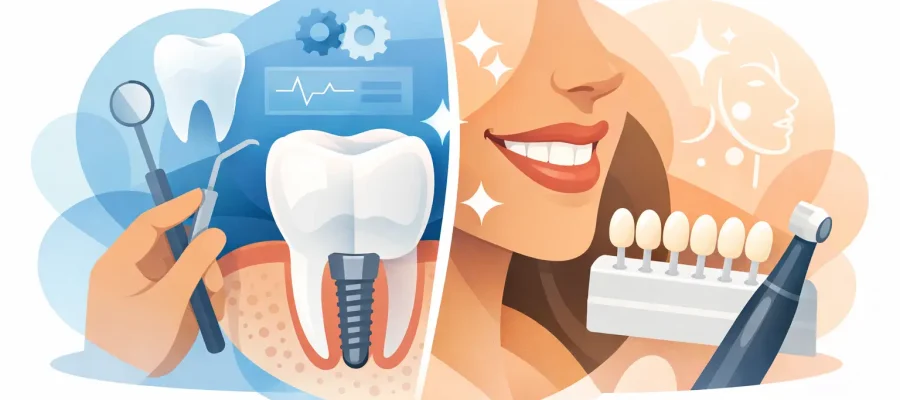
A smile can look flawless in a photo and still fail where it matters most – chewing, speaking, comfort, and long-term stability. That is why combining function and aesthetics in dentistry is not a cosmetic extra. It is the standard serious patients should expect when they invest in veneers, crowns, implants, or a full smile makeover.
For image-conscious patients, the goal is rarely just whiter teeth. It is a smile that suits the face, moves naturally, supports the lips, feels balanced in the bite, and holds up under daily use. The best results do not look fake, bulky, or overbuilt. They look effortless because they were planned with clinical discipline.
Why combining function and aesthetics in dentistry matters
A smile makeover succeeds when beauty and biomechanics work together. If a case is designed only for brightness and symmetry, the result may photograph well but create pressure points, chipping, jaw fatigue, speech changes, or gum irritation. If it is designed only for function, the teeth may feel stable but look flat, heavy, or disconnected from the patient’s face.
High-level dentistry sits in the middle. Tooth shape, edge position, bite relationship, gum levels, facial proportions, and material choice all need to support each other. That balance is what turns treatment from a quick cosmetic fix into a reliable upgrade.
This matters even more for international patients traveling for treatment. When you are planning around a wedding, filming schedule, business launch, or major life event, you want visible improvement fast, but not at the expense of comfort or longevity. Speed is valuable only when the planning is precise.
What function actually means in a smile makeover
Function in dentistry is not just whether the teeth touch. It includes how the upper and lower teeth meet, how force is distributed across the arch, how the jaw moves side to side, and whether the restorations protect the natural teeth, bone, and gums instead of stressing them.
In practical terms, functional dentistry asks clear questions. Can you bite into food confidently? Can you speak without lisping or clicking? Do the back teeth support the bite properly? Are the front teeth proportioned for appearance without taking excessive load? If implants are involved, is the bone support strong enough for long-term stability? If veneers or crowns are planned, is there enough enamel or structure to build on safely?
These are not minor technical details. They directly affect whether a smile still feels good six months, two years, or five years later.
Aesthetics are more than white, straight teeth
Luxury smile design is not about making every patient look the same. Strong aesthetic dentistry studies facial harmony, lip movement, smile width, gum display, skin tone, age, and personality. A TV-ready smile for one patient may look too aggressive on another. A natural executive look may be perfect for someone who wants refinement without obvious treatment.
The best aesthetic work respects proportion. Tooth length, width, translucency, texture, and shade must fit the face. Gum symmetry matters. So does the way the incisal edges follow the lower lip when smiling. When these details are right, people notice the overall effect before they notice the dentistry.
That is where premium clinics separate themselves. They do not simply place restorations. They engineer a signature smile that looks intentional from every angle.
How the planning phase brings both sides together
The real transformation happens before any final restoration is placed. Digital planning allows the clinical team to map aesthetics and function together rather than treating them as separate decisions. With Digital Smile Design and 3D previews, patients can see proposed tooth shapes, smile line changes, and facial balance before treatment moves forward.
This stage reduces risk. It helps answer whether a patient needs veneers, crowns, gum contouring, whitening, implants, or a combination. It also shows when less treatment is smarter. Not every patient needs full coverage crowns across an entire arch. Sometimes E-Max veneers in the visible zone plus whitening and minor gum refinement create a more conservative and elegant result.
For full-mouth cases, digital planning is even more critical. Patients replacing multiple missing teeth or restoring worn dentition need the vertical dimension, bite support, and tooth position carefully established. If the foundation is off, even beautiful ceramics will not perform well.
Procedure choices depend on the balance you need
Different treatments solve different problems, and the right choice depends on both visual goals and structural needs. Veneers can be ideal when the underlying teeth are healthy and the main issues are shape, color, spacing, or minor alignment. They offer a highly refined cosmetic result, but they are not the answer for every heavily damaged or bite-compromised case.
Crowns, especially zirconium crowns, are often better when teeth need more coverage and strength. They can restore appearance while also protecting weakened structure. E-Max works beautifully in the front where lifelike translucency matters. Zirconium often shines in cases where durability and support are priorities.
Implants change the conversation entirely. When a tooth is missing, aesthetics alone are not enough. The replacement has to integrate with bone support, gum contour, bite load, and adjacent teeth. In full-arch cases such as All-on-4 or All-on-6, the visible result can be dramatic and immediate, but the engineering beneath it is what makes fixed teeth feel secure and usable.
Gum aesthetics also play a bigger role than most patients expect. Teeth can be perfectly made and still look off if the gum line is uneven or excessive gum display interrupts the smile. In those cases, pink and white aesthetics must be treated together.
Speed works only when precision leads
Many patients want treatment completed in one trip, and same-day workflows can be a major advantage. CAD/CAM crowns, immediate implants in selected cases, and instant smile makeover protocols reduce downtime and make dental travel far more practical. But fast treatment is not the same as rushed treatment.
The difference comes down to diagnostics, case selection, and execution. A clinic can deliver one-visit restorations safely when imaging, digital design, bite analysis, and material planning are already aligned. When that discipline is missing, speed becomes a liability.
That is why sophisticated patients should ask not only how fast treatment can be done, but how the clinic protects function while achieving an elevated aesthetic result. The answer should involve imaging, smile design, mockups or previews, bite review, and a clear rationale for the chosen materials.
The trade-offs patients should understand
There is no single perfect smile formula. A very bright, highly uniform Hollywood Smile can look striking on camera, but some patients may prefer more translucency and softness for a natural finish. Ultra-thin cosmetic work can be conservative, but if the bite is unstable, more protective restorations may be the better option.
The same goes for timeline. Immediate results are attractive, especially for travelers, but some cases benefit from staged treatment. Bone grafting, sinus lift procedures, or complex bite rehabilitation may require patience to protect the final outcome. The smartest treatment plan is not always the shortest one. It is the one that gives you the strongest blend of appearance, comfort, and durability.
What sophisticated patients should look for in a clinic
If you are investing in high-end dentistry, look beyond before-and-after photos. Attractive photos matter, but they do not show occlusion, material quality, planning depth, or whether the smile was designed for the patient’s face and function.
A premium clinic should be able to explain the full pathway clearly: consultation, imaging, digital planning, preparation, temporary phase if needed, final placement, and post-treatment guidance. It should also be able to show how aesthetic decisions connect to structural ones. That includes bite stability, gum health, implant positioning, and material selection.
For international patients, logistics matter too. The easier the travel process, the more focused you can be on treatment. A curated pathway with airport transfers, hotel coordination, interpreters, and tightly scheduled appointments removes friction from a process that can otherwise feel overwhelming. At DRGO Smile Clinic, that combination of engineered smile design and concierge-level coordination is exactly what turns dental treatment into a controlled, high-comfort transformation.
The new standard for smile design
The future of cosmetic and restorative dentistry is not choosing between health and beauty. It is expecting both, from the first scan to the final polish. The most successful smiles are not just dramatic. They are stable, comfortable, expressive, and built to live in real life.
If your treatment plan makes your smile look better but leaves function as an afterthought, it is incomplete. The real upgrade is a smile that performs as beautifully as it appears – and once you know that standard exists, it is hard to settle for anything less.