


A gap in your smile does more than change a photo. Missing several teeth can affect how you chew, how clearly you speak, and how confidently you show up at work, events, and in front of a camera. So, can implants replace multiple teeth? Yes. With the right treatment design, dental implants can support anything from a few replacement teeth to a complete fixed arch that looks, feels, and functions like a natural smile.
The key is not placing an implant for every missing tooth. A premium implant plan uses the right number of implants, positioned with precision, to create strength, natural proportions, and a result built for your bite.
Can Implants Replace Multiple Teeth? Yes, With a Custom Design
A dental implant is a small titanium post placed in the jawbone to replace a missing tooth root. Once it integrates with the bone, it becomes a stable foundation for a custom crown, bridge, or full-arch restoration.
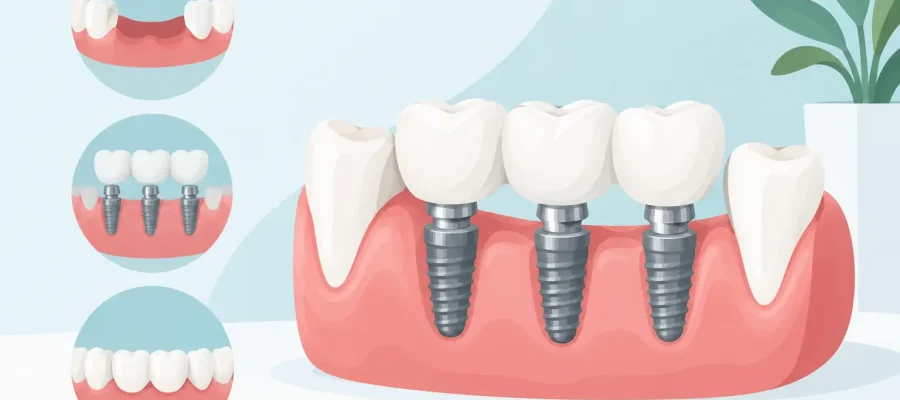
For one missing tooth, one implant usually supports one crown. When several teeth are missing beside each other, two or more implants can often hold a fixed bridge. This means you can replace multiple teeth without grinding down healthy neighboring teeth, as is often required with a traditional bridge.
For patients missing most or all teeth in an upper or lower jaw, full-arch implant systems such as All-on-4 or All-on-6 can provide a fixed, non-removable smile. Rather than placing an implant under every tooth, the restoration is supported by strategically positioned implants designed to distribute chewing forces across the arch.
The ideal number of implants depends on your bone volume, bite force, gum health, the location of missing teeth, and the type of final teeth you want. The goal is not simply to fill spaces. It is to create a durable, balanced smile that performs beautifully over time.
Your Main Options for Replacing Several Teeth
Implant-Supported Bridge
An implant-supported bridge is often the refined solution when you are missing two, three, or several consecutive teeth. For example, two implants may support a three-to-four-tooth bridge, depending on the location and clinical conditions.
The bridge is fixed in place, so it does not move while you eat or speak. It is custom-designed to match the color, shape, and translucency of your natural teeth or the wider smile makeover plan. Because the bridge is anchored to implants rather than adjacent natural teeth, healthy teeth may be left untouched.
This option is especially appealing for patients who want a stable, natural-looking result without the bulk or daily removal associated with a partial denture.
Individual Implant Crowns
If missing teeth are separated by healthy natural teeth, individual implants may be a better choice. Each implant receives its own custom crown, which can make cleaning and maintenance more similar to caring for natural teeth.
Individual crowns can offer exceptional detail and flexibility, particularly in the visible smile zone. However, they are not automatically the best answer for every case. More implants can mean more surgery, more healing considerations, and higher overall cost. A specialist-led consultation determines whether individual crowns or a bridge delivers the smarter long-term result.
Full-Arch Implants: All-on-4 or All-on-6
When many teeth are failing, severely damaged, or already missing, treating each tooth separately is not always the most efficient approach. Full-arch treatment replaces an entire upper or lower row of teeth with a fixed bridge supported by four or six implants.
All-on-4 uses four precisely angled implants to maximize available bone in many cases. All-on-6 uses six implants for additional support where anatomy and bite demands make that the stronger choice. Both treatments can create a complete, fixed smile with carefully designed tooth shape, gum contours, and bite alignment.
For eligible patients, immediate loading may allow a fixed temporary bridge to be placed shortly after implant surgery. You leave with teeth in place rather than waiting months with visible gaps. The final bridge is then created after healing, when the implants and gum tissues have stabilized.
Why Implants Change More Than Appearance
A removable partial denture may fill a space, but it does not replace the tooth roots. Implants do. That distinction matters because the jawbone needs stimulation from chewing forces to help maintain its volume.
After tooth loss, the bone in that area can gradually shrink. Over time, this may change facial support, make future implant placement more complex, and cause neighboring teeth to shift. Implant treatment helps preserve the bone around the replacement root while restoring a stronger chewing platform.
The aesthetic advantage is equally significant. A well-designed implant restoration can support the lips and cheeks, close dark gaps, and create a smile that looks intentional rather than patched together. For patients planning veneers, zirconium crowns, or a full Hollywood Smile transformation, implants can be integrated into the design so every tooth works together visually.
Still, implants are not a shortcut around good planning. A crown that looks perfect but sits in the wrong bite can chip, loosen, or place excess stress on the implant. Digital planning is what turns implant dentistry from a replacement procedure into an engineered smile solution.
What the Implant Process Looks Like
Your journey begins with a full clinical assessment, usually including 3D imaging, digital scans, bite analysis, and a detailed review of your medical and dental history. This reveals the quality of the bone, the position of nerves and sinus spaces, gum health, and whether any teeth can be preserved.
Next comes digital smile planning. Your specialist maps the ideal tooth positions first, then plans the implants to support that final smile. This prosthetically driven approach matters because implants cannot be moved once they have healed. Precision at the planning stage protects both appearance and function.
If damaged teeth need to be removed, extraction and implant placement may sometimes happen in the same appointment. When primary implant stability is strong enough, a temporary fixed bridge may be fitted immediately. This is often possible with full-arch treatments, but it is not appropriate in every case.
The healing phase allows bone to integrate with the implants, a process called osseointegration. During this period, temporary teeth protect your appearance while your final restoration is designed. The final bridge or crowns are then fabricated with attention to bite balance, gum contours, tooth color, and the character you want your smile to project.
At DRGO Smile Clinic, digital imaging and 3D smile design can make this process more visual before treatment begins. For international patients, that clarity is valuable: you can understand the plan, timeline, and expected stages before arranging travel.
When Bone Grafting or a Sinus Lift May Be Needed
Not every patient has enough healthy bone for immediate implant placement. This is common when teeth have been missing for years, when gum disease has caused bone loss, or when the upper back jaw sits close to the sinus cavity.
Bone grafting can rebuild volume where it is needed. A sinus lift creates additional space for implants in the upper jaw by carefully lifting the sinus membrane and adding graft material beneath it. These procedures can extend the treatment timeline, but they often make a stable, long-lasting implant result possible.
In some full-arch cases, angled implant placement can reduce the need for grafting. That is one reason All-on-4 may be considered for patients with reduced bone volume. It is not a universal solution, however. The safest recommendation depends on your scans, not a one-size-fits-all package.
Are You a Candidate for Multiple Dental Implants?
Most healthy adults with missing teeth can be considered for implant treatment, but candidacy is personal. Active gum disease must be treated first. Heavy smoking, uncontrolled diabetes, teeth grinding, and certain medications can affect healing and long-term success.
Bruxism does not necessarily rule out implants, but it changes the plan. You may need a stronger restorative material, a carefully adjusted bite, and a protective night guard. Patients with a history of periodontal disease also need a committed hygiene and maintenance routine after treatment.
The best implant result is not just about surgery day. It depends on professional cleanings, daily brushing, cleaning under bridges as instructed, and regular reviews of the bite and restoration. Fixed teeth feel liberating, but they still require disciplined care.
Planning Treatment Around International Travel
For international patients, the timeline deserves as much attention as the smile design. Simple implant cases may require an initial surgical visit and a later final-restoration visit after healing. Immediate full-arch treatment can provide fixed temporary teeth quickly, while the final bridge is completed after integration.
Your treatment coordinator should explain which stages can happen during each visit, how long you should stay after surgery, and whether your case needs a healing interval before final teeth. Premium care means building the travel plan around clinical safety, not rushing a final restoration before the tissues are ready.
A multiple-tooth implant treatment can restore far more than a missing section of teeth. With careful digital planning, the right implant design, and a final restoration shaped around your face and bite, it can give you a fixed smile that feels ready for every close-up, conversation, and milestone ahead.