


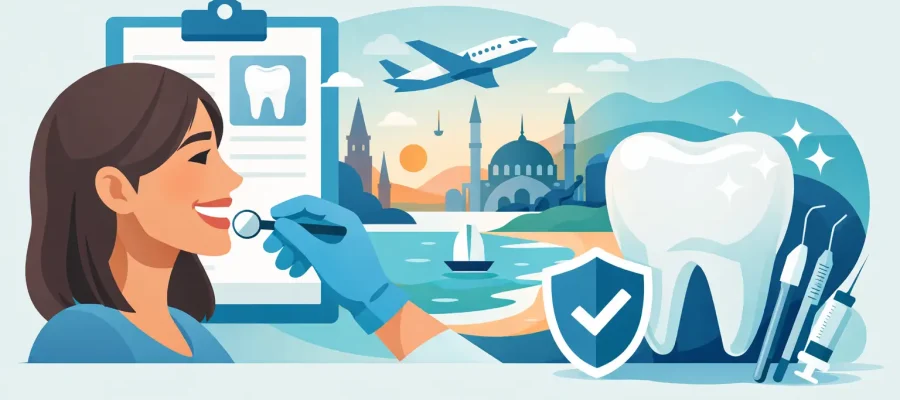
Is cosmetic dentistry in Turkey safe? Yes – if you choose with precision
The real question is not whether Turkey is safe for cosmetic dentistry as a country. The real question is whether the specific clinic, dentist, treatment plan, and materials are safe for you.
That distinction matters.
Turkey has become one of the world’s busiest destinations for veneers, crowns, implants, and full smile makeovers because patients can access advanced treatment, modern technology, and efficient timelines at a more attractive price than in the US or UK. But popularity creates noise. Some clinics are engineered around planning, precision, and long-term results. Others are engineered around volume.
If you are flying abroad for a Hollywood Smile, E-Max veneers, zirconium crowns, or full-arch implants, safety comes from disciplined dentistry, not marketing alone.
What makes cosmetic dentistry in Turkey safe or unsafe?
Safe cosmetic dentistry is built on diagnosis first, aesthetics second. That may sound obvious, but many patients shop by before-and-after photos alone. Photos can show shape and color. They do not show bite balance, gum health, bone levels, occlusion, or whether too much natural tooth was removed.
A safe case starts with a proper clinical review. That usually means digital imaging, a detailed oral exam, a discussion of your goals, and a treatment plan that explains what should be done now, what should wait, and what may not be the right option at all.
Unsafe treatment usually has a pattern. The consultation feels rushed. The same solution is recommended to every patient. Natural teeth are aggressively reduced when more conservative options may exist. Materials are mentioned in vague terms. The timeline sounds impressively fast, but no one explains the medical logic behind it.
Speed itself is not unsafe. Poor planning is.
Why Turkey has a strong reputation for smile makeovers
Turkey’s cosmetic dentistry market grew because patients wanted three things at once: visible results, a clear price, and a smoother travel experience. Leading clinics invested heavily in digital workflows, in-house milling, smile design systems, and coordinated international patient services. That allows many treatments to move faster without feeling improvised.
For example, same-visit crown workflows, 3D smile previews, and carefully staged implant protocols can improve predictability when they are done by an experienced team. The advantage is not just lower pricing. It is the combination of aesthetic focus, technical capacity, and patient coordination.
That said, a strong destination reputation can create false confidence. A country can be excellent for dental tourism overall and still contain clinics you should avoid.
How to judge a clinic beyond social media
A polished Instagram page is not a safety credential. Neither is an airport pickup.
A serious clinic should be able to explain how your case will be planned and executed. If you ask about veneers, you should hear the difference between E-Max and zirconium and why one may fit your bite, goals, or preparation level better. If you ask about implants, the clinic should discuss bone support, healing, prosthetic design, and whether immediate loading is truly appropriate.
You should also pay attention to how the clinic handles your records before you arrive. Good clinics ask for photos, scans, X-rays if available, and a health history. They do not promise a final treatment plan with total certainty before a proper examination. They can give a strong estimate, but responsible dentistry leaves room for clinical findings.
Another green flag is visual planning. Digital Smile Design or similar 3D preview systems can make the process feel more luxurious, but they are not just a nice extra. They help align expectation, facial proportions, tooth shape, and final outcome before irreversible work begins.
Is cosmetic dentistry in Turkey safe for veneers and crowns?
Often, yes – but veneers and crowns are where patients most need discipline from the clinic.
The risk is not that veneers or crowns are inherently dangerous. The risk is overtreatment. Some patients are ideal for minimal-prep veneers. Others need crowns because of existing restorations, heavy wear, or structural damage. Others may need orthodontic movement, gum contouring, or whitening first.
When a clinic recommends full crowns for every cosmetic case, that deserves a closer look. Crowns can be beautiful and long-lasting when indicated, especially with zirconium in high-strength cases. But they require more tooth reduction than conservative veneer treatment. The safest aesthetic plan is the one that preserves as much healthy tooth as possible while still delivering the result you want.
This is where premium clinics separate themselves. They do not just sell white teeth. They engineer a smile that fits your face, bite, speech, and long-term comfort.
Implants and full-mouth work require a higher level of caution
If you are considering single implants, All-on-4, or All-on-6, safety depends even more on diagnostics, surgical experience, and prosthetic planning.
Full-arch implant cases can be life-changing. They can also be unforgiving when rushed by the wrong team. You want to know whether the clinic plans bone support carefully, whether it has experience with grafting or sinus lift when needed, and how it decides between immediate fixed teeth and a staged healing approach.
Immediate implants and fixed temporary teeth can be excellent for the right patient. They offer speed, comfort, and a dramatic confidence boost. But they are not automatically the best option for every anatomy or every medical history. If a clinic never says, “it depends,” that is not confidence. That is sales.
Questions smart patients should ask before booking
You do not need to become a dentist. You do need enough clarity to spot quality.
Ask what imaging will be used, what materials are planned, how many teeth are actually being treated, and why. Ask whether a mock-up or digital preview is included. Ask what happens if the dentist finds decay, gum inflammation, or a bite issue after you arrive. Ask how follow-up is handled once you are back home.
You should also ask who will perform each stage of treatment. In advanced cosmetic and implant cases, the best outcomes usually come from a coordinated system – diagnosis, preparation, laboratory work, try-in, fitting, and bite refinement all managed carefully, not passed around casually.
The tone of the answers matters too. Clear, specific answers signal control. Evasive answers signal risk.
Safety is also about the patient journey
International dentistry is not only a clinical decision. It is a logistics decision.
A safe experience becomes much easier when the clinic manages travel timing correctly, builds enough appointments into the visit, and gives you realistic healing guidance. Many disappointing cases happen because the trip is compressed too tightly. Patients want fast results, but your mouth still needs time for adjustments, soft tissue response, and final checks.
That is why concierge support is not just a luxury detail. Transfers, scheduling coordination, interpreter support, and structured treatment days reduce friction and help protect the clinical outcome. When the process feels calm, the dentistry is easier to execute well.
For international patients seeking a high-control, design-led approach, clinics such as DRGO Smile focus on pairing advanced cosmetic planning with a tightly managed travel pathway so the result feels polished from consultation to final fit.
Red flags you should not ignore
Be careful with prices that seem dramatically lower than the rest of the market, especially if the quote appears instantly with no real case review. Be cautious if every patient appears to receive the same ultra-bright, same-shape smile regardless of face shape or age. And be skeptical of clinics that make permanent treatment sound casual.
Another red flag is pressure. Premium care should feel confident, not pushy. You should feel guided, not rushed into a deposit before your questions are answered.
Finally, pay attention to whether the clinic talks about maintenance. Safe cosmetic dentistry does not end at placement. Veneers, crowns, implants, whitening, and gum aesthetics all require aftercare, hygiene, and sensible expectations.
So, is cosmetic dentistry in Turkey safe?
Yes, it can be very safe – and exceptionally high quality – when you choose a clinic that treats smile design as a clinical science, not just a cosmetic product.
Turkey offers genuine advantages: experienced aesthetic dentists, advanced digital systems, efficient treatment timelines, and pricing that often makes premium care accessible. But none of that replaces due diligence. The safest decision is the one grounded in diagnosis, transparent planning, conservative technique where possible, and a team that can explain every step with confidence.
If you are investing in your smile for a wedding, a public-facing career move, a major life reset, or simply because you are ready to look how you have always wanted to look, do not shop for the cheapest transformation. Shop for the most controlled one.
A signature smile should feel exciting before it ever feels dramatic – and the right clinic will make safety part of the luxury, not separate from it.