


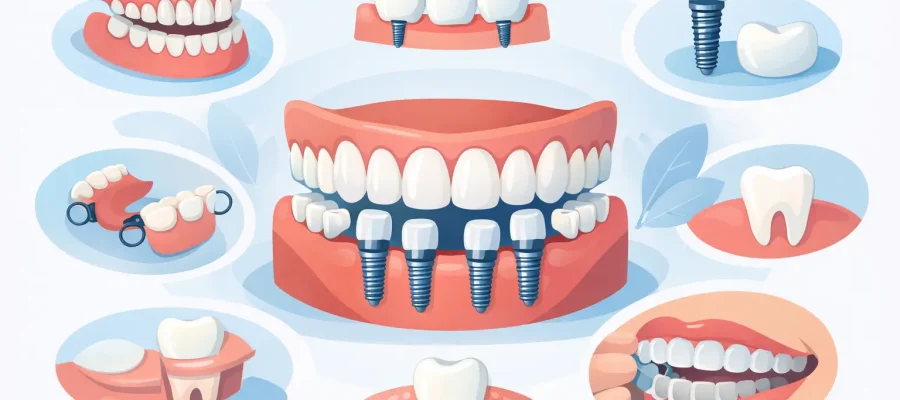
If you were quoted for full mouth implants and felt the price, surgery, or timeline was bigger than expected, you are not out of options. The best full mouth implant alternatives can still restore your smile, improve function, and give you a polished result that fits your health, budget, and schedule.
For many patients, the real question is not implants or nothing. It is which solution gives you the right balance of appearance, stability, treatment time, and long-term value. That answer depends on how many teeth you have left, the condition of your gums and bone, and how important fixed teeth are to your daily life.
Who should consider full mouth implant alternatives?
Full mouth implants are a premium solution for replacing an entire upper arch, lower arch, or both. They can feel close to natural teeth, preserve bone better than removable options, and offer excellent stability. But they are not the right fit for every case.
Some patients want to avoid extensive surgery. Others have low bone volume and would prefer to skip grafting or sinus lift procedures. Some are working toward a major event and need a faster cosmetic upgrade first, with implants later. And for many international patients, a lower-commitment starting point simply makes more sense.
That is why evaluating alternatives carefully matters. The right option should not just be cheaper. It should match your goals.
Best full mouth implant alternatives by treatment type
The strongest alternatives usually fall into two categories: removable tooth replacement and fixed cosmetic-restorative rehabilitation. They solve different problems, so comparing them side by side helps.
1. Implant-supported overdentures
If you want more security than traditional dentures without committing to a full fixed implant bridge, implant-supported overdentures are often the smartest middle ground. A denture attaches to a smaller number of implants, usually two to four per arch, which improves retention dramatically.
This option works well for patients who dislike loose dentures but want to reduce cost and surgical complexity. You still remove the prosthesis for cleaning, but daily life usually feels much more stable. Speech, chewing confidence, and comfort tend to improve compared with conventional dentures.
The trade-off is that it is not fully fixed. Some patients love the practicality. Others still want teeth that stay in place at all times.
2. Conventional full dentures
Traditional full dentures remain one of the most accessible solutions when all teeth are missing or need removal. Modern dentures can look far better than many people expect, especially when the smile line, tooth shape, and facial support are designed with aesthetics in mind.
The biggest advantages are speed, simplicity, and cost. There is no implant surgery, and treatment can move quickly. For patients with medical limitations, severe bone loss, or tight budgets, this can be a practical path.
The compromise is stability. Lower dentures in particular can move during eating and speaking. Bone loss also continues over time because there are no implants stimulating the jaw. For some patients, dentures are the final solution. For others, they are a transitional step before implant treatment.
3. Immediate dentures after extractions
Immediate dentures are placed right after teeth are removed, so you do not go through a toothless healing period. For patients coming from failing teeth, advanced decay, or severe gum disease, this can feel like a major emotional relief.
This option is especially useful when appearance matters right away. You can leave treatment with a complete smile instead of waiting weeks or months. That matters for professionals, public-facing clients, and anyone with a wedding, media appearance, or milestone coming up.
What to expect? Because your gums and bone change as they heal, immediate dentures often need adjustments, relines, or eventual replacement. They are excellent for continuity, but not always the final version of your restoration.
4. Full arch zirconia or porcelain bridges on natural teeth
Not every patient who asks about full mouth implants actually needs all teeth replaced. If enough healthy teeth remain, a full arch rehabilitation with zirconia crowns or porcelain restorations may deliver the aesthetic transformation you want without moving into full implant treatment.
This is often relevant when the main concern is worn, broken, heavily restored, or cosmetically poor teeth rather than complete tooth loss. A carefully planned bridge and crown approach can rebuild bite height, brighten the smile, and create a more balanced facial appearance.
The key is case selection. Natural teeth must be stable enough to support the work. If the foundation is weak, covering failing teeth with crowns is not a long-term win. But when the remaining teeth are strong, this route can provide a dramatic result with less surgery and faster completion.
5. Partial dentures and strategic tooth preservation
Sometimes the best alternative is not replacing everything. If several teeth can still be saved, a more conservative approach may combine extractions where needed with partial dentures and restorative work on the remaining teeth.
This matters because preserving natural teeth is often valuable for comfort, bite awareness, and treatment flexibility. A strategic plan may involve periodontal care, root canal treatment, crowns, and a removable partial instead of a full arch implant case.
This is rarely the most glamorous option, but it can be clinically smart. It also gives some patients time to spread treatment over phases instead of making one large decision all at once.
6. Resin-bonded or transitional fixed bridges
For select cases, a temporary or transitional fixed bridge can help patients move toward a more permanent solution while keeping a confident appearance in the meantime. This can be useful after extractions, during healing, or when planning staged treatment.
A transitional fixed option is not the same as a final full mouth implant restoration. It is more about maintaining aesthetics and function while the mouth stabilizes. For patients traveling for dentistry, this kind of planning can make the process feel much more controlled.
The downside is longevity. Transitional restorations are not designed to be the forever solution. But they can be very effective in the right sequence.
7. Full cosmetic smile rehabilitation instead of replacement
If your teeth are present but unattractive, short, discolored, worn down, or misshapen, you may not need replacement at all. A cosmetic rehabilitation using veneers, crowns, gum contouring, whitening, or a combination approach can create the look of a completely new smile while preserving much of your natural structure.
This is one of the most overlooked alternatives because many patients assume a dramatic smile change requires implants. It does not. When the underlying teeth and gums are workable, a cosmetic-restorative plan can produce a high-impact result faster than a full surgical case.
For image-conscious patients, this can be the ideal route. You get visible transformation, precise smile design, and a more efficient timeline, especially when digital planning is used before treatment begins.
How to choose the right alternative
The best choice comes down to three filters: function, esthetics, and commitment.
If your top priority is chewing power and all-day stability, implant-supported overdentures usually outperform conventional dentures. If your priority is a fast reset at a lower cost, traditional or immediate dentures may make more sense. If your main concern is how your smile looks rather than replacing missing teeth, a cosmetic full-mouth rehabilitation may be the stronger option.
Commitment matters too. Some alternatives require less surgery but more maintenance. Others look exceptional quickly but only work if the underlying teeth are healthy enough. The smartest treatment plan is the one built around your actual starting point, not just the most advertised procedure.
Questions to ask before saying yes
Before committing to any full arch treatment, ask what can realistically be saved, whether the result will be fixed or removable, how many visits are required, and what maintenance will look like after placement. You should also ask to see the smile design plan in advance whenever possible.
That last point matters more than patients think. When a clinic can show your future smile digitally and explain each stage clearly, the decision becomes much more confident. Premium dentistry is not just about the final teeth. It is about predictability.
For international patients, logistics also shape the right answer. A treatment that fits your travel schedule, healing timeline, and comfort level may be more valuable than chasing the most aggressive option. At DRGO Smile Clinic, this kind of planning is what turns a complex case into a controlled, high-comfort transformation.
A better smile does not always start with the biggest treatment. Sometimes it starts with the most intelligent one.