


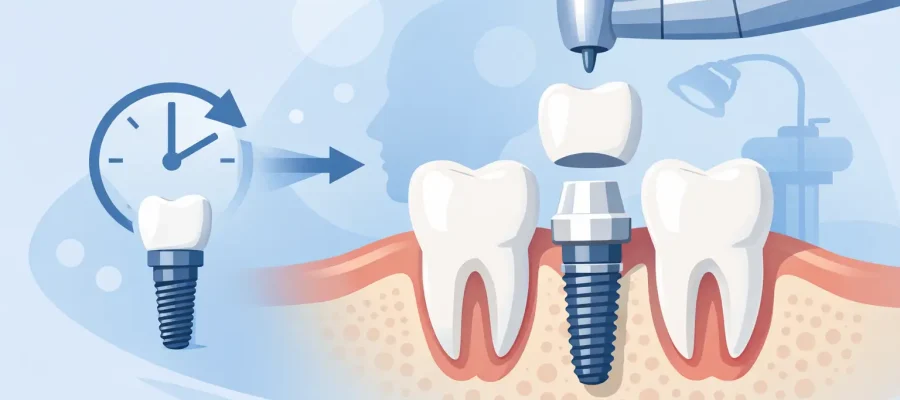
A missing tooth can change more than your bite. It can affect how confidently you speak, smile in photos, or sit across the table at a meeting. So, what is immediate loading in dental implants? It is a treatment approach in which a dental implant is placed and fitted with a temporary tooth or fixed temporary bridge very soon afterward – often on the same day.
For the right patient, immediate loading can mean leaving the clinic with teeth that look natural instead of waiting months with a visible gap or removable denture. It is a highly planned procedure, not a shortcut. Long-term success depends on bone quality, implant stability, bite control, and a precisely designed temporary restoration.
What Is Immediate Loading in Dental Implants?
A dental implant is a small titanium post placed into the jawbone to replace a tooth root. In conventional implant treatment, the implant is usually left to heal beneath the gum for several months before a crown or bridge is attached. This healing period allows the bone to integrate with the implant, a process called osseointegration.
With immediate loading, the implant receives a restoration shortly after placement. For a single tooth, that may be a temporary crown. For patients replacing a full arch of teeth, it may be a fixed temporary bridge attached to several implants, as in an All-on-4 or All-on-6 treatment.
The key word is temporary. Immediate loading does not always mean your final ceramic crown or final zirconia bridge is fitted on the day of surgery. The first restoration is designed to protect the healing implants while giving you an immediate, confident smile. Once healing is complete and the bite has been reassessed, the final restoration is created for long-term function and aesthetics.
Immediate Loading vs. Immediate Implant Placement
These terms are often used interchangeably, but they describe different parts of treatment.
Immediate implant placement means an implant is inserted directly after a tooth is extracted. Immediate loading means a tooth or bridge is attached to that implant soon after surgery. A patient can receive an implant immediately after an extraction but still wait for the crown. Conversely, an implant might be placed in a healed site and loaded immediately with a temporary tooth.
Some patients are candidates for both. For example, a failing front tooth may be carefully removed, replaced with an implant, and restored with a temporary crown in one visit. This can preserve the smile line and avoid the appearance of a missing front tooth during healing. But it is only appropriate when clinical conditions support a stable, predictable result.
How the Immediate Loading Process Works
The visible speed of immediate loading is made possible by detailed planning before treatment begins. At DRGO Smile Clinic, implant cases are evaluated with digital imaging and smile-focused planning so the surgical and aesthetic teams can work toward the same outcome.
1. Digital Assessment and Smile Planning
Your treatment starts with a clinical examination, 3D CBCT imaging, and an evaluation of your gums, bone volume, bite, and facial proportions. For aesthetic-zone cases, the shape, shade, and position of the future tooth are planned before surgery.
This matters because an implant cannot simply be placed wherever bone happens to be available. It must support a tooth that looks balanced in your smile and functions correctly when you bite. Digital planning helps determine implant angle, depth, number of implants, and whether bone grafting or a sinus lift is needed first.
2. Implant Placement and Stability Testing
During surgery, the dentist places the implant into the jawbone and measures its initial stability. Immediate loading requires strong primary stability – meaning the implant must be firmly anchored at the time it is placed.
Clinicians may assess this through insertion torque and implant stability measurements. If the implant does not achieve the required stability, the safest decision may be to allow a conventional healing period. This is not a failed procedure. It is a clinical decision made to protect the final outcome.
3. A Temporary Crown or Fixed Bridge
When stability is suitable, a temporary crown or bridge is attached. For a front tooth, the temporary restoration is shaped to support the gum tissue and maintain a natural-looking smile during healing. It is usually kept out of heavy bite contact at first.
For full-arch cases, several implants are connected by a fixed temporary bridge. Splinting implants together can distribute biting forces more evenly, which is one reason immediate loading is frequently associated with full-mouth solutions such as All-on-4 and All-on-6.
4. Healing and Final Restoration
The months after surgery are where discipline matters. The bone must integrate with the implants without being exposed to excessive force. Your temporary teeth allow you to look presentable and speak comfortably, but they are not an invitation to bite into hard foods.
After healing, the team checks implant health, gum contours, bite function, and aesthetics before producing the final restoration. This may be a custom crown, an E-Max-style aesthetic solution where appropriate, or a durable zirconia bridge for full-arch rehabilitation.
Who Is a Good Candidate for Immediate Loading?
Immediate loading is not automatically the best choice simply because a patient wants fast treatment. The strongest candidates generally have healthy gum tissues, adequate bone density and volume, favorable anatomy, good overall health, and a bite that can be controlled during healing.
Non-smokers or patients willing to stop smoking have an advantage, as smoking can compromise healing and gum health. Patients with uncontrolled diabetes, active gum disease, severe teeth grinding, untreated infection, or significant bone loss may need additional treatment before immediate loading is considered.
The location of the implant also matters. Front teeth are highly visible, so an immediate temporary crown can offer major aesthetic value. Back teeth experience higher chewing forces, making case selection especially important. Full-arch treatment can be particularly suitable for immediate fixed teeth when enough strategically positioned implants achieve strong stability.
The Benefits of Fixed Teeth Immediately
The most obvious benefit is emotional: you do not have to hide your smile while waiting for treatment to progress. For international patients with limited travel time, immediate temporary teeth can also make the treatment journey more practical and comfortable.
Immediate loading may help preserve gum shape around a front tooth and can reduce the need for a removable temporary appliance. In full-arch cases, replacing unstable or failing teeth with a fixed bridge can quickly improve chewing confidence, speech, and day-to-day comfort.
There is also an aesthetic advantage. A properly planned temporary restoration gives the dentist valuable information about tooth length, smile proportions, lip support, and bite before the final teeth are made. Think of it as a functional preview of your final smile, refined through real-life wear rather than guesswork.
The Trade-Offs You Should Understand
Fast does not mean risk-free. The main concern with immediate loading is movement. If an implant moves too much while the bone is healing around it, integration can be compromised. That is why the temporary restoration is carefully designed and why dietary instructions are non-negotiable.
For the first stage of healing, patients are typically asked to follow a soft-food diet and avoid biting directly into hard, crunchy, or sticky foods. If you grind or clench your teeth, a night guard may be recommended after your clinician determines the right timing.
Immediate temporary teeth may also need small adjustments as swelling resolves and gums heal. Their purpose is to guide healing and maintain your appearance, not to carry the same forces as final teeth. Patients who expect a perfect, permanent result on surgery day may be disappointed; patients who understand the staged process are usually much more comfortable with it.
Questions to Ask Before Choosing Immediate Loading
A quality implant consultation should make the decision feel clear, not pressured. Ask whether you have enough bone for immediate stability, whether any infection or gum disease needs treatment first, and whether your temporary teeth will be fixed or removable.
You should also ask what materials will be used for the temporary and final restorations, how long healing is expected to take, and what happens if your implant does not meet the stability threshold on surgery day. A clinic focused on predictability will explain the alternative plan before treatment begins.
For travelers, timing matters as much as the procedure itself. Confirm how long you should remain in Istanbul after surgery, how follow-up will be coordinated when you return home, and when you should plan for your final restoration. Clear answers protect both your investment and your peace of mind.
Immediate loading can be a life-changing option when it is earned by the right anatomy, planning, and clinical judgment. The best result is not simply teeth placed quickly – it is a smile that looks exceptional on day one and remains stable, comfortable, and beautifully functional for years to come.