


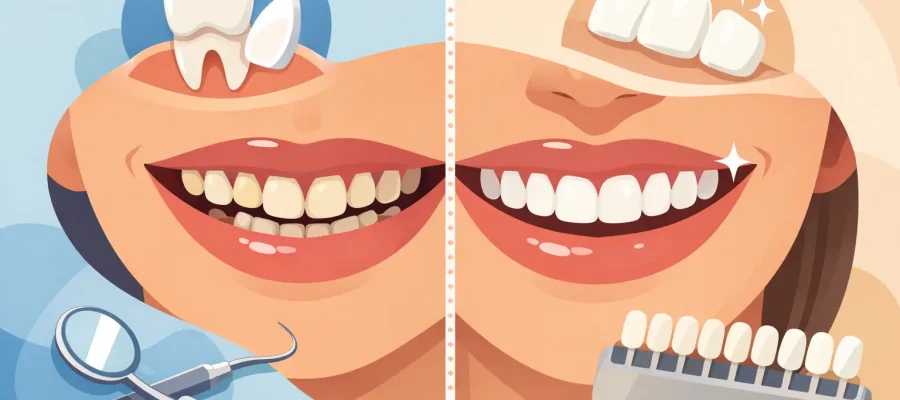
A veneer transformation should not make people think, “You got veneers.” It should make them think you look healthier, sharper, and more confident without immediately spotting why. That is exactly why realistic veneers before after examples matter so much. They show the difference between a smile that looks expensive and a smile that looks natural.
For patients comparing clinics, photos are often the first filter. But not every before-and-after gallery tells the truth about what a realistic result actually is. Bright white teeth in a polished photo can look impressive for a second and still be the wrong choice for your face, lip line, age, or skin tone. The best veneer work is not about making teeth look perfect in isolation. It is about making the full smile look believable.
What realistic veneers before after examples should actually show
A strong veneer case does not start with the final shade. It starts with proportion. When you look at realistic veneers before after examples, pay attention to whether the after photo still looks like the same person – just more refined. The smile should fit the facial features, not overpower them.
Natural-looking veneers usually keep a few details that fake-looking work removes. The tooth edges should not all be cut to the exact same length. The central incisors should lead the smile, but not dominate it. The canines should have presence without appearing bulky. There should also be a controlled surface texture, because real enamel is not completely flat under light.
The most convincing before-and-after cases also preserve character where appropriate. Some patients need a full redesign because of severe wear, fractures, discoloration, or previous dental work. Others need a softer correction – closing spaces, improving symmetry, and refreshing color without changing their identity. The right plan depends on the starting point.
The difference between dramatic and realistic
A dramatic result is not automatically unrealistic. If a patient begins with heavy staining, chipped edges, uneven gum levels, or multiple failing restorations, the change may be significant. What matters is whether the final result still follows natural rules.
For example, a realistic veneer transformation can be very bright, especially if a patient wants a camera-ready Hollywood Smile. But brightness has to be managed carefully. Teeth that are too opaque can flatten the smile. Teeth that are too white for the whites of the eyes or complexion can read as artificial, especially in daylight.
This is where many patients misread before-and-after photos. A high-contrast studio image can make a result look glossy and uniform. A realistic example still holds up in normal indoor light, daylight, close-up video, and casual conversation. That is the standard worth paying attention to.
What to check in veneer before-and-after photos
The easiest mistake is focusing only on the “after.” The smarter approach is to study the relationship between both images.
First, look at tooth shape. Were short or worn teeth restored with proportions that suit the patient’s face, or were they made overly square and oversized? Wider veneers can create a powerful smile, but too much width can make the mouth look crowded. Longer veneers can create elegance, but too much length can age the smile or make speech feel unnatural at first.
Second, look at the gum frame. Realistic results are often created not only by veneers themselves but also by correcting the gum line when needed. If one side sits higher than the other, even premium ceramic can still look off. In high-level smile design, gums, lips, tooth display, and facial symmetry are planned together.
Third, check the color transition. Natural smiles are not one flat block of white. The most refined veneer work includes depth, light reflection, and controlled translucency. This matters even more in close-up photography and on video calls, where artificial opacity becomes obvious.
Fourth, consider the patient’s age and style. A 25-year-old creator wanting a brighter, sharper smile for camera work may choose a different finish than a 48-year-old executive who wants a premium but understated result. Both can be realistic. Realistic does not mean dull. It means tailored.
Why some veneer results look fake
Most unnatural veneer outcomes come from one of three problems: poor planning, aggressive standardization, or choosing a style that ignores the patient’s features.
Poor planning usually shows up in smiles that look disconnected from the face. The teeth may be technically clean and symmetrical, but they do not match lip movement or facial proportions. This often happens when treatment is rushed without detailed design.
Aggressive standardization is another issue. Some clinics produce one look for everyone – very white, very square, very uniform. That works for marketing photos because it is easy to notice. It does not always work in real life. Premium cosmetic dentistry should not feel mass-produced.
Then there is preference. Some patients ask for an ultra-bright celebrity style and later realize they wanted polished, not artificial. That is why visual planning matters. A 3D preview or structured mock-up gives patients a chance to fine-tune shape and shade before final placement instead of discovering the mismatch afterward.
How realistic veneer design is planned
The best results are engineered before any final ceramic is made. That process begins with analysis, not drilling. Photos, video, bite assessment, digital scans, and smile measurements help map what the new smile should achieve.
A realistic veneer plan usually answers a few core questions. How much tooth show appears at rest and when smiling? Does the patient need subtle edge lengthening or a full proportional reset? Is the goal youthful softness, polished symmetry, or a more glamorous high-impact finish? How bright can the smile go before it stops looking natural on that specific face?
From there, the smile is designed in layers. Tooth shape is selected to complement the face. Shade is chosen based on the patient’s goals, complexion, and surrounding dental structures. Functional details are also checked, because a smile that looks beautiful but chips or feels awkward when biting is not a successful result.
This is where top clinics separate themselves. Precision planning, digital smile previews, and controlled lab work create predictability. For international patients on a tight schedule, that predictability matters just as much as aesthetics.
Realistic veneers before after examples by patient type
One useful way to read smile transformations is by category rather than by generic gallery browsing.
The first category is correction-focused. These are patients with chipped edges, worn enamel, minor crowding, or old bonding that no longer matches. In realistic before-and-after examples, the improvement is clean and noticeable, but the person still looks like themselves. These are often the most elegant cases because the dentistry disappears.
The second category is color rescue. Some patients have deep staining, patchy enamel, or root canal discoloration that whitening alone cannot fix. Here, veneers create a brighter and more even smile, but the best results avoid a chalky finish. The teeth should still reflect light like natural enamel.
The third category is full smile redesign. This is common among patients preparing for a wedding, media appearance, major business milestone, or public-facing rebrand. The change can be bold, but realism still comes from personalized width, controlled length, and a shade selected for the face rather than social media trends.
The fourth category is restorative-aesthetic crossover. These patients may have grinding damage, fractures, bite wear, or old crowns mixed with natural teeth. Realistic outcomes here depend on balancing cosmetics with function. Sometimes veneers are part of the answer, but sometimes crowns, gum treatment, whitening, or bite correction also belong in the plan.
Why international patients should look beyond the photo
If you are traveling for treatment, the photo gallery matters, but the process matters just as much. A realistic result is harder to achieve when the workflow is vague. You want to know how the clinic plans, how it previews the smile, what materials it uses, and how adjustments are handled before final bonding.
This is especially important when time is limited. Fast treatment can be a major advantage if the system is built for it. Digital scans, CAD/CAM workflows, structured try-ins, and precise lab communication can make a short trip highly efficient without making the result feel rushed. At DRGO Smile Clinic, that level of planning is what allows speed and precision to work together rather than compete.
Patients should also ask whether veneers are truly the right treatment. Sometimes minimal bonding is enough. Sometimes whitening plus gum contouring creates the improvement a patient wants. Sometimes a person asking for veneers actually needs crowns because the teeth are heavily restored or structurally weak. Realistic care starts with giving the right indication, not selling the most glamorous one.
The smartest question to ask before you commit
Instead of asking, “Can you make my teeth look perfect?” ask, “Can you show me what will look natural on my face?” That question changes the conversation. It shifts the focus from generic whiteness to personalized design.
The best cosmetic dentistry is not built around trends. It is built around fit – fit for your features, your timeline, your camera presence, your bite, and your version of confidence. When you review realistic veneers before after examples with that lens, the strongest work becomes easy to spot. It is the smile that looks effortless even though every detail was carefully planned.
A truly successful veneer result does not need to announce itself. It simply makes your whole presence look more finished, and that is usually the result patients remember most.