


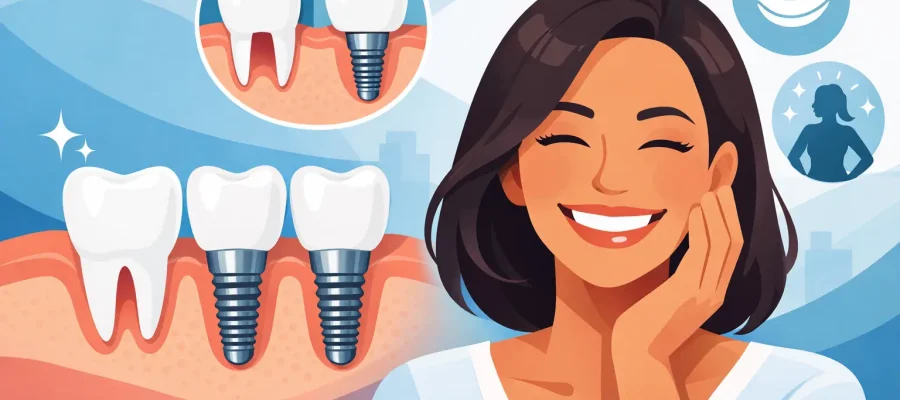
A missing tooth rarely stays just a missing tooth. It shows up in photos, in meetings, at dinner, and in the split second before you smile fully. That is exactly how dental implants restore confidence – not by changing who you are, but by removing the daily hesitation that missing or failing teeth create.
For many adults, confidence drops long before function completely breaks down. You may still be eating, speaking, and getting through the day, but with constant workarounds. Smiling with your lips closed. Avoiding certain angles on camera. Choosing softer foods. Worrying that a denture might move at the wrong moment. Dental implants change that equation because they replace more than visible teeth. They restore stability, proportion, and the feeling that your smile belongs to you again.
Why confidence changes when teeth are missing
Tooth loss is physical, but the effect is deeply social. People notice the gap in their smile before they notice the reason behind it. Even when others say nothing, patients often become hyper-aware of every conversation, every laugh, and every close-up photo.
That self-consciousness can build quietly. Professionals may speak less assertively in presentations. People dating again may cover their mouth when they laugh. Someone preparing for a wedding, media appearance, or major life event may suddenly feel that their smile no longer matches how they want to present themselves. The issue is not vanity. It is identity, presence, and ease.
There is also the structural side. Missing teeth can cause neighboring teeth to shift, bone levels to decline, and facial support to change over time. This is one reason confidence often continues to drop after a tooth is lost. The smile can start to look older, less even, and less healthy, even if the rest of the face is well cared for.
How dental implants restore confidence in real life
The biggest shift is stability. A dental implant is anchored in the jawbone, which gives it a fixed, secure feel that removable options cannot fully replicate. When a replacement tooth does not slide, click, or depend on adhesives, patients tend to relax almost immediately. They stop managing their smile and start using it naturally.
That stability changes everyday behavior. Eating in public feels easier. Speaking feels clearer. Laughing stops being a calculated movement. Patients often describe the result in simple terms: they feel normal again. In premium smile design, that sense of normal is the real luxury – not having to think about your teeth every minute.
Aesthetic precision matters just as much. A well-planned implant restoration is designed to blend with facial proportions, gum contours, and the shade and shape of surrounding teeth. When the restoration looks natural under daylight, on video, and in close conversation, confidence becomes visible. People stop asking themselves whether others can tell. They start focusing on the room instead.
There is also a psychological difference between covering a problem and structurally solving it. A bridge can be an excellent option in some cases. A removable denture may still be appropriate for certain patients. But implants often feel more definitive because they rebuild support where the tooth once was. That permanence can be emotionally powerful, especially for patients who are tired of temporary fixes.
The confidence difference between single implants and full-arch implants
A single implant can have an outsized effect, especially if the missing tooth is in the smile zone. One visible gap can change the entire expression of the face. Replacing it with a properly shaped crown can restore symmetry fast, which is why patients often notice an immediate emotional lift.
Full-arch cases are different. Here, confidence is usually affected by a wider mix of problems – failing teeth, loose dentures, advanced wear, discomfort, and years of compromised chewing. For these patients, implant systems such as All-on-4 or All-on-6 can be life-changing because they replace instability with a fixed set of teeth. The transformation is not subtle. It can affect speech, facial support, diet, and social confidence all at once.
That said, the right treatment depends on bone levels, gum condition, bite forces, health history, and aesthetic goals. Immediate fixed teeth are possible in many cases, but not every patient is the same-day candidate they hope to be. Precision planning matters more than speed alone.
What patients are really buying when they choose implants
They are not just buying titanium posts and ceramic crowns. They are buying predictability.
For image-conscious adults, predictability is the foundation of confidence. They want to know how the smile will look before treatment starts. They want realistic timelines. They want to understand whether the final result will feel natural, look refined on camera, and hold up in real life. This is where advanced planning changes the experience.
Digital diagnostics, 3D previews, guided surgery, and carefully engineered restorations reduce guesswork. They help patients see the outcome, not just imagine it. In a high-trust clinic environment, that clarity lowers anxiety because the treatment feels designed rather than improvised.
For international patients, predictability also includes logistics. Time away from home, number of visits, healing phases, hotel coordination, airport transfers, and language support all shape the emotional experience. A beautifully restored smile means less if the treatment journey feels chaotic. When the clinical side and travel side are managed together, patients can stay focused on the result.
The trade-offs patients should understand
Implants are a premium solution, and confidence grows fastest when expectations are accurate. They are not instant magic in every case. Some patients need bone grafting or a sinus lift before implants can be placed securely. Others may be candidates for immediate implants, while some will need staged healing for the best long-term outcome.
There is also a difference between getting teeth quickly and getting the right teeth. Fast treatment is attractive, especially for travelers, but speed should sit on top of solid diagnostics, not replace them. The best result is one that looks elegant, functions well, and remains stable over time.
Cost is another factor. Implants usually cost more upfront than removable options. But many patients decide the value is clear when they consider comfort, aesthetics, maintenance, and quality of life. Confidence is hard to measure on a spreadsheet, yet it often drives the decision more than any other variable.
What the treatment journey feels like
The process starts with planning. This includes scans, photos, bite analysis, and a detailed review of facial aesthetics and oral health. In high-end implant cases, planning is where confidence begins, because patients can see that the smile is being built with intention.
Next comes preparation. If a damaged tooth must be removed, the site is evaluated for implant placement and bone support. Some patients can move directly into immediate implant treatment. Others need preparatory procedures to create a stronger foundation. The right choice is the one that protects the final result.
Placement is typically more comfortable than many patients expect, especially when the workflow is organized and the care team is focused on comfort. Temporary teeth may be provided in selected cases, which matters for patients who do not want a visible gap during healing.
The final restoration is where the emotional shift becomes real. Once the crown or fixed arch is placed and adjusted for shape, bite, and polish, the smile stops feeling like a project and starts feeling like part of the patient again. At clinics built around precision smile makeovers, such as DRGO Smile Clinic, this stage is treated as both a clinical finish and an aesthetic reveal.
Why implants often improve more than a smile
Confidence rarely stays in one lane. When patients feel secure about their teeth, they often change how they show up elsewhere. They speak more freely. They stop declining photos. They dress with more intention. They return to events they had been avoiding. The improvement can look cosmetic from the outside, but internally it often feels like relief.
That is why implant treatment matters to professionals, founders, creators, and event-driven patients. Your smile is part of your presence. If it feels compromised, your energy shifts toward hiding instead of engaging. A well-executed implant restoration gives that energy back.
The best dental work does not beg to be noticed. It simply lets you act like yourself without hesitation. If you have been living around a missing tooth, an unstable denture, or a failing smile, that change can feel bigger than aesthetics. It can feel like getting your edge back.