


Choosing between the different types of dental implants is not just a clinical decision. It affects how your smile looks, how fast you can get back to normal life, how many visits you need, and whether your final result feels simple or frustrating. If you are comparing treatment options from abroad, the right implant plan should give you both stability and a clear timeline.
Dental implants are not one single treatment. They are a category of solutions used to replace one missing tooth, several missing teeth, or a full arch. The best option depends on your bone level, gum condition, bite force, aesthetic goals, and how quickly you want fixed teeth. For many patients, especially those traveling for treatment, speed matters – but only when it is backed by careful planning.
The main types of dental implants
When people search for types of dental implants, they are usually talking about one of two things: the shape and placement of the implant itself, or the style of restoration it supports. Both matter.
The most common implant is the endosteal implant. This is placed directly into the jawbone and acts like an artificial tooth root. It is the standard option for most healthy implant candidates because it offers strong support and predictable long-term function. If you have enough bone and healthy gums, this is usually the first option your surgeon considers.
A subperiosteal implant sits on top of the jawbone but under the gum tissue. This is far less common today because modern bone grafting and advanced surgical planning have made endosteal implants possible for more patients. Still, it can be considered in selected cases where bone volume is limited and the patient is not a candidate for more extensive grafting.
Zygomatic implants are a more specialized option. Instead of anchoring in the upper jaw, they are placed into the cheekbone. These are usually reserved for patients with severe upper jaw bone loss who want to avoid major grafting procedures. They can be highly effective, but they require advanced surgical expertise and are not a routine implant choice.
Types of dental implants by tooth replacement need
For most patients, the more practical way to understand types of dental implants is by what they replace.
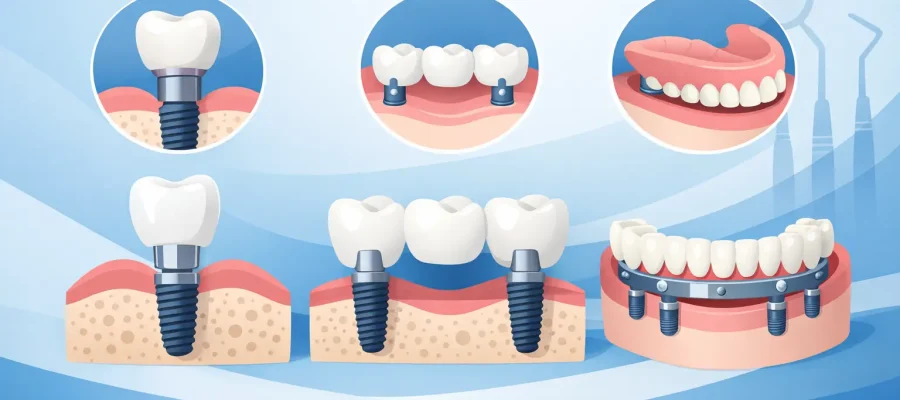
Single-tooth implants
If you are missing one tooth, a single implant with a custom crown is often the cleanest solution. The implant replaces the root, and the crown restores the visible tooth. This option protects neighboring teeth because nothing needs to be trimmed down to support a bridge.
It is a strong choice when aesthetics matter, especially in the smile zone. The trade-off is timing. In some cases, the implant can be placed immediately after extraction, but only if the bone and gum conditions are right. In other cases, healing time is needed before the final crown is placed.
Implant-supported bridges
When several teeth are missing in a row, an implant-supported bridge may be more efficient than placing an implant for every missing tooth. Two or more implants can support a connected bridge, reducing the number of implants needed while still giving fixed teeth.
This approach often works well in the back of the mouth where chewing force is high. It can also be a smart balance between cost and function. The main consideration is hygiene and planning – the bridge design needs enough support, enough cleansable space, and a bite that does not overload the implants.
Full-arch implants
If you are missing all or most teeth in the upper or lower jaw, full-arch implant treatment becomes the conversation. This is where options like All-on-4 and All-on-6 come in.
All-on-4 uses four implants to support a full set of fixed teeth. The back implants are typically angled to maximize available bone and reduce the need for grafting. It is popular because it can often deliver fixed teeth quickly, sometimes on the same day, while keeping surgery efficient.
All-on-6 follows the same concept but uses six implants instead of four. That added support can improve load distribution and long-term stability in the right patient. It may be preferred when bone quality allows for it, when bite forces are stronger, or when a more reinforced foundation is desired.
Neither option is automatically better. All-on-4 can be excellent for patients seeking speed, simplicity, and graft-free planning. All-on-6 may be ideal when anatomy supports more implants and the goal is broader support across the arch. The right answer depends on the scan, not the trend.
Immediate vs traditional implant placement
Another way to compare types of dental implants is by treatment timing.
Immediate implants are placed at the same appointment as tooth extraction, or very soon after. In carefully selected cases, they can also support a temporary tooth or temporary full arch right away. This is one of the most attractive pathways for international patients because it shortens treatment phases and can restore appearance fast.
But immediate treatment is not for everyone. It works best when infection is controlled, bone is adequate, and implant stability can be achieved at the time of placement. If those conditions are not present, rushing the process can compromise the result.
Traditional implant placement follows a more staged protocol. First the failing tooth is removed if needed. Then the bone and gum area heals. After that, the implant is placed and allowed to integrate before the final restoration is fitted. It takes longer, but in some cases it is the safer and more predictable route.
For a premium result, speed should never replace planning. It should come from planning.
Bone level changes the best option
One of the biggest factors in implant planning is bone volume. Many patients assume they can simply choose the implant style they prefer, but bone anatomy often narrows the field.
If bone is strong and well preserved, standard endosteal implants are usually straightforward. If bone has shrunk after years of tooth loss, additional procedures such as bone grafting or sinus lift may be needed, especially in the upper back jaw.
This is where advanced imaging matters. A 3D scan shows whether you are a candidate for immediate implants, whether full-arch treatment can avoid grafting, and whether a more complex solution like zygomatic implants should even be discussed. Without that level of planning, treatment can sound simpler than it is.
Materials and restoration style matter too
Patients often ask whether implant type refers to the material. Usually, the implant post itself is titanium, which remains the most proven option for strength and osseointegration. In selected cases, zirconia implants may be discussed, especially for metal-free preferences, but they are less commonly used across complex full-arch cases.
The restoration on top also changes the experience. A single implant may carry a ceramic crown for high aesthetics. A full-arch implant case may begin with a temporary fixed bridge and later move to a stronger final prosthesis once healing is complete. That final bridge can be designed for beauty, durability, or a balance of both.
For image-conscious patients, this matters. The best implant plan is not only about what integrates with bone. It is about how the final smile line, tooth proportion, gum transition, and bite performance are engineered from day one.
Which dental implant option is right for you?
If you are missing one tooth and the surrounding bone is healthy, a single implant is often the most natural answer. If you are missing several teeth together, an implant bridge may give you fixed function without unnecessary extra implants. If you are facing multiple failing teeth or complete tooth loss, full-arch solutions such as All-on-4 or All-on-6 usually offer the biggest transformation.
The real decision is not made from a price list alone. It comes from photographs, a 3D scan, a bite assessment, and a plan that matches your travel timeline and aesthetic expectations. That is especially important if you want immediate teeth, a short stay, or a smile designed around a major event.
At a clinic like DRGO Smile Clinic, the value is not just in offering several implant options. It is in matching surgical precision with digital smile planning, fast-turnaround workflows, and a treatment journey that feels organized from airport pickup to final fit.
A strong implant result should feel effortless once it is done. The work happens in the planning – choosing the option that suits your bone, your face, your schedule, and the standard you want to see every time you smile.