


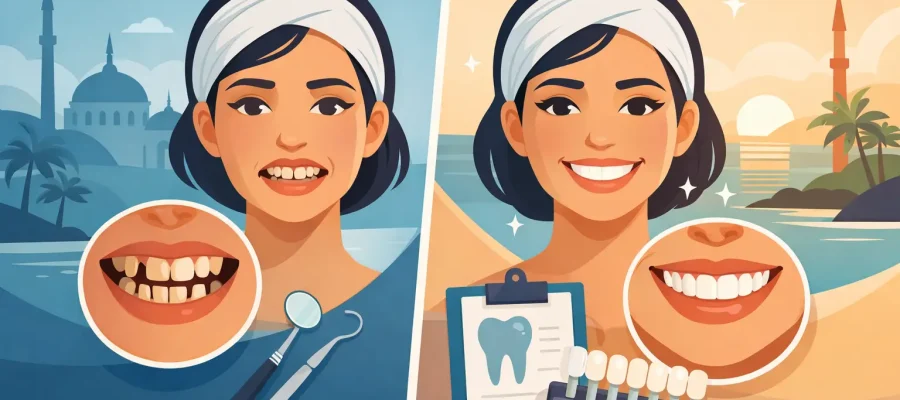
A dramatic smile makeover can look effortless in a final photo: brighter teeth, cleaner proportions, a more balanced gumline, and a smile that finally matches the way you want to be seen. But turkey teeth before and after: what should you expect? The honest answer is more than a shade change. A premium result depends on diagnosis, digital planning, precise preparation, and choosing a treatment that protects your natural teeth.
The phrase “Turkey teeth” is commonly used online to describe cosmetic dental work completed in Turkey, usually veneers or crowns. It is not a clinical treatment. The difference between a striking, natural-looking transformation and an overdone result comes down to the clinic’s planning standards, materials, bite analysis, and the skill of the dentist and laboratory team.
Turkey teeth before and after: the real change
Before treatment, patients often have concerns that are visible in photos and felt every day: uneven spacing, worn edges, discoloration that whitening cannot correct, old fillings, chipped teeth, short-looking teeth, or crowns that no longer match. Some also have gum asymmetry or a bite that has changed over time.
After treatment, the goal is not simply to make every tooth bigger and whiter. It is to create harmony between the teeth, lips, face, and gums. A well-designed smile can make teeth look healthier, more proportional, and naturally luminous without looking flat, bulky, or identical to someone else’s.
The most convincing before-and-after results usually show improvements in several areas at once:
- Tooth color is brighter but still has depth and character.
- Tooth length and edge shape are balanced with the lips.
- Small gaps, chips, and uneven contours are corrected.
- The gumline frames the smile more evenly when gum treatment is appropriate.
- The bite is considered so the final teeth are built for function, not just photographs.
A transformation can be highly visible, but it should still look like it belongs to you.
Start with the question that matters: veneers or crowns?
Many international patients arrive believing they need one specific treatment. In reality, the right option depends on how much healthy tooth structure remains, the existing restorations, the bite, and the changes required.
Porcelain veneers are thin ceramic shells bonded to the front of selected teeth. They are often an excellent option for patients with generally healthy teeth who want to improve color, shape, minor spacing, or small chips. Because they can require minimal preparation in suitable cases, veneers may preserve more natural tooth structure than full crowns.
Zirconium or ceramic crowns cover the entire tooth. They may be recommended when a tooth is heavily filled, cracked, root canal treated, significantly worn, already crowned, or needs more structural support. Crowns are not automatically the “better” choice because they are more comprehensive. They are the better choice only when the tooth needs that level of restoration.
There are also cases where whitening, bonding, orthodontic alignment, gum contouring, or a combination of treatments produces a more conservative and beautiful outcome. A responsible plan does not turn healthy teeth into crowns just to meet a short timeline.
What happens before your makeover
The strongest results are decided before any tooth is prepared. This stage should include a detailed review of your medical and dental history, photos, X-rays or 3D imaging when indicated, an examination of the gums, and an assessment of how your teeth meet when you bite.
At DRGO Smile Clinic, Digital Smile Design can turn those findings into a visual proposal. Your dentist evaluates facial proportions, lip movement, tooth display at rest and when smiling, and the character you want your smile to convey. Some patients want a bright Hollywood Smile with more definition. Others want softer edges, a warmer shade, and changes that are difficult for colleagues to identify.
A 3D preview or smile mock-up is valuable because it creates a real conversation before the final ceramics are made. You can discuss tooth length, shape, and brightness instead of relying on vague phrases like “natural” or “perfect.” The preview is a planning tool, not a guarantee that every mouth will respond identically, but it greatly improves predictability.
If you have untreated decay, gum inflammation, active infection, severe grinding, or a complex bite issue, those concerns must be addressed first. Cosmetic work placed over unresolved disease is not premium dentistry. It is a shortcut with an expiration date.
Your treatment days in Istanbul
For straightforward veneer or crown cases, an international treatment plan often takes five to seven days. Exact timing varies based on the number of teeth, gum treatment, laboratory requirements, and whether implants or root canal treatment are needed.
On the first clinical day, the teeth are prepared only as much as the planned restoration requires. Digital scans replace traditional impression material in many cases and capture precise details for the laboratory. Temporary teeth are then fitted, allowing you to experience the proposed length and shape in daily life.
The temporary phase is more useful than many patients realize. It gives you the chance to speak, smile, and see your teeth in different lighting. If a tooth feels too long, too square, or too bright in the design, this is when refinements should be discussed.
At the try-in appointment, the dentist checks the ceramic restorations for fit, contact points, shade, symmetry, and bite. Final bonding or cementation takes place only when the team and patient are satisfied with the result. Same-day CAD/CAM crowns may be possible for selected single-tooth or limited cases, but full smile design still benefits from the careful try-in process rather than unnecessary speed.
What to expect immediately after
Most patients can smile confidently as soon as their final restorations are fitted. Mild gum sensitivity, tenderness around prepared teeth, or temporary sensitivity to cold can occur, especially if several teeth were treated. This usually settles, but persistent pain, pressure when biting, or a tooth that feels “high” should be reported promptly.
Your smile may also look unfamiliar for a few days. That does not mean the design is wrong. Your eye is used to your previous teeth, including their color and imperfections. Give yourself time to see the result in normal settings, not only under clinic lighting or a phone camera.
If gum contouring was part of the plan, the soft tissue needs additional healing time. If implants were placed, the timeline is different again. Immediate temporary teeth can sometimes be fitted on the day of surgery, while final implant bridges are usually placed after an appropriate healing period. Anyone promising the same timeline for veneers, crowns, and full-arch implants is oversimplifying three very different treatments.
How long will the result last?
High-quality ceramic veneers and crowns can last many years, but they are not maintenance-free. Their longevity depends on material quality, preparation design, bonding or cementation, bite forces, hygiene, and habits. People who clench or grind need a protective night guard. Patients who use their teeth to open packaging, bite nails, or chew hard objects are more likely to chip any restoration, even premium ceramic.
Care is straightforward: brush twice daily with a non-abrasive toothpaste, clean between teeth every day, maintain regular dental checkups, and follow the specific guidance provided for your restorations. Whitening does not change the color of porcelain, so discuss future whitening goals before your final shade is selected.
How to judge before-and-after photos properly
Before-and-after galleries are useful, but they should not be treated as a substitute for diagnosis. Look beyond the brightness of the final image. Are the gums healthy-looking? Do the teeth match the patient’s face? Is there variation in tooth shape, translucency, and surface texture? Does the smile still look believable when the patient is not posing under a filter?
Ask to see cases similar to your starting point. A patient replacing old crowns needs a different plan than someone with naturally healthy but discolored teeth. If you grind your teeth, have gum recession, or want implant treatment, look for proof that the clinic manages those clinical realities as well as cosmetic design.
The best after photo is not the one that gets the most attention online. It is the one you can live with comfortably, speak with naturally, maintain confidently, and still be proud of years later. A personalized digital consultation is the right place to turn that expectation into a treatment plan built around your teeth, your timeline, and your signature smile.