


A full arch of failing, missing, or uncomfortable teeth can affect far more than meals. It can change how you speak in meetings, smile in photos, and show up for the moments that matter. For people asking who may be a candidate for All-on-4 dental implants, the answer is often broader than expected – but the right answer depends on a detailed clinical assessment, not a one-size-fits-all promise.
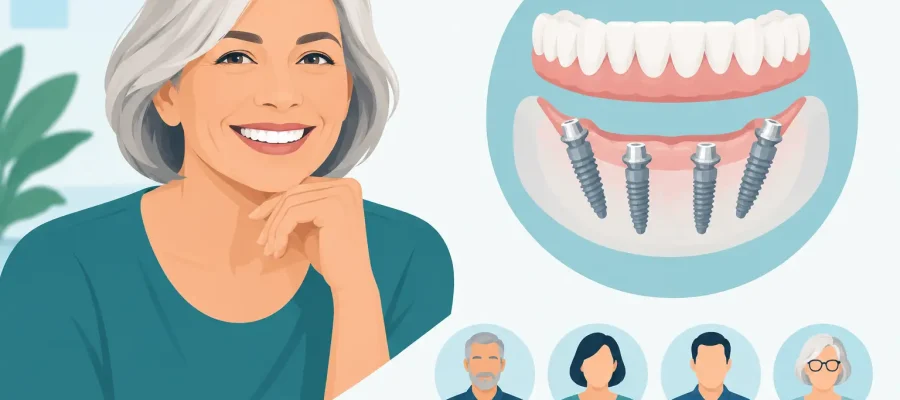
All-on-4 is designed to restore an entire upper or lower arch with a fixed set of teeth supported by four strategically placed dental implants. Rather than replacing every lost tooth with an individual implant, this approach creates a stable foundation for a full-arch prosthesis. For the right patient, it can offer a dramatic shift from removable dentures to secure, natural-looking teeth.
Who May Be a Candidate for All-on-4 Dental Implants?
The strongest candidates are typically adults who have lost most or all teeth in one arch, have teeth that can no longer be predictably saved, or are tired of loose dentures. The treatment may also suit someone facing extensive extractions because of advanced decay, severe gum disease, repeated root canal failures, or fractured teeth.
All-on-4 can be especially appealing to patients who want a fixed solution without placing an implant for every missing tooth. The rear implants are often angled to make the best use of available bone, which may reduce the need for bone grafting in some cases. That distinction matters for international patients seeking an efficient treatment plan and a clearly organized travel schedule.
A candidate is not defined by age alone. Healthy adults in their 40s, 50s, 60s, and beyond may be considered if their medical history, oral condition, and bone anatomy support implant treatment. What matters is whether the mouth and body can heal predictably and support long-term function.
You have extensive tooth loss or failing teeth
If several teeth are already missing, loose, heavily restored, or painful, rebuilding the entire arch may be more logical than continuing with individual repairs. There is a point where repeated crowns, bridges, fillings, and emergency treatment become an expensive cycle rather than a durable plan.
A full-arch solution can create a fresh clinical starting point. The team evaluates which teeth are truly maintainable and which are compromising the health, bite, or appearance of the whole arch. When remaining teeth have a poor long-term outlook, extraction and implant-supported restoration may offer greater predictability.
You struggle with removable dentures
Dentures can move while eating, create sore spots, limit food choices, and reduce confidence in social settings. Adhesives may offer temporary help, but they do not create the stability of implant support.
All-on-4 is often a strong option for denture wearers who want teeth that are fixed in place. Depending on the treatment plan and clinical conditions, patients may receive a fixed temporary bridge on the day of surgery, then return for their final restoration after healing. The goal is not merely to replace teeth, but to restore security when speaking, laughing, and eating.
You have enough bone in the right areas
Bone volume is central to implant planning, but a history of bone loss does not automatically rule out All-on-4. The angled placement of posterior implants can allow clinicians to use stronger available bone in the front of the jaw. This is why a 3D scan is essential: it reveals bone height, width, density, sinus position in the upper jaw, and the location of nerves in the lower jaw.
Some patients will still need bone grafting or a sinus lift. Others may be better suited to All-on-6, which uses six implants for additional support, or to a staged treatment approach. The best protocol follows your anatomy and bite forces, not a marketing label.
Health Factors Your Implant Team Will Review
A premium result begins with honest screening. Before committing to full-arch implants, your dental team should review your medical history, medications, lifestyle, gum health, jawbone quality, and expectations for the final smile.
Well-managed diabetes, controlled blood pressure, and many common health conditions do not necessarily prevent treatment. However, uncontrolled diabetes, active cancer therapy, significant immune suppression, certain bone medications, or untreated bleeding conditions may affect healing and require medical coordination. Patients who smoke or use nicotine are not always excluded, but they face a higher risk of complications and implant failure. Stopping or significantly reducing nicotine use before surgery is strongly recommended.
Active periodontal disease also needs careful attention. If gum infection has contributed to tooth loss, the source of infection must be treated as part of the plan. Implants are highly durable when properly planned and maintained, but they are not maintenance-free. Daily cleaning and professional follow-up protect the investment.
Your bite and habits matter
A powerful bite, clenching, or grinding does not automatically make someone unsuitable. It does mean the implant positions, materials, and final bite design must be engineered with additional care. In some cases, a protective night guard is recommended after the final teeth are fitted.
Patients should also understand that the temporary bridge has a different role from the final bridge. During healing, it protects the surgical sites and allows the implants to integrate with the bone. A softer-food period and careful bite instructions are part of protecting that process. The final restoration is designed after healing, when the team can refine fit, smile proportions, tooth color, and function.
What the All-on-4 Assessment Looks Like
A credible All-on-4 consultation should feel precise, not rushed. It begins with photographs, digital scans, X-rays or CBCT imaging, and a review of your dental and medical history. For remote patients, an initial online consultation can help determine whether you appear to be a likely candidate before travel, but the final treatment decision must follow an in-person examination and imaging.
At DRGO Smile Clinic, Digital Smile Design can be used to plan more than implant positions. It helps visualize facial harmony, lip support, tooth proportions, and the overall character of your new smile. This is particularly valuable when full-arch treatment is both a functional and aesthetic transformation.
Your team should discuss whether teeth will be removed, whether immediate implants are appropriate, and whether a fixed temporary bridge can be delivered on the same day. Immediate teeth are not guaranteed for every patient. Severe infection, insufficient initial implant stability, or complex anatomy can make a staged protocol safer. A clinic that explains this clearly is protecting your result.
When All-on-4 May Not Be the Best Choice
All-on-4 is powerful, but it is not automatically the best answer for every mouth. If you have only one or two missing teeth and the neighboring teeth are healthy, individual implants may be the more conservative solution. If several natural teeth remain healthy and stable, preserving them may be preferable to full-arch extraction.
Some patients need preliminary gum treatment, extractions with a healing period, grafting, or medical clearance before implants can proceed. Others may benefit from All-on-6 because their anatomy, bite, or final bridge design calls for more support. There is no advantage in forcing a fast solution when a staged plan will deliver a more secure outcome.
Aesthetic expectations also deserve a direct conversation. All-on-4 can create a bright, balanced, camera-ready smile, but the final design must work with your facial features, gum display, speech, and bite. The most beautiful result is one that looks intentional, feels comfortable, and functions naturally every day.
Are You Ready for a Fixed Full-Arch Smile?
You may be a candidate if you have widespread tooth loss or failing teeth, are frustrated by dentures, have adequate bone or a realistic pathway to prepare it, and are ready to commit to healing and long-term maintenance. The only reliable way to know is through digital imaging, clinical examination, and a treatment plan built around your health and goals.
A well-planned All-on-4 journey can replace uncertainty with fixed teeth, renewed facial support, and the confidence to smile without holding back. Start with a professional evaluation, ask direct questions about your options, and choose the plan that protects both your health and the signature smile you want to carry into your next chapter.