


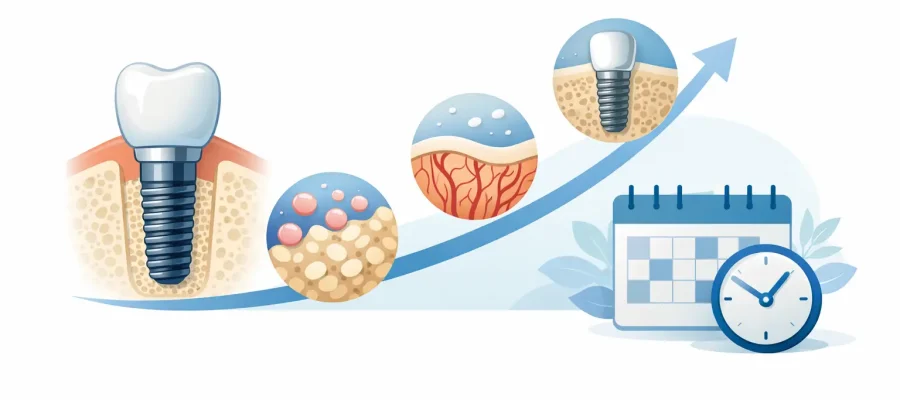
If you are planning dental implants, the implant bone graft healing timeline is one of the first details that shapes everything else – your travel schedule, your final smile date, and whether immediate treatment is realistic. Patients usually want one clear answer: how long until the implant can go in? The honest answer is that bone healing follows a predictable pattern, but the exact timing depends on the size of the graft, the area treated, and how much native bone you already have.
That matters even more for international patients. When you are coordinating treatment around work, events, or a short stay in Istanbul, timing is not just clinical. It is logistical. A well-planned grafting timeline protects the final result, because implants need stable, mature bone if you want strength, long-term success, and an esthetic finish.
What the implant bone graft healing timeline usually looks like
In most cases, the early healing phase starts in the first one to two weeks. This is when the gum tissue closes, swelling drops, and the site begins to stabilize. Patients often feel much better before the graft is actually ready for an implant, which is where confusion happens. Feeling normal does not mean the bone is fully regenerated.
From there, the body starts replacing graft material with living bone. For a small socket graft placed right after an extraction, healing may be ready for implant placement in about 8 to 12 weeks. For moderate grafting, a common timeline is closer to 3 to 4 months. Larger defects, ridge augmentation, or sinus lift procedures can extend healing to 4 to 9 months.
That range sounds wide because it is. A tiny graft used to preserve bone after one tooth is very different from rebuilding an area that has been missing bone for years. The goal is not speed at any cost. The goal is placing the implant at the moment when the site has enough quality and volume to support it properly.
Why healing time changes from patient to patient
The biggest factor is the amount of missing bone. If your jawbone has only mild shrinkage, the graft may integrate faster. If there is a major horizontal or vertical defect, the body has more work to do.
The location also matters. The upper jaw often has softer bone than the lower jaw, and the back upper region can be more complex because of the sinus cavity. That is why sinus lift cases often need longer healing than a straightforward lower implant site.
Your biology plays a role too. Smokers, patients with uncontrolled diabetes, and people with a history of gum disease may heal more slowly or less predictably. Even stress, poor sleep, and nutrition can affect the recovery curve. On the other hand, patients in good general health with clean oral conditions often move through healing efficiently.
The graft material and technique matter as well. Some grafts are small and highly contained, while others need membranes, fixation, or staged reconstruction. Modern planning with 3D imaging helps your surgeon estimate the most realistic timeline before treatment begins, not after.
What happens week by week after bone grafting
The first 72 hours are usually about swelling control and protection. Mild bleeding, pressure, and tenderness are normal. Most patients can function well with medication and basic aftercare, but this is not the time to chew on the area or test it.
By the end of the first week, the soft tissue begins to seal. Swelling typically improves, and discomfort becomes more manageable. If sutures are used, they may dissolve on their own or be removed at a follow-up, depending on the technique.
Between weeks two and six, the site often feels quiet, which can create false confidence. Under the surface, the graft is still integrating. Blood supply is developing, early bone formation is happening, and the area remains vulnerable to unnecessary pressure or infection.
From about two to four months, the graft becomes more organized and mineralized. This is often the window when a surgeon reevaluates the site with imaging and checks whether implant placement is appropriate. For larger grafts, this biological remodeling continues much longer.
Can an implant be placed at the same time as the bone graft?
Sometimes, yes. Sometimes, no. This is one of the most valuable planning decisions in implant dentistry.
If the implant can achieve strong primary stability on the day of surgery, a surgeon may place the implant and graft at the same appointment. This can shorten the overall treatment journey and reduce the number of surgical stages. It is a strong option in selected cases, especially when enough native bone is still present to anchor the implant securely.
If stability is not good enough, staging is smarter. In that case, the bone graft heals first, then the implant is placed later. It adds time, but it protects the outcome. For patients chasing a premium esthetic result, especially in the smile zone, that extra patience can be the difference between a good result and a precise one.
The implant bone graft healing timeline for common scenarios
A socket preservation graft after extraction is often the fastest category. If the site is clean and the defect is limited, implant placement may be possible in around 2 to 3 months.
A localized ridge graft for moderate bone loss often needs about 3 to 4 months before implant placement. This is a common middle-ground scenario and often produces very predictable results.
A sinus lift or larger augmentation can require 4 to 6 months, and in more demanding cases up to 9 months. That does not mean something is wrong. It usually reflects the scale of reconstruction and the need for mature, load-bearing bone.
For full-arch treatment, the timeline depends on whether immediate implants are possible. Some patients can receive extractions, implants, and fixed temporary teeth quickly, even with selective grafting. Others need a staged approach because the starting bone condition does not support immediate loading safely.
How to heal faster without risking the result
You cannot rush biology, but you can avoid delays. The first priority is protecting the surgical site. Follow the food instructions, avoid chewing on the area, and do not disturb the graft with aggressive rinsing or brushing too early.
Nicotine is a major problem for graft healing. Smoking reduces blood flow and raises the risk of graft failure, infection, and poor implant integration. If you want the best chance of a smooth timeline, stopping matters.
Oral hygiene has to stay excellent, even while the grafted area is healing. That means keeping the mouth clean exactly as instructed, not improvising. Missing aftercare is one of the easiest ways to turn a straightforward timeline into a delayed one.
This is also why disciplined planning matters. At DRGO Smile Clinic, advanced imaging and case design are used to choose the fastest safe path, not just the fastest possible one. That distinction protects both esthetics and durability.
When to worry about slow healing
Some variation is normal, so slower does not automatically mean failed. But certain signs deserve immediate review: worsening pain after the first few days, persistent swelling, pus, a bad taste that does not resolve, graft particles pouring out in large amounts, or a wound that opens significantly.
The real checkpoint is not how the site feels alone. It is how it looks clinically and how it appears on imaging. Many grafts need a scan before implant placement to confirm that the volume and density are there. That objective review is what gives confidence to move to the next step.
Planning your travel around treatment
For medical travelers, this timeline should be mapped before flights are booked. Some patients can complete grafting on one visit and return later for implants. Others may qualify for immediate implants and temporary teeth, which changes the entire schedule.
This is where personalized treatment planning becomes valuable. A clinic should not promise a one-visit implant solution before reviewing your scans, bone levels, bite, and esthetic goals. Premium results come from engineered timing, not generic timelines.
If you are comparing clinics, ask a simple question: will my case be immediate, staged, or possibly converted from one to the other after 3D evaluation? That answer says a lot about how seriously the clinic takes predictability.
The right timeline is the one that gets you to a stable, attractive, long-lasting result with no shortcuts you will regret later. If bone grafting is part of your implant journey, patience is not lost time. It is part of building the foundation your final smile will stand on.