


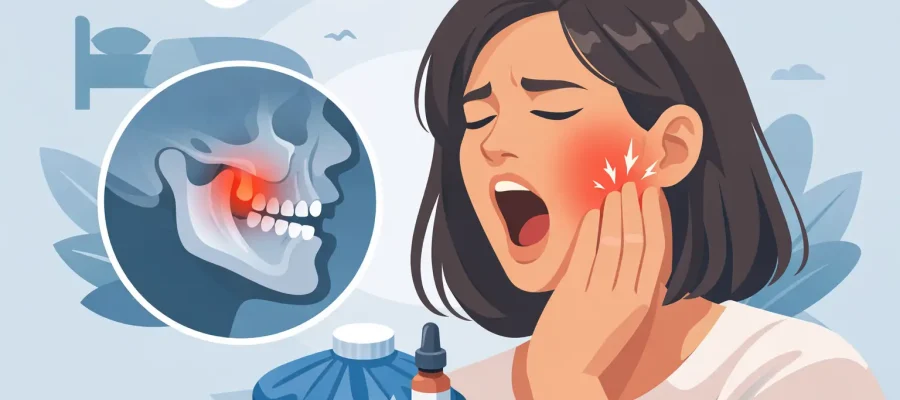
A yawn should feel effortless. If your jaw clicks, catches, or sends a sharp ache toward your ear every time you open wide, it is usually a sign that something in the joint, muscles, or bite is under strain. Jaw pain when yawning is common, but it is not something to ignore if it keeps happening.
For many adults, the discomfort starts subtly. You notice tightness in the morning, a pop when chewing, or a feeling that your jaw shifts slightly off track when you open wide. Then a simple yawn turns into the moment you feel it most. That pattern matters, because yawning pushes the jaw close to its maximum range of motion. If there is an issue with the TMJ, muscle tension, or bite balance, a yawn often exposes it.
Why jaw pain when yawning happens
The temporomandibular joints, or TMJs, connect your lower jaw to the skull on both sides of your face. These joints work together with discs, ligaments, and muscles to let you speak, chew, smile, and open wide. When everything is moving smoothly, yawning is easy. When something is inflamed, overloaded, or out of balance, that same movement can feel painful.
One of the most common reasons is muscle tension. If you clench your teeth during the day, grind at night, or hold tension in your face when stressed, the chewing muscles can become overworked. A wide yawn stretches those tired muscles suddenly, which can create soreness or a cramping sensation.
Joint irritation is another frequent cause. The TMJ contains a small disc that helps the jaw move smoothly. If that disc shifts or the joint becomes inflamed, opening wide may trigger pain, clicking, or a brief locking feeling. Some people describe it as a pressure near the ear. Others feel a sharp pinch at the end of the yawn.
Your bite can also play a role. When teeth do not meet evenly, the jaw may compensate every time you close, chew, or speak. Over time, that uneven function can strain the joints and muscles. In patients considering veneers, crowns, implants, or a full smile redesign, bite planning is not just cosmetic. It affects how the jaw performs under daily load.
Common causes behind jaw pain when yawning
TMJ disorder
TMJ disorder is a broad term for problems involving the jaw joints and surrounding muscles. It can include joint inflammation, disc displacement, restricted movement, or muscle-based pain. Yawning often makes TMJ symptoms more obvious because it pushes the joint through a larger opening arc than normal speech or eating.
Not every click means a serious disorder, and not every painful yawn means long-term damage. Still, if the pain is recurring, paired with stiffness, or associated with limited opening, it deserves a closer look.
Teeth grinding and clenching
Bruxism is one of the biggest drivers of jaw tension. It is especially common in high-stress professionals and frequent travelers, many of whom do not realize they are doing it until symptoms appear. Grinding loads the jaw muscles for hours at a time. By morning, the area may feel tight, fatigued, or tender when you yawn.
You may also notice flattened teeth, headaches around the temples, or sensitivity near dental restorations. In these cases, the yawn is not the cause. It is simply the movement that reveals the overload.
Bite imbalance or dental changes
A changing bite can come from worn teeth, missing teeth, old restorations, or dental work that needs adjustment. Even subtle changes can alter how the jaw tracks. If the lower jaw has to slide into place rather than close naturally, the joints and muscles absorb the strain.
This is why advanced cosmetic and restorative dentistry should always be planned with function as carefully as esthetics. A beautiful smile that ignores jaw mechanics is not a premium result.
Overstretching the jaw
Sometimes the cause is simple. A very wide yawn, a long dental appointment, or biting into something hard can overstretch the soft tissues around the joint. That can leave temporary soreness for a day or two. If it resolves quickly and does not repeat, it is usually less concerning.
Arthritis or inflammation
Some patients develop degenerative changes or inflammatory conditions in the jaw joints. This is more likely if there is a history of joint pain elsewhere in the body, previous trauma, or persistent stiffness. In those cases, yawning may produce a deeper, more constant ache rather than a quick sharp pain.
What the pain can feel like
Jaw pain is not always just pain in the jaw. It may radiate toward the ear, temple, cheek, or neck. Some people hear clicking or popping. Others feel a grinding sensation, a brief lock, or the sense that one side opens more smoothly than the other.
That variation matters because muscle tension, joint issues, and bite problems can overlap. A patient can clench at night, have a bite imbalance, and still present mainly with pain when yawning. The right diagnosis depends on the pattern, not just the symptom name.
When to get checked
If jaw pain when yawning happens once after a big stretch, monitor it. If it keeps returning, starts interfering with chewing, or is paired with locking, limited opening, headaches, or ear-area pain, it is time for an evaluation.
A proper dental assessment looks at more than the sore spot. It should include your bite, jaw movement, muscle tenderness, dental wear, existing restorations, and whether one joint is tracking differently from the other. In more complex cases, imaging may be needed to understand joint position and surrounding structures.
This is especially important if you are planning esthetic or restorative treatment. Veneers, crowns, implants, and full-mouth work should be designed around a stable bite and healthy jaw function. Speed is valuable, but precision matters more.
How to relieve jaw pain when yawning
The right fix depends on the cause, but a few steps can reduce strain quickly. Eating softer foods for a short period, avoiding extra-wide opening, and using warm compresses can calm irritated muscles. Some patients benefit from gentle jaw relaxation exercises, especially when tension is the main driver.
If clenching is involved, a night guard may help protect the teeth and reduce muscle overload. If the bite is off, selective adjustment or restorative correction may be the more lasting solution. If inflammation is significant, a dentist or physician may recommend short-term anti-inflammatory support.
The key point is this: temporary relief is useful, but recurring symptoms usually need a structural answer. If your jaw is repeatedly signaling strain, comfort alone is not the finish line. Stability is.
Can cosmetic or restorative dentistry affect the jaw?
Yes, in both directions. Poorly planned dentistry can worsen jaw strain if bite balance and jaw movement are ignored. Well-planned dentistry can improve comfort when worn teeth, missing teeth, collapsed bite, or unstable restorations are contributing to dysfunction.
That is why high-level treatment planning should connect esthetics with engineering. Digital design, bite analysis, and precise material selection all matter. In advanced cases, the order of treatment matters too. A patient with jaw instability may need the bite stabilized before moving into final veneers, crowns, or implant restorations.
At DRGO Smile Clinic, this kind of planning is part of how premium outcomes stay predictable. A smile should look exceptional, but it also needs to function cleanly under everyday forces like chewing, speaking, and yes, yawning.
What not to do
Do not force your jaw open if it feels like it catches. Do not ignore repeated clicking that turns into pain. And do not assume the problem is minor just because it comes and goes. Jaw issues often cycle. They flare, settle, and then return when stress, travel, sleep disruption, or bite pressure increases.
Self-diagnosis can also miss the real cause. Ear pain may actually be jaw-related. A headache may be tied to clenching. A sore yawn may reflect an underlying bite issue rather than a temporary strain. The more recurring the pattern, the less useful guesswork becomes.
The bigger picture
For image-conscious adults, jaw comfort is easy to overlook until it begins affecting daily life. But function shapes confidence too. You feel it when speaking on camera, at business dinners, during long flights, or before a major event. A smile is not just visual. It is mechanical, expressive, and constantly in use.
If your jaw hurts when you yawn, treat it as useful information. It may be a small tension issue that resolves with conservative care, or it may be an early sign that your joints, muscles, or bite need expert attention. Either way, the smartest move is not to push through it. It is to get clarity, protect function, and make sure every part of your smile performs as well as it looks.
A comfortable jaw is part of a polished result, and once you feel the difference, it shows in everything from the way you eat to the way you carry yourself.