


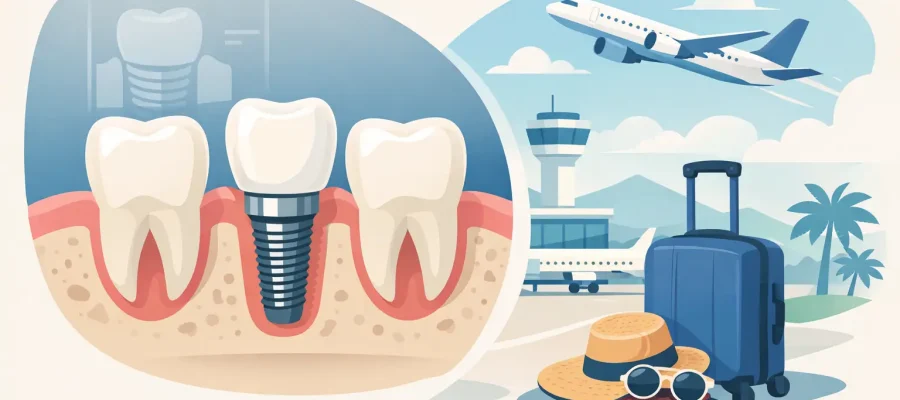
You can leave the clinic with a fixed tooth or fixed bridge the same day, but the real question is what happens next when your return flight is already booked. If you are asking are immediate implants safe for travel, the honest answer is yes for many patients, but only when the case selection, surgical stability, and travel timing are handled with discipline.
That distinction matters. Immediate implants are designed for speed, but they are not rushed treatment. They work best when the implant is placed into the right bone, with the right insertion torque, under the right bite conditions, and with a temporary restoration that protects healing instead of overloading it. Travel itself is not usually the problem. Unstable planning is.
Are immediate implants safe for travel after surgery?
In well-planned cases, most patients can travel safely after immediate implant placement. For many international patients, this is already part of the treatment model. They arrive, complete digital planning, surgery, and temporary restoration in a tightly managed sequence, then fly home with aftercare instructions and a clear follow-up schedule.
What makes that safe is not luck. It is the combination of medical screening, precise imaging, careful implant placement, and a temporary tooth or bridge designed to avoid excessive pressure during early healing. Immediate implants can look finished very quickly, but biologically they still need time to integrate with the bone.
That is why the answer is never a blanket yes for everyone. A healthy non-smoker with strong bone, controlled bite forces, and a single front-tooth implant is different from a patient with active gum disease, uncontrolled diabetes, heavy grinding, or a full-arch case under major functional load. Both may still be candidates, but the travel plan and healing strategy will not be identical.
What actually determines travel safety
The first issue is primary stability. This means how firmly the implant is anchored at the time of placement. If the implant achieves strong initial stability, the surgeon has far more confidence in giving you a temporary tooth or immediate fixed bridge and clearing you for travel. If the stability is borderline, the safer path may be a more protective temporary solution or a longer local stay.
The second issue is whether the restoration is immediate loading or immediate placement without functional loading. Patients often hear these terms as if they mean the same thing. They do not. An implant can be placed immediately after extraction, but the temporary tooth may be designed to stay out of heavy biting contact. That subtle difference protects the implant during its most vulnerable phase.
The third issue is the complexity of surgery. A straightforward single implant is one travel conversation. Full-arch treatment, multiple extractions, bone grafting, or sinus lift procedures create a different recovery profile. These cases can still be compatible with international travel, but they require tighter scheduling, more detailed medication planning, and more realistic expectations about swelling, speech adaptation, and comfort in the first days.
The first 72 hours matter more than the flight itself
Most concerns patients have about flying are really concerns about early healing. Mild swelling, tenderness, and some bruising are normal after implant surgery. Those effects are usually most active in the first 48 to 72 hours. That is why many premium clinics build a short recovery window into the treatment itinerary instead of sending patients directly from the dental chair to the airport.
A flight does not automatically damage an implant. Cabin pressure is not the central issue for most straightforward implant cases. The bigger concern is whether you are traveling too soon to manage swelling comfortably, whether bleeding has fully settled, and whether you have had enough time for the team to check the temporary restoration, bite balance, and soft-tissue response before departure.
This is where a managed treatment-and-travel pathway makes a real difference. When your hotel, transfers, appointments, and review visits are coordinated around the surgical timeline, the experience feels controlled rather than compressed.
When immediate implants are not the best fit for a traveler
The premium answer is not to promise immediacy to every patient. It is to choose it when the biology supports it.
If there is active infection that compromises the implant site, insufficient bone for stable anchorage, severe parafunctional habits like clenching, or medical factors that slow healing, the safest plan may involve staging the treatment. That can mean extraction and site preservation first, then implant placement later. It may also mean placing the implant but delaying a visible temporary if the bite cannot be controlled safely.
For image-driven patients, that can sound disappointing at first. But the better luxury outcome is a result that lasts, not a fast decision that creates avoidable risk. Speed is valuable only when it protects the final smile rather than gambling with it.
What to ask before you book your trip
If you are comparing clinics abroad, ask how they decide whether immediate implants are safe for travel in your specific case. You want more than a marketing promise. You want a clinical framework.
Ask whether your plan is based on 3D imaging, whether the surgeon expects immediate loading or a protected temporary, how many nights you should stay after surgery, and what happens if the implant does not reach the required stability for same-day restoration. A serious clinic will answer clearly and without pressure.
You should also ask about contingencies. If swelling is heavier than expected, if a temporary crown needs adjustment, or if you feel bite pressure before your flight, can the team see you quickly? Precision dentistry is not just the procedure itself. It is the system around it.
Travel tips after immediate implants
Once you are cleared to travel, the goal is simple: protect the site and avoid unnecessary stress during early healing. Keep your medication schedule consistent, stay hydrated, and follow the food instructions exactly. Most problems after immediate implants do not come from flying. They come from chewing too aggressively, touching the area, skipping hygiene guidance, or treating a temporary tooth like a final one.
If you have a full-arch temporary bridge, your diet matters even more. Soft foods are not a suggestion. They are part of implant protection. If you grind your teeth, wearing any prescribed night protection once your team allows it becomes part of preserving the result.
It is also smart to travel with a written aftercare plan, your medication list, and a direct contact method for the clinic. Confidence comes from knowing who to message if something feels off.
Are immediate implants safe for travel for full-arch patients?
They can be, and many full-arch patients do travel internationally for immediate fixed teeth. But this is where planning has to be especially sharp. Full-arch treatment is not just surgery. It is surgery, prosthetic design, bite control, swelling management, speech adaptation, and staged follow-up.
For the right candidate, the payoff is significant. You can arrive with failing teeth or unstable dentures and leave with fixed teeth immediately, which is a major quality-of-life upgrade. But the temporary bridge still has a job to do during healing. It provides aesthetics and function while protecting the implants from overload.
That means your travel window should be built around review appointments, not just the surgery date. Patients with major events coming up often focus on how fast they can leave. The better question is whether the timeline gives the clinical team enough space to refine the bridge, verify comfort, and make sure the healing response is on track.
Why premium clinics treat travel as part of the procedure
For international dentistry, logistics are not separate from safety. They are part of it. Airport transfers, hotel proximity, translation support, and tightly sequenced appointments reduce stress and reduce missed steps. That is particularly valuable when the treatment is immediate and the schedule is short.
At a clinic built around international smile makeovers and implant workflows, the experience should feel engineered from scan to departure. That is the standard patients expect from DRGO Smile Clinic and from any serious destination provider competing at the top end of cosmetic and implant dentistry.
A polished patient journey does not replace clinical skill, but it supports it. When everything around the surgery is organized, patients recover better, understand instructions more clearly, and leave with fewer surprises.
The right answer is personalized, not generic
So, are immediate implants safe for travel? Often, yes. But only when the implant is stable, the temporary is properly designed, the case has been screened carefully, and the travel plan respects the biology of healing.
If a clinic tells every patient they can fly immediately with no caveats, that is not confidence. It is oversimplification. The better answer is tailored to your bone quality, your health history, your bite, your treatment type, and how much follow-up is built into your stay.
The smartest travel dentistry decisions feel fast on the surface and extremely careful underneath. That is how a signature smile stays beautiful long after the flight home.