


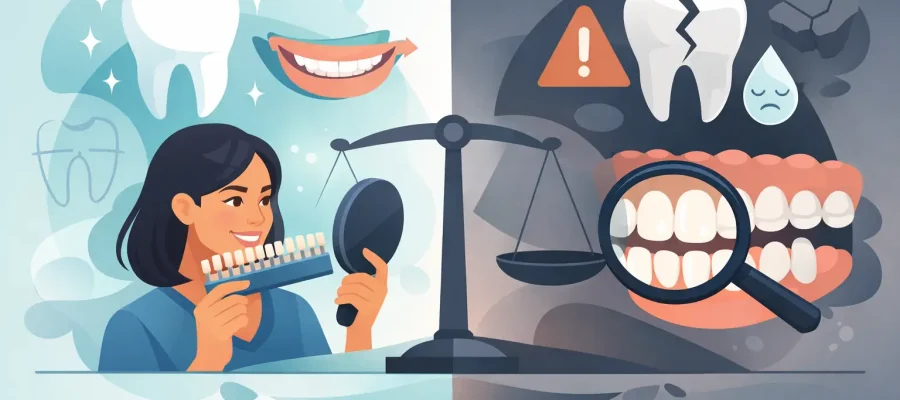
A dramatic before-and-after can make a smile makeover look instant, effortless, and perfect. Real treatment is more precise than that. The best cosmetic dentistry can transform color, shape, symmetry, and bite with impressive speed, but it still has boundaries. If you are considering veneers, crowns, whitening, gum contouring, or implants, understanding smile makeover risks and limitations is what protects both your appearance and your long-term dental health.
For patients traveling for treatment, this matters even more. Fast timelines and beautiful visuals are appealing, but a premium result depends on disciplined planning, honest case selection, and a clinic that knows when to say yes, no, or not yet.
What a smile makeover can do – and what it cannot
A well-planned smile makeover can correct stained, worn, uneven, spaced, chipped, and mildly misaligned teeth. It can improve proportions, brighten the smile line, refine gum levels, and replace missing teeth in a way that feels more balanced and camera-ready. With digital planning, temporary mock-ups, and modern materials like E-Max and zirconium, the result can be highly controlled.
What it cannot do is override biology. Cosmetic work cannot make weak enamel stronger unless the underlying issue is treated. Veneers cannot stop clenching. Crowns cannot cure gum disease. Whitening cannot change the shape of teeth. Even implants, which are one of the most advanced restorative solutions, do not behave exactly like natural teeth and still depend on healthy bone, healthy gums, and good maintenance.
That is the first limitation many patients miss: a smile makeover is not one single treatment. It is a combination of procedures, and each one has its own trade-offs.
The most common smile makeover risks and limitations
The biggest risk is overtreatment. In the wrong hands, a patient who needs conservative whitening and edge bonding may be pushed toward full crowns or aggressive veneer preparation. More dentistry is not automatically better dentistry. A premium smile should look refined, not overbuilt.
Sensitivity is another common issue. Teeth can become temporarily sensitive after whitening, enamel preparation, or crown placement. In some cases, especially where enamel is already thin or recession is present, sensitivity can last longer than expected. This does not always mean something is wrong, but it should be factored into the plan.
There is also the risk of an unnatural result. That can mean teeth that are too opaque, too white, too square, too large for the face, or too uniform to look believable. Patients often arrive with inspiration photos, but facial proportions, lip dynamics, skin tone, and bite mechanics all affect what will look elegant in real life.
Functional problems matter just as much as aesthetics. If the bite is not carefully managed, new veneers or crowns may chip, feel bulky, or create jaw discomfort. Patients who grind their teeth are especially vulnerable. The makeover may look flawless on day one and still fail early if the occlusion was not engineered correctly.
Then there is the maintenance reality. Cosmetic dentistry is not maintenance-free. Polishing, hygiene visits, night guards, stain management, and occasional replacements are part of ownership. That does not make treatment a poor investment. It simply means longevity depends on habits as much as materials.
Risks by treatment type
Veneers and crowns
Veneers are excellent for reshaping the visible surface of teeth, but they are not reversible in the practical sense once tooth preparation is done. Even minimal-prep designs usually commit you to future maintenance and eventual replacement. Crowns involve more coverage and are useful when teeth are structurally compromised, but they also require more reduction than veneers.
The limitation here is simple: these restorations improve appearance and structure, but they do not make a neglected tooth low-risk forever. Margins can stain, bonding can fail, and porcelain can chip under pressure. Material choice matters too. E-Max offers beautiful translucency, while zirconium can be preferred when strength is a higher priority. The right answer depends on your bite, parafunctional habits, and visual goals.
Teeth whitening
Whitening is the least invasive option, but expectations can become unrealistic quickly. It works well on many extrinsic and age-related stains, yet it does not whiten crowns, veneers, fillings, or every type of deep discoloration. Tetracycline staining, internal discoloration, and very dark teeth may not respond evenly.
This is one of the clearest examples of limitation over risk. Whitening is safe when properly supervised, but it cannot deliver a veneer-level redesign of color and shape.
Gum contouring and gum aesthetics
Gum reshaping can improve balance and make teeth appear longer or more symmetrical. The risk is removing too much tissue or misjudging the biologic width, which can compromise comfort and healing. Some gummy-smile cases also involve jaw position or lip movement, not just excess gum tissue. In those cases, contouring alone may not solve the issue.
Dental implants
Implants can be life-changing, especially for missing teeth or full-arch rehabilitation. They also carry the most medical variables. Implant success depends on bone volume, systemic health, smoking status, bite forces, and hygiene. Immediate loading can be an excellent option in the right case, but not every patient is a candidate for fixed teeth immediately.
The limitation is not only surgical. Implant restorations require careful aesthetic planning, especially in the front of the mouth where gum architecture and smile line exposure are unforgiving. A stable implant can still look unnatural if the emergence profile, tissue support, or tooth proportions are off.
Why some patients are not ideal candidates yet
A strong clinic does not treat every patient on the same timeline. Some need preparation before the makeover itself. Active gum disease, untreated decay, severe clenching, unstable bite patterns, smoking, uncontrolled diabetes, and poor oral hygiene all increase risk.
There are also cases where orthodontics should come first. If the teeth are significantly crowded or the bite is heavily misaligned, masking the problem with veneers or crowns may create a fast transformation but a weaker long-term foundation. For patients focused on speed, this can be frustrating to hear. It is still better than forcing cosmetic treatment into a case that needs correction first.
This is where digital planning becomes valuable. A 3D smile preview can show what is possible, but the ethical version of planning also shows what may need to happen before the final design can be delivered safely.
How to reduce smile makeover risks and limitations
Risk control starts with diagnostics, not marketing. High-quality photographs, digital scans, bite analysis, X-rays, and a clear review of your medical and dental history should shape the plan. If your consultation focuses only on tooth color and package price, the evaluation is incomplete.
You should also expect a conversation about trade-offs. How much tooth preparation is needed? Will temporaries be worn? What happens if you grind at night? How often might restorations need maintenance? A premium clinic should be able to explain not just the visual outcome, but the engineering behind it.
For international patients, timing matters. A same-trip transformation can be realistic, but only if the treatment sequence matches the biology. Some cases are suited to one-visit CAD/CAM crowns or immediate implant protocols. Others need staged healing. Predictability comes from selecting the right workflow, not the fastest one by default.
At DRGO Smile Clinic, this is where the luxury experience should actually mean something. VIP transfers and a five-star stay are valuable, but the real premium is disciplined planning, controlled preparation, and a smile design that looks exceptional because it was built on sound clinical decisions.
Questions worth asking before you commit
Ask what can go wrong in your specific case, not in general. Ask whether your natural teeth can be preserved with a more conservative option. Ask how your bite will be tested before final placement. Ask what happens if you are unhappy with shape or brightness at the try-in stage. Ask what maintenance is expected once you return home.
The right clinic will not be defensive about these questions. Confidence in cosmetic dentistry should come from clarity, not pressure.
The real standard for a successful makeover
The best smile makeovers are not the whitest or the most dramatic. They are the ones that still look right after the photos, after the flight home, after a year of eating, speaking, smiling, and living with them. A beautiful result should elevate your image without creating a fragile situation underneath.
If you approach treatment with clear eyes, the conversation changes. You stop asking for the biggest transformation possible and start asking for the smartest one. That is usually where the most impressive results begin.