


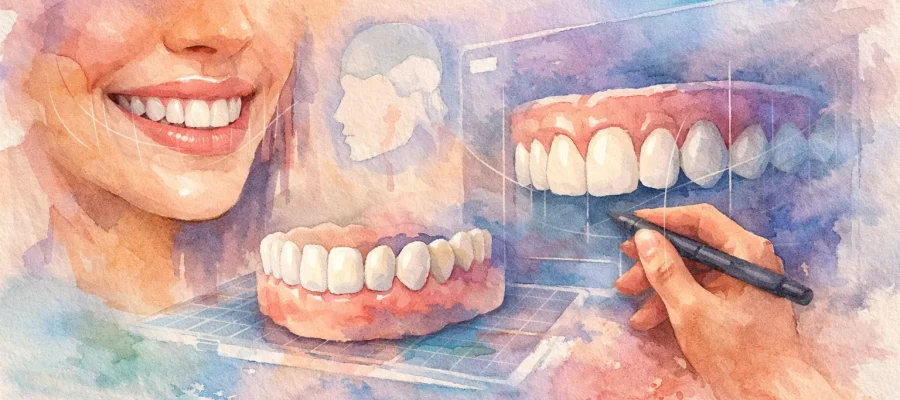
A smile makeover feels very different when you can see it before anyone touches your teeth. That is the real value of a digital smile design 3d preview. It turns a vague promise into a visible plan.
For patients flying in for veneers, crowns, implants, or a full Hollywood Smile, that matters even more. You are not just choosing a procedure. You are choosing a face-forward result, a timeline, and a clinic you trust to get it right fast. A 3D preview helps close the gap between expectation and outcome.
What a digital smile design 3d preview actually shows
A digital smile design 3d preview is a planning system that uses your photos, videos, facial proportions, bite data, and scans to simulate your future smile. Instead of looking at generic before-and-after cases, you see a version built around your own face.
That distinction is everything. A great smile is not only about making teeth whiter or larger. It is about tooth shape, edge length, gum display, midline, lip support, and how the smile looks when you speak, not only when you pose. The 3D preview brings those details into one visual model so your treatment team can design with intention.
For cosmetic cases, this often means previewing veneers, zirconium crowns, E-Max restorations, whitening effects, and gum contouring. For implant cases, it can also show how fixed teeth will restore facial balance and function when natural teeth are missing or heavily damaged.
Why patients ask for a 3D smile preview before booking
Most patients are not worried about whether dentistry works. They are worried about whether the result will suit them. That is a different question.
A digital smile design 3d preview gives you something concrete to react to. Maybe you want a brighter, more camera-ready smile, but not an overly square celebrity look. Maybe you want longer central teeth, but you do not want your smile to feel too dominant for your face. Maybe you want to correct crowding and worn edges while keeping a natural style. A preview makes those preferences visible early, when changes are easy.
This is especially useful for international patients working on a compressed schedule. If you are traveling for treatment, you want fewer surprises. Visual planning helps align the clinical team and the patient before the prep stage begins, which supports faster, more predictable delivery once you arrive.
How the process works
The process starts with records. That usually includes high-quality facial photos, close-up intraoral images, digital scans, and sometimes short videos of you smiling and speaking. Those videos matter because a smile that looks good in a still image can behave differently in motion.
Next comes analysis. The dentist studies facial symmetry, lip line, tooth proportions, bite relationship, gum levels, and the way your smile frames the lower face. This is where cosmetic planning becomes more than software. The technology is powerful, but the quality of the result still depends on clinical judgment and aesthetic discipline.
Then the proposed design is built. Tooth length, width, contour, and arrangement can be adjusted to fit your face and goals. In some cases, you may compare a softer natural style against a brighter, bolder Hollywood Smile approach. If the case involves implants or full-mouth rehabilitation, function becomes a bigger part of the design conversation. The goal is not just visual impact. It is stable biting, comfortable speech, and a result that can hold up over time.
Once the design is approved, it can guide mock-ups, temporaries, and final restorations. That is the practical advantage. The 3D preview is not just for marketing. It is a working blueprint.
What a good preview can tell you – and what it cannot
A strong 3D preview can tell you whether the direction is right. It can show if the teeth feel too long, too flat, too rounded, too bright, or too narrow for your face. It can help you decide between natural refinement and a higher-impact makeover. It can also expose issues that need to be addressed first, such as uneven gums, bite instability, missing support, or old restorations that will affect the final design.
What it cannot do is promise an identical real-world result down to every reflection and texture. Dentistry is still biology, materials, and hands-on execution. Final ceramics, soft tissue response, and functional adjustments all influence the finished look.
That is why the best clinics do not oversell the preview as a magic guarantee. They use it as a precision planning tool. It improves predictability, but it works best when paired with strong preparation protocols, high-end materials, and an experienced restorative team.
Who benefits most from digital smile design 3D preview planning
This technology is especially valuable for patients getting visible, high-commitment treatment. Veneers and crowns are the obvious examples because shape, brightness, and proportion matter so much. But it is just as useful for patients replacing multiple teeth or rebuilding a full arch.
If you have an event deadline, such as a wedding, media shoot, business launch, or major social milestone, a preview helps you move faster with more confidence. It is also ideal if you are detail-oriented and want more control over the design before treatment starts.
Patients with previous dental work often benefit too. When old crowns, uneven bonding, worn edges, or shifting teeth have created a patchwork look, the preview helps reset the case around a unified final outcome instead of isolated fixes.
Why this matters in smile tourism
Travel dentistry works best when the pathway is tightly managed. The more planning done upfront, the smoother the treatment visit tends to be.
For international patients, a digital smile design 3d preview reduces uncertainty before flights, hotel stays, and procedure days are booked. It helps answer the questions that usually slow decisions down. Will the result look natural on me? Can we make it more refined or more dramatic? How many teeth actually need treatment? Can implants and cosmetics be coordinated in one plan? Is the timeline realistic?
This is where a clinic with both advanced dentistry and concierge structure has an advantage. At DRGO Smile Clinic, the design phase supports the same promise as the treatment itself: speed with control, aesthetics with discipline, and a smoother experience from consultation to final reveal.
The trade-offs to understand before saying yes
A preview is a major advantage, but it should not be the only reason you choose a clinic. Beautiful visuals are easy to present. What matters is whether the provider can translate the plan into durable dentistry.
Ask how the preview connects to the actual workflow. Will the same team that designs the case prepare the teeth and deliver the restorations? Is the bite being evaluated, or only the front-facing look? Are material choices being discussed based on your goals, or is every patient being pushed into one solution? Those details affect the result more than the screen image alone.
It also depends on the case. A simple whitening and bonding plan may need less digital design than a full veneer case. A patient with gum asymmetry, clenching, tooth loss, or bone issues may need more diagnostics and more staged treatment than the preview first suggests. Good planning is not about making every case look easy. It is about showing the smartest route to the outcome you want.
What to look for in your own preview consultation
When you review a 3D smile preview, pay attention to whether the design looks balanced with your facial features, not just brighter than before. Ask why specific tooth shapes were chosen. Ask if gum levels, bite forces, and speech were considered. Ask what can still be refined before final restorations are made.
The right consultation should feel collaborative, but not vague. You should leave with a clear visual direction, a realistic timeline, and an explanation of what happens next. If the clinic can only show pretty renderings without linking them to clinical steps, that is a red flag.
The best smile makeovers are not based on guesswork or pressure. They are engineered. A digital smile design 3d preview gives you the chance to see the destination before you commit to the journey, which is exactly how high-value dentistry should feel.