


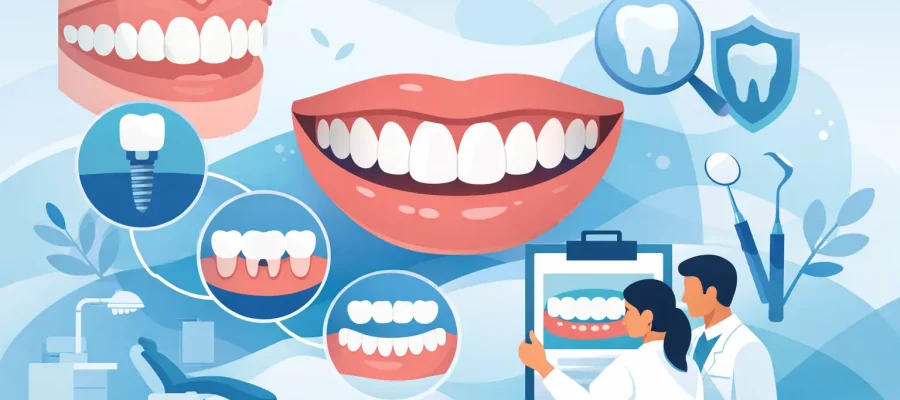
When your teeth are worn down, missing, breaking, or simply no longer working as a system, the question is not which single procedure you need. It is which full mouth reconstruction options guide actually helps you rebuild function, appearance, and long-term stability in the right order. That is where smart planning matters most.
Full mouth reconstruction is not one treatment. It is a customized combination of restorative, surgical, and cosmetic procedures designed to rebuild the entire bite. For some patients, that means implants and fixed bridges. For others, it means crowns, veneers, gum contouring, and bite correction. The right plan depends on what is damaged, what can still be saved, and how fast you want to reach a confident final result.
What full mouth reconstruction really includes
A true reconstruction starts with diagnosis, not guesswork. The teeth, gums, bone levels, jaw function, bite position, and smile line all need to be evaluated together. If one area is treated in isolation, the final result may look good for a moment but fail under pressure.
Most patients seeking full reconstruction fall into one of a few categories. Some have multiple missing teeth and need fixed replacements. Some have severe wear from grinding, acid erosion, or old dentistry that no longer fits. Others want a complete aesthetic reset because crowns, fillings, gum levels, and tooth shapes are inconsistent. In many cases, function and appearance are both part of the same problem.
This is why a premium clinic treats reconstruction as an engineered process. Digital planning, 3D smile previews, and bite analysis help define what the final smile should look like before treatment begins. That creates more predictability, especially for international patients who want a clear plan, a defined timeline, and fewer surprises.
Full mouth reconstruction options guide for common cases
The best full mouth reconstruction options guide does not push every patient toward the same solution. It separates cases by what the mouth needs structurally.
If you have multiple missing teeth
Dental implants are often the strongest option when teeth are missing and you want fixed, long-term support. A single implant can replace one tooth, while several implants can support bridges or full-arch restorations. If most or all teeth in one arch are missing or beyond saving, All-on-4 or All-on-6 can be the most efficient path. These systems use four or six implants to support a full fixed set of teeth.
The benefit is stability. Fixed implant teeth feel more secure than removable dentures and usually offer better bite force and confidence. The trade-off is that implants require enough bone or added procedures such as bone grafting or sinus lift when support is limited. Treatment timing can also vary. Some patients qualify for immediate fixed temporary teeth, while others need healing time before the final bridge.
If your natural teeth can still be saved
When the teeth are structurally present but heavily worn, broken, root-treated, or uneven, crowns are often central to reconstruction. Full coverage crowns can rebuild shape, strength, and bite position. Zirconium crowns are popular in larger restorative cases because they combine durability with a clean aesthetic finish.
In more visible areas, E-Max restorations may be considered where the case allows. These can deliver a more refined translucent look, but they are not always the first choice for every high-load bite. That is one of the most important realities in reconstruction – the most aesthetic material is not automatically the best material for every tooth.
If the issue is heavily aesthetic but function is stable
Some patients ask for full mouth reconstruction when what they really need is a controlled smile makeover. If the bite is healthy, roots are sound, and there is no major structural collapse, veneers, selective crowns, whitening, and gum aesthetics may create the transformation they want without turning every tooth into a major restorative case.
This approach is more conservative, but only when the fundamentals are strong. Veneers should not be used to hide deeper bite problems that need reconstruction first.
If your bite has collapsed
A collapsed bite happens when tooth wear, missing back teeth, or old restorations reduce the vertical dimension of the face and overload the remaining teeth. These cases need careful rebuilding of the bite before the final smile is designed.
That often involves temporary restorations first. The patient tests a new bite position, speech is checked, chewing comfort is monitored, and then the definitive restorations are made. It takes discipline, but it protects the final result.
How treatment is usually staged
Reconstruction works best when the sequence is clear. The first phase is planning. Records are taken, scans are reviewed, and the case is designed around function, aesthetics, and timing. A digital mockup or smile preview can help you see the direction before commitment.
The second phase is stabilization. This may include removing failing teeth, treating infection, gum therapy, root canal retreatment, or placing implants. In some cases, temporary teeth are delivered the same day to maintain appearance and confidence.
The third phase is smile and bite design. Temporary restorations, mockups, or trial smiles can be used to refine shape, length, and bite balance. This matters because reconstruction is not only about replacing teeth. It is about making the entire mouth work comfortably.
The final phase is definitive placement. Crowns, bridges, veneers, or fixed implant restorations are delivered once the design has been tested and the tissues are ready. At a clinic built around fast digital workflows, some stages can be compressed dramatically, especially for cosmetic and crown-based cases.
Choosing between implants, crowns, and veneers
Patients often compare these as if they are interchangeable. They are not. Implants replace missing teeth. Crowns rebuild damaged teeth. Veneers refine visible surfaces when the underlying tooth is healthy enough. The right reconstruction may use all three.
If a tooth is cracked deep below the gum or repeatedly failing, saving it may cost more time and money than replacing it strategically. On the other hand, removing salvageable teeth too quickly can be unnecessarily aggressive. The best clinics are selective. They preserve what is worth preserving and replace what weakens the long-term result.
This is where diagnostics change everything. A treatment plan should explain not just what is being recommended, but why each tooth is being saved, crowned, veneered, extracted, or replaced with an implant.
Timeline, travel, and what international patients should expect
For patients traveling from the US or other countries, timing is a major decision factor. Not every full reconstruction can be finished in one visit, but many parts of the process can be accelerated with modern planning and in-house digital workflows.
Crown and veneer cases may move quickly if the mouth is healthy and the plan is straightforward. Implant cases are more variable. Immediate implants and same-day temporary teeth are possible for the right candidate, especially in full-arch treatment, but the final restoration may still require a second stage after healing.
That is why clear case selection matters more than marketing promises. Speed is valuable only when it does not compromise fit, bite, or tissue health. A well-run clinic should tell you exactly what can be completed now, what needs healing, and what your second visit would involve.
At DRGO Smile Clinic, this kind of planning is paired with a concierge pathway that reduces friction for international patients. That means the clinical plan and the travel plan are built together, which makes the experience feel more controlled from arrival to final fitting.
Cost versus value in a full reconstruction
Patients rarely ask only about price. They want to know what they are buying. In a reconstruction case, value comes from planning accuracy, material quality, laboratory precision, clinician experience, and how well the final bite is engineered.
A cheaper plan can become expensive if restorations break, the bite feels wrong, or implants are placed without enough restorative foresight. A higher-end plan should give you more than nicer photos. It should give you a stronger diagnosis, cleaner execution, and a result that feels stable in daily life.
The right question is not What is the cheapest way to rebuild my mouth? It is Which plan gives me the safest, most attractive, most predictable result for my situation?
What to ask before you commit
Before choosing any provider, ask to see how the case will be planned, not just how it will be sold. You should know whether your treatment includes digital smile design, temporary prototypes, implant planning, bite analysis, and clear staging. You should also understand whether the recommendation is conservative, aggressive, or somewhere in between.
A strong clinic will be able to show you the logic of the plan. If all teeth are being crowned or extracted, there should be a clinical reason. If your treatment is marketed as fast, there should be a detailed explanation of what is realistically completed in that timeline.
The best reconstruction is the one that still makes sense five years later. A beautiful smile matters. So do comfort, speech, hygiene, and confidence when you chew without thinking about your teeth.
If you are considering a full mouth rebuild, look for a plan that treats your smile like a system, not a set of isolated fixes. That is where real transformation starts – with precision first, and beauty built on top of it.