


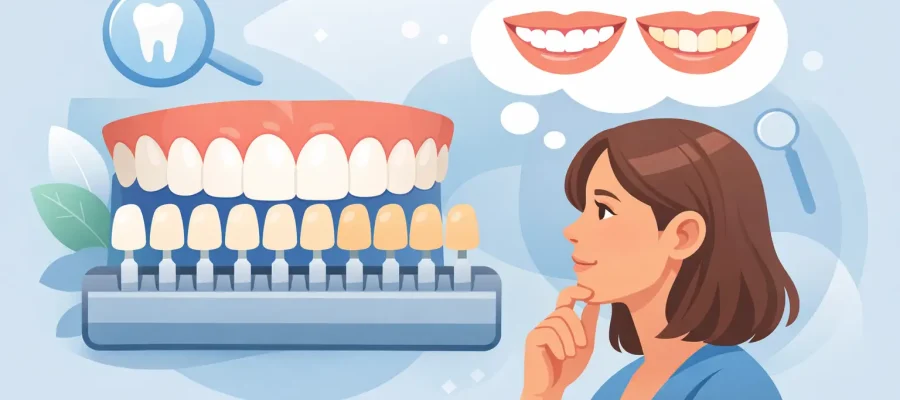
A veneer shade can make your smile look expensive, natural, youthful – or obviously done. That is why patients asking how to choose veneer shade are usually not asking for a color chart alone. They are asking how to get a smile that looks right on their face, in daylight, on camera, and years from now.
The answer is not “pick the whitest.” The right veneer shade is a design decision. It should match your features, your lifestyle, and the level of transformation you actually want. Some patients want polished and believable. Others want a brighter, red-carpet finish. Both can work. The key is choosing deliberately, not emotionally.
How to choose veneer shade without making your smile look fake
The biggest mistake is treating shade as a standalone choice. Veneers are never just color. Brightness, translucency, tooth shape, surface texture, and symmetry all affect whether a smile looks natural or artificial. A very white veneer can still look refined if the proportions and finish are realistic. A softer shade can still look flat if the design is bulky or opaque.
This is why experienced cosmetic dentists look at the full composition of the smile, not only the shade tab. Your skin undertone matters. The whites of your eyes matter. Your lip line matters. Even the size of your teeth changes how white a smile appears. Larger veneers reflect more light, so the same shade can look more intense on one patient than another.
Age also matters more than most people expect. Ultra-bright veneers on a very mature face can sometimes create contrast that feels unnatural. That does not mean older patients need dull teeth. It means the most elegant result usually balances brightness with softness and depth. For younger patients, a cleaner white can look effortless because the rest of the face supports that level of brightness.
Start with the look you want, not the shade code
Before discussing shade names, define the outcome. Do you want your smile to look naturally attractive, obviously enhanced, or camera-ready bright? Those are different targets, and each one points to a different shade range.
A natural luxury result usually sits in a bright but believable zone. It lifts the smile, improves uniformity, and still feels like it belongs to you. This is often the best option for professionals, patients who are frequently in close conversation, and anyone who wants compliments without people immediately noticing veneers.
A statement smile pushes brightness further. This is common among creators, public-facing professionals, brides and grooms, and patients specifically asking for a Hollywood Smile. The result can be striking and beautiful, but it has to be planned with precision. If the shade is too white for your complexion or the veneers are too opaque, the smile can lose dimension.
Patients often change their mind once they see a digital preview or a mock-up. What sounds perfect in theory can feel too aggressive when it is placed on your own face. That preview stage is where good planning protects you from regret.
Skin tone, eye whites, and facial contrast
If your complexion has warm undertones, very icy veneers can sometimes look disconnected. A slightly softer bright white often blends better and still looks premium. Cooler undertones can usually carry crisper whites more easily. Neither rule is absolute, but they help guide the direction.
The whites of your eyes are another useful reference. When veneers are dramatically brighter than the eyes, the contrast can read as artificial. The best smiles often look bright in harmony with the face, not brighter than everything around them.
Dark hair, defined brows, and strong facial features can support a bolder smile. Softer coloring may call for a more balanced white. The goal is not restraint for its own sake. It is visual coherence.
Your natural teeth still matter
If you are getting a full smile makeover, there is more freedom because every visible tooth can be designed together. If only some teeth are being restored, shade matching becomes more delicate. In those cases, going too bright can make the untreated teeth look darker and less healthy by comparison.
This is one reason whitening is often done before veneers when natural teeth will remain visible. It gives the dentist a cleaner starting point and allows the final restorations to be matched more precisely.
The shades patients usually consider
Most cosmetic veneer conversations revolve around a spectrum rather than one exact shade. On one side, there are natural bright tones with warmth and translucency. In the middle, there are clean aesthetic whites that look noticeably improved but still realistic. On the far end, there are extra-bright “Hollywood” shades that create maximum impact.
None of these is automatically better. It depends on your priorities.
If you want a smile that works in every setting – business meetings, daylight photos, close-up conversation – a balanced bright white is often the safest and smartest choice. If your personal brand is built around visibility, beauty content, luxury presentation, or entertainment, you may prefer a stronger white that reads well on camera.
The trade-off is simple. The whiter you go, the more disciplined the rest of the design has to be.
How to choose veneer shade with your dentist
This decision should never happen in a rush. A proper shade selection process is part aesthetic planning, part clinical judgment.
First, your dentist should assess your face, gum display, lip dynamics, and existing tooth condition. Then the discussion should move to references: what kinds of smiles you like, what level of brightness you are drawn to, and what you definitely want to avoid. “Natural but better” means different things to different patients. Visual examples reduce confusion fast.
Next comes previewing. This is where modern smile design changes everything. Instead of guessing from a small shade tab, you should be able to see how proposed veneers will sit within your full facial expression. Digital Smile Design and 3D planning are especially valuable here because shade only makes sense in context.
At DRGO Smile Clinic, this preview-led approach is a major advantage for international patients who want speed without taking unnecessary risks. If you are traveling for treatment, certainty matters. You want to know the smile is being engineered around your face, not chosen from a generic preference list.
Material changes the way shade looks
Veneer material affects the final result. E-Max veneers are popular because they can deliver brightness while still maintaining lifelike translucency. That means the smile catches light in a natural way rather than looking chalky.
This matters because two veneers with the same target shade can look different depending on thickness, layering, and the tooth underneath. A dentist may recommend a certain shade not because it is darker or lighter on paper, but because it will perform better once fabricated and bonded.
Temporary mock-ups are underrated
If you are unsure, a mock-up or trial smile can be the most useful step in the process. It lets you judge the overall effect in motion – speaking, smiling, and seeing yourself from different angles. Patients often notice details here that they cannot catch in static photos.
This stage is especially valuable if you are torn between “natural bright” and “very white.” In many cases, the face gives the answer immediately.
Common mistakes when choosing veneer shade
One common mistake is choosing based only on social media photos. Lighting, filters, editing, and makeup can make shades appear more flattering online than they do in real life. A smile that looks amazing in a studio shot may feel too stark in daylight.
Another mistake is copying someone else’s veneers. Their facial structure, skin tone, lip shape, and tooth proportions are different from yours. The best veneer shade is not the one you admired on another person. It is the one that makes sense on your face.
The third mistake is focusing only on whiteness. Patients often think brighter automatically means younger, cleaner, and more expensive. Sometimes it does. Sometimes it just means flatter. Real beauty in cosmetic dentistry comes from controlled brightness, natural depth, and precise proportions.
The best veneer shade is the one you still love later
A good shade choice should feel exciting now and comfortable long term. Trends shift. Your photos, meetings, travel, and everyday life continue. The smartest smiles are designed to hold up everywhere.
If you are deciding how to choose veneer shade, think beyond “white enough.” Ask whether the smile fits your image, your features, and your future. When shade is selected with strategy, the result does not just look better. It looks like you, upgraded.
The right veneer shade should make you stop thinking about your teeth and start using your smile like it was always meant to be seen.