


A chipped front tooth two weeks before your wedding, a dark tooth that shows in every photo, or worn edges that make your smile look older than you feel – this is when the question of dental crowns vs bonding becomes real. Both treatments can improve shape, color, and symmetry fast. But they solve different problems, involve different levels of preparation, and create very different long-term results.
If your goal is not just to fix a tooth but to engineer a more polished, camera-ready smile, the right choice depends on what the tooth needs structurally, how dramatic a change you want, and how long you expect that result to last. Bonding is conservative and efficient. Crowns are more comprehensive and more powerful. The best option is the one that matches the condition of the tooth and the standard of finish you expect.
Dental crowns vs bonding at a glance
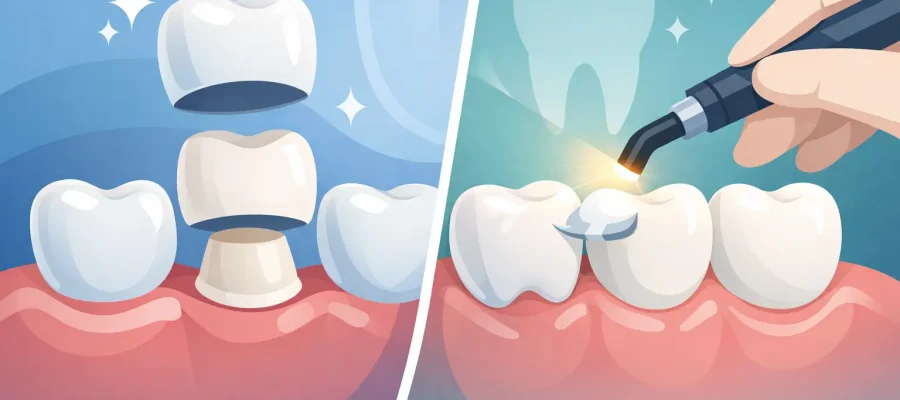
Bonding uses a tooth-colored composite resin that is sculpted directly onto the tooth. It is ideal for smaller corrections like chips, minor gaps, light reshaping, or masking limited discoloration. The dentist places the material in layers, shapes it, hardens it with a curing light, and polishes it to blend with the surrounding enamel.
A crown is different. It covers the entire visible part of the tooth like a custom-made shell. Crowns are used when a tooth is weakened, heavily restored, structurally compromised, or needs a major cosmetic transformation. Materials matter here. High-end crowns such as zirconia or E-Max are designed for strength, translucency, and a more refined aesthetic finish.
That difference – adding to part of a tooth versus fully covering it – is what drives almost every other trade-off, from durability to cost to treatment planning.
When bonding makes sense
Bonding is often the right move when the tooth is healthy overall and the issue is relatively small. A minor chip on an incisor, slightly uneven edges, a narrow gap, or a tooth that needs subtle contouring can often be corrected beautifully with composite.
The biggest advantage is conservation. Very little, if any, natural tooth structure needs to be removed. For patients who want an upgrade without committing to a more invasive restoration, that matters. Bonding is also quick. In many cases, it can be completed in one visit.
It is also the more budget-friendly option upfront. If you have one or two small cosmetic concerns and want a clean improvement without extensive treatment, bonding can deliver strong value.
But there are limits. Composite resin is not as strong or stain-resistant as premium ceramic. Over time, it can chip, lose polish, or pick up discoloration from coffee, tea, red wine, and smoking. It can look excellent when done well, but it usually does not hold its finish as long as a ceramic restoration.
For image-conscious patients who want a very bright, highly polished, long-lasting result, bonding may feel like a smart short-term fix rather than the final answer.
When crowns are the better investment
Crowns are usually the stronger option when the tooth needs more than a surface correction. If a tooth is cracked, heavily filled, root canal treated, worn down, misshapen, or significantly discolored, a crown can restore both beauty and structural stability.
This is where crowns move beyond simple repair and into full smile architecture. A crown lets the dentist control color, shape, length, alignment illusion, and light reflection with much more precision than bonding. That makes crowns especially attractive for patients planning a visible smile upgrade for business, media, social content, or major life events.
They also tend to last longer under the right conditions. Ceramic materials such as zirconia and E-Max are built for durability and aesthetics. They resist staining better than composite and maintain a more stable surface gloss over time.
The trade-off is preparation. Crowns usually require reshaping the tooth so the restoration can fit correctly. That makes the decision more significant. You choose crowns when you want a stronger, more complete transformation and the tooth condition justifies it.
Aesthetics: natural touch-up or full smile control
In a direct comparison of dental crowns vs bonding, appearance is often where patients make their final decision.
Bonding can look very natural, especially for small corrections. A skilled dentist can shape and shade the resin to blend smoothly with neighboring teeth. For subtle improvements, it can be hard to spot.
Crowns offer more control and more consistency, especially when several teeth are being improved together. If your goal is a brighter, more symmetrical, more camera-ready smile, crowns usually create the cleaner finish. Ceramic reflects light in a way that more closely mimics premium enamel, and the result tends to stay polished longer.
This is especially relevant when patients want a signature smile rather than a simple repair. If the plan includes changing multiple teeth at once, correcting wear, improving proportions, and creating a uniform color, crowns are often the more predictable route.
Durability and maintenance
Bonding is not fragile, but it is more maintenance-sensitive. If you bite your nails, chew ice, grind your teeth, or use your front teeth aggressively, composite can chip or wear faster. Repairs are often simple, which is a plus, but touch-ups are part of the long-term reality for many patients.
Crowns are typically more durable in everyday use. They are better suited for teeth under higher load and for patients who want restorations that can hold up well over years with proper care. That does not mean they are indestructible. Grinding, poor oral hygiene, or trauma can still damage a crown. But in general, the strength profile is higher.
Maintenance for both options still comes down to the basics: excellent brushing, flossing, regular checkups, and wearing a night guard if you clench or grind.
Cost: lower entry vs longer horizon
Bonding usually costs less at the start. That makes it attractive for smaller cosmetic fixes or for patients who want improvement now without a larger commitment.
Crowns cost more because they involve more planning, more preparation, and custom lab or CAD/CAM fabrication. But the value equation is not only about day-one price. It is also about how often the restoration may need polishing, repair, replacement, or updating.
If bonding needs repeated touch-ups over the years, the cost gap can narrow. If a crown prevents a compromised tooth from breaking further, it can become the more efficient choice clinically and financially.
The right question is not just which is cheaper. It is which treatment matches the lifespan, performance, and finish you expect.
Timing matters, especially for travel patients
For international patients, timing can decide everything. If you are flying in for treatment and want visible change on a predictable schedule, the workflow matters as much as the material.
Bonding can often be done quickly, sometimes in a single appointment. That is helpful if the case is limited and the teeth are otherwise healthy.
Crowns traditionally require more than one stage, but modern digital dentistry has changed that. With proper planning, smile design, and same-day CAD/CAM capability, selected crown cases can move much faster than many patients expect. For people balancing travel, work, and a hard event deadline, that speed and predictability can be a major advantage.
At DRGO Smile Clinic, this is exactly where planning changes the experience. Digital Smile Design, 3D previews, and one-visit crown workflows give patients clarity before treatment starts and help compress the timeline without sacrificing precision.
How dentists decide between bonding and crowns
The decision is rarely based on one factor alone. Dentists look at the amount of healthy tooth left, bite pressure, staining, old fillings, tooth position, and the level of cosmetic change requested.
If the tooth is strong and the change is modest, bonding may be ideal. If the tooth is compromised or the aesthetic demand is high, a crown is often the safer and more refined answer. Sometimes the best plan is mixed. A patient might need crowns for heavily worn or dark teeth and bonding for smaller adjustments elsewhere.
That is why a real smile plan matters more than choosing a treatment from a menu. The best cosmetic dentistry is not about selling the bigger procedure. It is about using the least aggressive option that can still deliver the result you want with confidence.
Which one is right for you?
If you want a conservative fix for a small flaw, bonding can be elegant, fast, and effective. If you want a more dramatic upgrade, longer-lasting polish, or stronger protection for a damaged tooth, crowns usually justify the investment.
The key is to think beyond the immediate repair. Ask what standard of result you want to see in photos, how long you want that result to hold, and whether the tooth needs cosmetic enhancement or true structural reinforcement. When the treatment matches the tooth and the vision, the smile looks effortless – and feels worth it every time you catch your reflection.
The smartest next step is not guessing between the two. It is getting a precise evaluation so your smile plan is built around outcome, not assumption.