


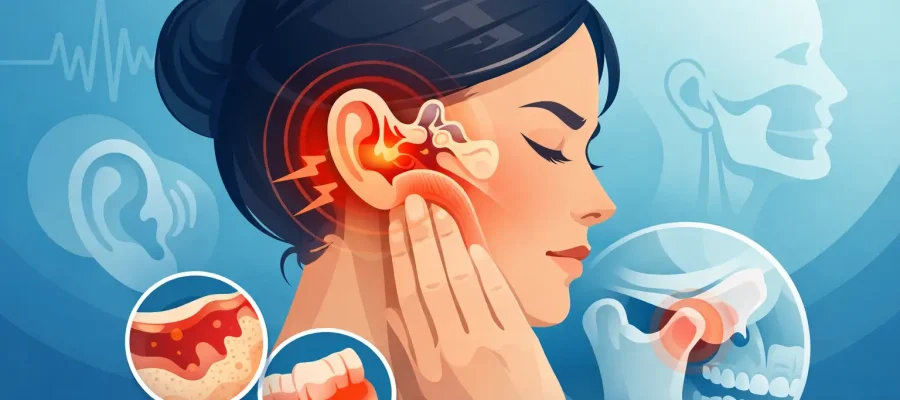
A patient may come in convinced they need a filling, a night guard, or even masseter Botox – but the real issue starts in the ear. If you have ever wondered, can an ear infection cause jaw pain, the short answer is yes. The ear and jaw sit close together, share nearby nerves and muscles, and can easily create pain patterns that feel misleading.
That overlap matters because jaw pain is not always a dental problem, and ear pain is not always an ear problem. Getting the source right is what leads to fast relief and avoids treatment you do not actually need.
Can an Ear Infection Cause Jaw Pain or Toothache-Like Pain?
Yes, it can. An ear infection can cause jaw pain because inflammation inside or around the ear can irritate the tissues and nerves that also influence the jaw joint and the muscles used for chewing. Many people describe it as a dull ache near the hinge of the jaw, pressure in front of the ear, or soreness that gets worse when chewing.
It can even feel like a tooth problem. Referred pain is common in the face. That means your brain may register discomfort in the teeth, jaw, temple, or ear even when only one area is truly inflamed.
This is one reason facial pain needs a precise diagnosis. From a dental perspective, the symptoms of an ear infection, TMJ strain, a cracked tooth, wisdom tooth inflammation, and clenching can overlap more than most patients expect.
Why the Ear and Jaw Are So Closely Connected
The jaw joint, or TMJ, sits directly in front of the ear canal. When that area becomes irritated, it is easy for pain to spread in either direction. If the ear is inflamed, the surrounding structures can become sensitive. If the jaw joint is overloaded, the discomfort can feel like it is deep in the ear.
Muscles add another layer. The masseter, temporalis, and other chewing muscles work in coordination with structures near the ear. If an ear infection changes the way you hold your jaw, sleep, or chew, those muscles may tighten and create secondary soreness.
Nerves are part of the story too. Several cranial and cervical nerves serve overlapping areas of the face, ear, and jaw. That is why the body can send a pain signal that feels broad rather than precise.
What Kind of Ear Infection Can Cause Jaw Pain?
Not every ear infection behaves the same way. A middle ear infection often creates pressure, fullness, throbbing pain, and sometimes fever or reduced hearing. That pressure can radiate toward the jaw. An outer ear infection may create more pain when touching the ear or moving the jaw, because the nearby tissues are irritated.
There are also non-infectious ear problems that may still feel like infection at first, such as fluid buildup, Eustachian tube dysfunction, or sinus-related pressure. Patients sometimes describe all of these as an ear infection, even when the cause is different. The symptom pattern matters more than the label.
If jaw pain gets sharper when opening wide, chewing steak, yawning, or clenching at night, the issue may be more TMJ-driven. If it comes with ear fullness, fever, drainage, recent cold symptoms, or sudden hearing changes, an ear condition becomes more likely.
Symptoms That Suggest the Pain Starts in the Ear
Jaw pain rarely appears in isolation when the ear is the source. There are usually extra clues. You may notice pressure inside the ear, muffled hearing, popping, ringing, tenderness around the ear, or pain that worsens when lying down. Some people also feel swollen glands below the jaw or along the neck.
In children, ear infections are even more likely to show up as vague face or jaw discomfort because they cannot always pinpoint what hurts. In adults, the picture is often mixed. You may have a mild ear problem layered on top of clenching or a stressed jaw joint.
That is where clinical judgment matters. The smartest treatment plan starts with identifying the primary driver, not just the loudest symptom.
When Jaw Pain Is Probably Not From an Ear Infection
Jaw pain can have a dental origin, a joint origin, or a muscle origin. If the pain is triggered by biting on one tooth, sensitivity to cold, visible swelling in the gums, or pain around a wisdom tooth, a dental problem is more likely. If your jaw clicks, locks, shifts, or feels tired when chewing, TMJ dysfunction or muscle overload may be the better explanation.
Grinding is another common culprit. Many high-performance professionals and frequent travelers clench without realizing it, especially during periods of stress, disrupted sleep, or long flights. That can create pain in front of the ear and across the jawline that feels deceptively similar to an ear issue.
This is why self-diagnosing facial pain can waste time. If the source is dental, you want treatment before the problem escalates. If the source is medical, a dental procedure will not fix it.
Can an Ear Infection Make TMJ Symptoms Worse?
Absolutely. Even if an ear infection is not the only issue, it can aggravate the jaw joint and surrounding muscles. Pain changes how you move. You may chew on one side, hold your jaw tighter, sleep differently, or avoid opening fully. That compensation can inflame the TMJ and create a second layer of discomfort.
The reverse is also true. A person with preexisting TMJ tension may be more aware of pain around the ear during a mild infection or congestion episode. In real clinical settings, these problems do not always arrive one at a time.
That is why a good exam looks at the full system – teeth, bite, muscles, joint motion, and ear-related symptoms – instead of treating every jaw pain case as simple TMJ.
What to Do if You Have Ear Pain and Jaw Pain Together
Start with timing and pattern. If the pain began after a cold, sinus infection, swim exposure, or sudden ear pressure, an ear problem is more likely. If it began after heavy chewing, dental work, stress, or night grinding, the jaw may be the starting point.
For short-term relief, keep your diet soft, avoid very wide opening, and do not force the jaw to stretch. Warm compresses may help muscle tension, while rest and hydration can support recovery if congestion or infection is involved. Over-the-counter pain relief may be reasonable for many adults, but it should not replace an evaluation if symptoms persist.
If you have drainage from the ear, fever, noticeable hearing loss, facial swelling, trouble swallowing, or severe pain, you should seek medical care quickly. If the pain feels focused in a tooth, the gum is swollen, or chewing triggers a sharp response on one side, a dental exam should move up the list.
Can a Dentist Tell if Jaw Pain Is From an Ear Infection?
A dentist cannot diagnose every ear condition, but an experienced dental team can often tell when the pain pattern does not fit a tooth or bite problem. That alone is valuable. Rule-outs matter.
In a focused exam, we look for signs of cracked teeth, infection, gum inflammation, bite imbalance, wisdom tooth problems, and TMJ dysfunction. We also assess where the pain is reproduced – in the tooth, the joint, the muscles, or not at all. If the dental findings are clean and the symptoms point toward the ear, the next step may be a physician or ENT evaluation.
This kind of precision is especially important for patients planning cosmetic or restorative dentistry. If you are considering veneers, crowns, implants, or a full smile makeover, underlying pain should be identified first. Premium outcomes depend on accurate planning, not guesswork.
When to Get Checked Without Waiting
Some symptoms deserve faster attention. See a doctor promptly if you have high fever, fluid or blood from the ear, rapidly increasing swelling, dizziness, severe headache, or sudden hearing changes. See a dentist promptly if you have facial swelling, a bad taste in the mouth, tooth pain that wakes you up, or difficulty biting.
If the pain has lasted more than a few days and you still cannot tell whether it is the ear or the jaw, that is reason enough to be evaluated. Lingering facial pain is one of those issues that usually becomes simpler after an exam, not before.
At a clinic focused on precise diagnosis and engineered treatment planning, such as DRGO Smile Clinic, that distinction matters. The goal is not to sell treatment for every symptom. It is to identify the true source, protect long-term oral health, and move only when the plan is clear.
The key thing to remember is this: yes, an ear infection can cause jaw pain, but jaw pain is not automatically an ear infection. The face is a crowded map of shared nerves, muscles, and joints. When the pain feels confusing, the smartest move is not to guess harder – it is to get the right set of eyes on it.