


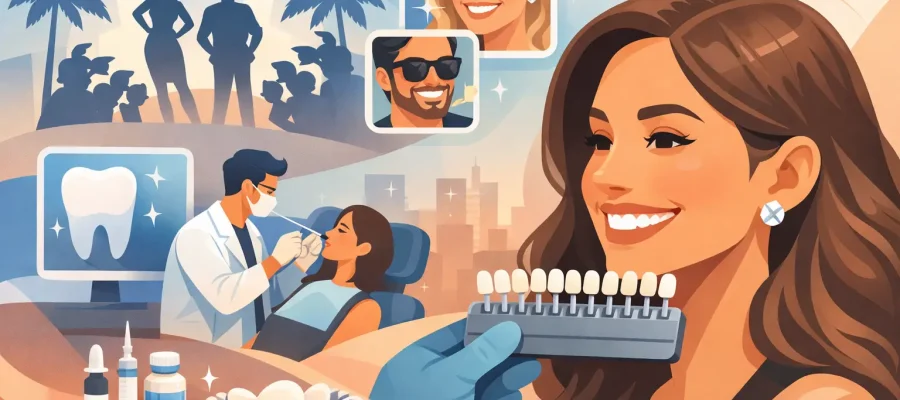
A few years ago, the celebrity look meant ultra-white, ultra-uniform teeth that announced themselves from across the room. Now, celebrity smile makeover trends are moving in a more refined direction. The new standard still reads expensive, camera-ready, and highly polished, but it also looks believable in daylight, on video calls, and in close-up content.
That shift matters if you are planning cosmetic dentistry for a wedding, public-facing career move, brand shoot, or major life upgrade. The most requested smiles today are not built around one feature alone. They are engineered around facial balance, lip support, gum display, bite stability, and the kind of brightness that looks elevated rather than artificial.
What celebrity smile makeover trends are really signaling
Celebrities rarely set trends through a single procedure. What people respond to is the finished effect – rested face, clean proportions, confident smile line, and teeth that suit the person rather than overpower them. In dentistry, that has translated into a more disciplined design approach.
Patients still want dramatic improvement. They just want it delivered with better restraint. The standout smiles now have softer anatomy, less blocky shape, more individualized texture, and shades that stay bright without drifting into opaque white. This is especially relevant for international patients who want visible transformation but do not want strangers to immediately assume they had dental work done abroad.
There is also a strong move toward treatment plans that combine aesthetics with function. A smile that photographs well but feels bulky, affects speech, or creates bite issues does not hold up. The premium tier of cosmetic dentistry now depends on precision planning, not just surface-level whiteness.
The biggest shift: natural-looking luxury
The most obvious development in celebrity smile makeover trends is the move away from the old “piano key” look. That style was easy to spot – oversized units, flat edges, very high opacity, and minimal personality. It delivered instant drama, but not always elegance.
Today, luxury is quieter. Patients are asking for smiles that are symmetrical without being identical, bright without looking fluorescent, and youthful without looking fake. That often means preserving or recreating subtle shape differences between central incisors, laterals, and canines. It may also mean choosing slimmer proportions, softer embrasures, and a shade that complements skin tone and facial features instead of dominating them.
This does not mean everyone wants subtle change. Some patients still prefer a bold Hollywood Smile, and that can work beautifully when it matches the face and the patient’s goals. The point is that customization has replaced copying. The question is no longer, “How white can we go?” It is, “What looks expensive on you?”
Digital preview culture has changed patient expectations
Social media made smile aesthetics more visible. Digital planning has made them more precise. One reason celebrity-inspired dentistry has become more accessible is that patients no longer have to commit blindly. They want to see direction before treatment starts.
That is why 3D planning and Digital Smile Design have become central to premium care. For patients traveling internationally, this is even more important. If you are flying in on a tight schedule, you want clarity on shape, length, proportion, and overall style before irreversible work begins.
A digital preview does not replace clinical judgment, but it reduces guesswork. It aligns expectations early and makes the process feel controlled. That control is a major part of the luxury experience. High-end patients are not just buying veneers or crowns. They are buying predictability.
Veneers are still dominant, but material choice matters more now
Veneers remain one of the strongest forces behind celebrity smile makeover trends, but the conversation has become more sophisticated. Patients ask more informed questions about preparation, translucency, durability, and how the restorations will behave under different lighting.
E-Max veneers continue to attract attention because they can create a bright, refined result with a natural light response. They are particularly appealing when the goal is a polished smile that does not look heavy. In other cases, zirconium-based solutions may be better when more strength or masking power is needed. It depends on the starting condition of the teeth, bite forces, and whether there are old restorations, discoloration, or structural damage to manage.
This is where trend-chasing can go wrong. The procedure that delivered a celebrity-level result for one person may not be the right answer for another. A camera-ready smile is not about choosing the most talked-about material. It is about matching the material to the case.
Gum aesthetics and facial framing are getting more attention
One of the less obvious trends is how much more focus there is on the frame around the teeth. Celebrity smiles rarely succeed on tooth color alone. The gum line, lip movement, and facial muscle balance all affect the final impression.
That has made gum contouring and gum aesthetics more mainstream in premium smile makeovers. If the teeth are beautifully restored but the gum levels are uneven, the smile can still feel off. Correcting asymmetry or excessive gum display can make a result look cleaner and more intentional.
There is also growing interest in treatments that support lower-face aesthetics, including masseter Botox in selected cases. For patients with strong jaw tension or a wider lower-face appearance linked to masseter hypertrophy, this can complement a smile makeover by refining facial proportions. It is not for everyone, and it is not a replacement for dental treatment, but it reflects a bigger pattern: the best aesthetic dentistry now considers the whole face.
Fast treatment is part of the trend – but only when the planning is strong
Speed has become a defining expectation, especially among entrepreneurs, creators, and event-driven patients. People want visible change on a schedule that fits work, travel, and public life. That is one reason same-day crowns, immediate implant protocols, and accelerated smile makeover workflows have become so attractive.
But speed only adds value when it is supported by diagnostics, design discipline, and experienced execution. Fast treatment with weak planning tends to create the exact problems premium patients want to avoid – bulky restorations, unstable bite, rushed esthetics, and disappointing photos.
The clinics that stand out are the ones that compress time without sacrificing control. CAD/CAM workflows, in-house design, high-quality imaging, and coordinated treatment sequencing make that possible. For international patients, this is especially powerful because it can turn a complex makeover into a structured, efficient trip rather than a drawn-out process across multiple visits.
Full-smile harmony is replacing single-feature perfection
Another important change in celebrity smile makeover trends is the move away from obsessing over individual teeth. Premium cosmetic dentistry now looks at how the entire smile works when the patient talks, laughs, and rests.
That includes tooth display at rest, incisal edge position, smile arc, midline, buccal corridor, and how the upper teeth relate to the lower lip. It also includes practical questions. Will the teeth look too long in motion? Will the new volume affect speech? Will the shade still look elegant in natural light?
These details separate a result that looks premium from one that simply looks expensive. The goal is not perfection in isolation. It is harmony under real-life conditions.
What patients should take from these trends
If you are considering a celebrity-style smile makeover, the lesson is not to copy a famous face. It is to expect a higher level of planning. Ask whether your smile will be designed for your facial proportions, whether you can preview the result, and whether the clinic can explain why a certain material and shape strategy fits your case.
You should also be realistic about trade-offs. Extremely white shades can look striking on camera but less natural in person. Minimal-prep options can be appealing, but they are not suitable for every alignment or color problem. Fast timelines are attractive, but not every mouth is a same-day case. Bone levels, bite condition, gum health, and existing dental work all influence what can be done well.
That is why premium treatment feels different. It is not built around a one-size-fits-all package, even when pricing is clear and the journey is streamlined. It is built around controlled transformation.
For patients traveling for care, that standard matters even more. A well-managed clinic experience should combine cosmetic expertise, surgical capability when needed, digital smile planning, and concierge coordination that removes friction from the trip. When those elements work together, the result feels less like medical tourism and more like a tightly produced personal upgrade.
At DRGO Smile Clinic, that is exactly how high-end smile design is approached – with digital precision, fast-turnaround workflows, and a signature-smile mindset shaped around the individual rather than the trend alone.
The smartest trend to follow is simple: choose the smile that still looks right when the filters are off, the camera is close, and you are seeing yourself as the best version of you.