


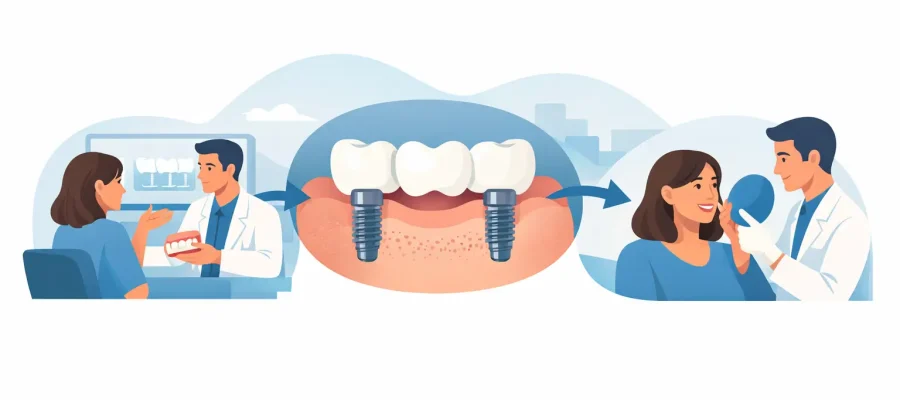
You usually know the moment a removable solution stops feeling acceptable. Meals become strategic. Photos get edited. Meetings, dates, and travel plans all come with a small layer of self-conscious calculation. That is exactly why an implant bridge patient journey example matters – it turns a major treatment decision into a clear sequence with visible milestones, realistic timing, and fewer unknowns.
For international patients, the question is rarely just, “Can I get an implant bridge?” It is, “How many days do I need away from home, what will I look like between visits, how uncomfortable is it, and when do I get the final result?” A good treatment plan answers all four before you book a flight.
A real-world implant bridge patient journey example
Picture a patient in their late 40s or 50s from the US. They have failing teeth, older dental work, or multiple missing teeth in one arch. They want fixed teeth, not a removable denture. They also want a result that looks refined, not bulky or artificial, and they want the process managed tightly enough that treatment abroad feels efficient rather than risky.
That patient usually starts with a remote consultation. They send photos, a panoramic X-ray or CBCT if available, and a short explanation of what is happening – loose teeth, chronic infections, broken bridgework, chewing difficulty, or cosmetic collapse. At this stage, the clinic is not guessing. It is assessing bone levels, gum condition, bite, smile line, and whether the patient is better suited to a few implants with a segment bridge or a full-arch solution such as All-on-4 or All-on-6.
This first phase is where expectations are set properly. Some patients are candidates for immediate implants and same-trip temporary fixed teeth. Others need extractions, grafting, or staged healing. The difference matters because speed is possible, but only when it does not compromise stability.
Before travel: planning reduces stress
The strongest implant cases are engineered before the patient lands. That means digital diagnostics, a proposed timeline, and a clear explanation of what is included in the trip. For international patients, convenience is not a bonus. It is part of the treatment experience.
A premium clinic will usually map out arrival, imaging, surgery day, review appointments, and departure around healing biology rather than around wishful scheduling. If the patient is getting an immediate temporary bridge, the design phase starts early. Smile proportions, tooth shape, lip support, and bite are considered before implants are placed, because the bridge is not just replacing teeth. It is rebuilding facial support and confidence.
Patients often ask whether they can combine treatment with sightseeing. Sometimes yes, but surgery sets the pace. A lighter social schedule is fine. Aggressive tourism right after implant placement is usually not the smartest move.
Day 1: scans, exam, and final treatment confirmation
When the patient arrives, the first in-clinic day is about verification. New scans are taken, the mouth is examined in person, and the treatment plan is confirmed against real anatomy rather than remote estimates. This is one reason experienced centers move efficiently – they plan ahead, then validate precisely.
If there are damaged teeth that cannot be saved, this is when the patient hears the final recommendation. In some cases, preserving a few natural teeth is possible. In others, removing compromised teeth and placing implants creates a stronger long-term foundation. The trade-off is emotional as much as clinical. Keeping weak teeth can feel conservative, but it may lead to more instability, more repairs, and a less predictable smile.
The patient also reviews sedation or anesthesia options, post-op instructions, and the likely shape of the temporary bridge. This conversation matters because temporary does not mean random. A well-made temporary fixed bridge protects healing, restores function, and gives the patient a preview of the final direction.
Surgery day: extractions, implants, and immediate fixed teeth
For many patients, surgery is the part they fear most and usually the part that feels more controlled than expected. If the case is suitable, any failing teeth are removed, implants are placed, and a temporary bridge is attached either the same day or within a very short window.
This is where modern workflow changes the entire experience. Instead of spending months with visible gaps or a loose removable denture, the patient can leave with fixed teeth immediately. That does not mean the final bridge is finished on day one. It means the patient leaves surgery with structure, appearance, and confidence already restored.
There are limits, though. Immediate loading depends on implant stability, bone quality, and bite forces. If the jawbone is too weak or the case is too complex, pushing for same-day fixed teeth may not be the smart move. High-end implant treatment is not about forcing speed into every case. It is about delivering speed where biology allows it.
The first few recovery days
Most patients expect extreme pain. More commonly, they experience pressure, swelling, tenderness, and fatigue for a few days. The bigger adjustment is functional. Eating becomes soft-food focused, speaking may feel slightly different at first, and smiling can feel unfamiliar simply because the face has changed quickly.
This is also when follow-up care becomes valuable. Bite checks, bridge adjustments, and hygiene guidance make a real difference. A temporary bridge that is even slightly off can feel awkward fast. Small refinements in the first days often improve comfort dramatically.
For international patients, this stage is one reason concierge planning matters. When transfers, scheduling, medication guidance, and communication are handled well, the patient can focus on healing rather than logistics.
Healing at home: the quiet middle of the implant bridge journey
The least glamorous part of an implant bridge patient journey example is the healing phase back home. It is also where long-term success is built. Over the next few months, the implants integrate with bone. The gums settle. The temporary bridge does its job while the mouth stabilizes.
This period requires discipline. Soft diet instructions matter. Smoking control matters. Night grinding matters. Even patients who want the fastest possible result need to respect healing biology. The final bridge is only as reliable as the foundation beneath it.
Remote check-ins are common during this phase. Patients send progress photos, report any pressure points or concerns, and prepare for their second visit if a final bridge is being made after integration. In some protocols, especially simpler implant bridge cases, the timeline is shorter. In full-arch cases, a few months between phases is more typical.
Return visit: designing the final bridge
The second major trip is when the case becomes refined. By now, swelling is gone, tissues are more stable, and the team can focus on precision. Impressions or digital scans are taken. The bite is analyzed more carefully. The smile design is adjusted if needed.
This is where premium treatment separates itself from basic replacement dentistry. The final bridge is not just about filling space. It is about tooth proportion, translucency, gum transition, speech, lip support, and facial harmony. If the temporary bridge gave the patient confidence, the final bridge should give them polish.
Material choice matters here. Some patients are better suited to zirconia-based strength and long-term wear resistance. Others may have esthetic priorities or bite factors that influence the design. There is no universal best bridge material – only the best match for the anatomy, forces, and visual goals in front of you.
A try-in may be done before final delivery, especially in complex full-arch cases. This step allows changes to shape, length, and phonetics before the definitive bridge is secured. Patients who care deeply about appearance usually appreciate this stage because it turns the result into something collaborative rather than generic.
Final placement: function meets aesthetics
When the final bridge is delivered, the difference is usually immediate. The smile looks more natural, the bite feels more intentional, and the overall result shifts from “restored” to “finished.” Patients often notice the little things first – clearer speech, stronger chewing, better support in the lips and lower face, and the relief of not thinking about their teeth every hour.
A final implant bridge should feel secure, balanced, and easy to maintain. It should also come with straightforward aftercare instructions. Even exceptional work needs maintenance. Professional hygiene, periodic reviews, and bite monitoring are part of protecting the investment.
At clinics built for international smile transformations, this final phase is designed to feel efficient rather than drawn out. A patient should know exactly why they are there, what happens each day, and when they can go home with confidence.
What this journey looks like when it is done right
The best implant bridge experience feels precise from the first message to the final fitting. That means no vague promises, no inflated urgency, and no one-size-fits-all treatment pressure. It means clear diagnostics, realistic timelines, and a result that balances speed, safety, and aesthetics.
At a clinic such as DRGO Smile Clinic, that level of control comes from combining implant surgery, smile design, digital workflow, and travel coordination into one managed process. For patients flying in for treatment, that integration is not just luxurious. It is practical.
If you are comparing options, focus less on marketing phrases and more on the sequence: diagnosis, candidacy, immediate vs delayed loading, temporary bridge design, healing support, and final bridge refinement. When each stage is planned properly, the treatment feels less like a leap and more like a controlled upgrade to your daily life.
The right implant bridge should do more than replace missing teeth. It should give you back a version of yourself that feels stable, polished, and ready for everything you have been putting off.