


Lose one visible tooth and the question gets real fast: do you want the quickest fixed replacement, or the one built to behave more like a natural tooth over time? When patients ask about dental implants vs. bridges: which option is better?, the honest answer is not one-size-fits-all. It depends on your bone levels, timeline, budget, smile goals, and how much dentistry the neighboring teeth already need.
For many international patients, this decision is not only clinical. It is practical and aesthetic. You may be planning treatment around a wedding, a business event, a content shoot, or a limited travel window. In that setting, the better option is the one that gives you the right blend of appearance, stability, speed, and long-term value.
Dental implants vs. bridges: which option is better for your smile?
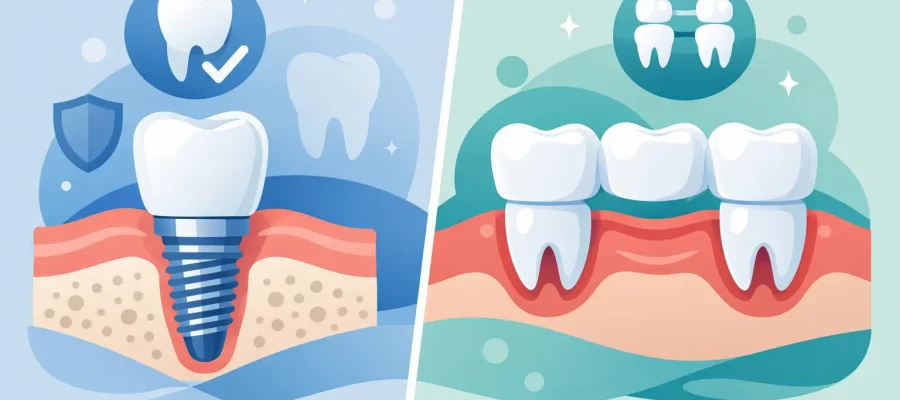
A dental bridge replaces a missing tooth by using the teeth on either side as support. Those neighboring teeth are shaped, crowns are placed over them, and the artificial tooth sits between them. The result is fixed, natural-looking, and often relatively fast to complete.
A dental implant replaces the missing tooth root as well as the visible crown. A titanium implant is placed in the jawbone, allowed to integrate, and then restored with a custom crown. In the right case, this creates a stand-alone replacement that does not rely on adjacent teeth.
If you want the shortest version, implants usually win on preservation and longevity, while bridges often win on speed and lower upfront cost. But that headline misses the details that actually matter when you are choosing treatment.
Where implants usually come out ahead
The biggest advantage of an implant is that it replaces the tooth independently. The neighboring teeth are left untouched. If those teeth are healthy, that matters. Preparing two sound teeth for a bridge means removing enamel that cannot be put back.
Implants also help preserve bone. Once a tooth is lost, the jaw in that area can begin to shrink because the root is no longer stimulating the bone. A bridge fills the gap above the gumline, but it does not stop that bone remodeling underneath. An implant can help maintain the structure of the jaw and support a more stable gumline over time.
From an aesthetic standpoint, that can be a major advantage, especially in the smile zone. A well-planned implant crown can look highly natural, and maintaining bone support often helps the result age better. For patients focused on a refined, camera-ready outcome, that long-term tissue support is not a small detail.
Implants are also easier to clean in many cases. You brush and floss around them more like natural teeth. Bridges can be very successful, but they usually require special cleaning underneath the false tooth, and hygiene becomes more technique-sensitive.
Where bridges can be the smarter choice
A bridge can be an excellent option when speed is the priority and the neighboring teeth already need crowns. In that case, a bridge is not necessarily sacrificing healthy structure. It may actually combine two needs into one treatment plan.
Bridges also avoid surgery. Some patients are not ideal implant candidates due to uncontrolled health conditions, heavy smoking, inadequate bone, or a preference to avoid grafting and healing periods. Others simply want a fixed result with fewer surgical steps.
Timeline matters too. Implants often require healing, even when immediate protocols are possible. A bridge can sometimes deliver a fixed cosmetic improvement faster, which is relevant if your treatment window is tight. For patients traveling for dentistry, that can influence the decision more than people expect.
Cost is another factor. A bridge often has a lower initial fee than a single implant with abutment and crown. If you are comparing only the upfront price, the bridge may look more attractive. The better value, though, depends on how long each solution lasts in your specific mouth and how much maintenance is likely over time.
The real trade-off: short-term convenience vs. long-term preservation
This is where the comparison becomes more useful than the sales version you often see online. Bridges can be faster and simpler. Implants can be more conservative and more future-focused. Neither is automatically better just because it sounds more advanced.
If the teeth next to the gap are heavily filled, cracked, worn, or already planned for crowns, a bridge can make excellent clinical sense. If those teeth are pristine and your bone is strong, an implant often protects more of what nature gave you.
Age is not the deciding factor by itself, but long-term planning matters more for younger patients. If you are likely to rely on this restoration for decades, preserving adjacent teeth and supporting bone becomes increasingly important. On the other hand, if surgery is not suitable or your goal is a beautifully finished fixed solution in a shorter path, a bridge can be the right answer.
Aesthetic results: what looks better?
Both can look excellent when designed properly. The better-looking option depends less on the label and more on planning, materials, bite, gum architecture, and execution.
In the front of the mouth, implants require especially careful positioning. A slightly off-angle implant or poor tissue support can compromise the final look. Bridges, in some front-tooth cases, can actually produce a more controlled cosmetic result if gum levels, spacing, or neighboring restorations are already part of the plan.
In the back of the mouth, function often drives the decision more than fine-detail aesthetics. An implant can distribute bite forces well and stand independently. A bridge can also perform well, but the long-term health of the support teeth becomes part of the equation.
For high-visibility smile makeovers, digital planning changes the conversation. Seeing the shape, proportion, and emergence profile before treatment helps patients make confident choices based on outcomes, not guesswork.
Healing, comfort, and daily life
Patients often assume a bridge is always easier and an implant is always harder. That is too simplistic. Implant placement is surgical, yes, but many patients find it more manageable than expected, especially when planned precisely. A bridge avoids surgery, but the tooth preparation can create its own sensitivity and commitment.
Recovery also depends on the case. A straightforward single implant in healthy bone is very different from an implant that needs bone grafting or sinus lift. A three-unit bridge on strong neighboring teeth is very different from a bridge placed on teeth with uncertain prognosis.
Comfort in daily use matters too. Both options should feel fixed and stable when done well. Implants often feel more like independent teeth. Bridges can feel completely natural, but cleaning around them requires consistency.
How dentists decide which option is better
The best treatment plan starts with diagnosis, not preference. A proper assessment looks at bone volume, gum health, bite forces, the condition of neighboring teeth, smile line, medical history, and your timeline.
That is why the right clinic does not present implants as premium by default or bridges as the budget fallback. It evaluates what gives you the strongest outcome with the fewest compromises. In a high-level restorative setting, the question is not just whether the tooth can be replaced. It is whether the replacement fits the rest of your smile, your face, and your future dental health.
For international patients, logistics also belong in the planning. Can your treatment be staged efficiently? Are temporaries available? Is immediate placement realistic? Can the aesthetic phase be previewed before the final restoration? At DRGO Smile Clinic, this kind of structured planning is what helps patients make high-stakes decisions with clarity instead of pressure.
So, dental implants vs. bridges: which option is better?
If your adjacent teeth are healthy, your bone support is adequate, and you want the most tooth-conserving long-term solution, an implant is often the better choice. If you need a faster fixed result, want to avoid surgery, or the neighboring teeth already require crowns, a bridge may be the smarter option.
The strongest decision is not the one that sounds more advanced. It is the one that matches your anatomy, your aesthetic standard, and your timeline without creating avoidable compromises elsewhere in the mouth.
A missing tooth changes more than your bite. It affects how confidently you speak, smile, and show up. The right replacement should do more than fill a space. It should make your next photo, meeting, and milestone feel easy again.