


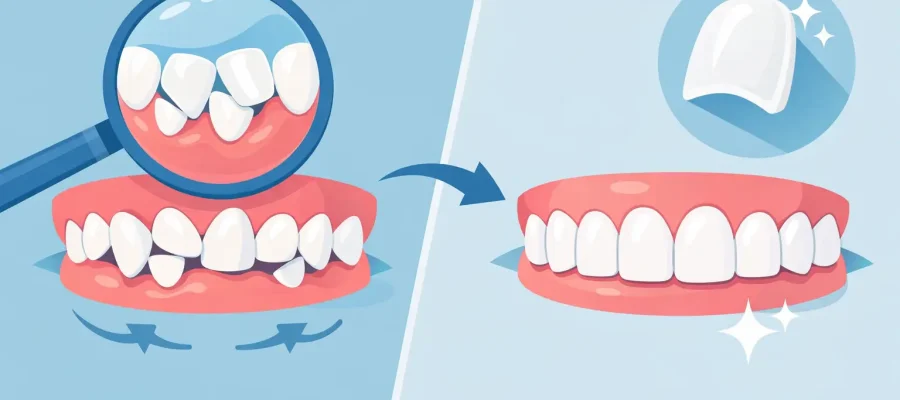
A slightly turned front tooth can make your whole smile feel off in photos, on video calls, and in person. If you have been wondering, can veneers fix crooked teeth? The short answer is yes – sometimes very effectively. But veneers do not move teeth. They reshape what people see, which is why the right case selection matters as much as the final cosmetic result.
For the right patient, veneers can create the appearance of straight, balanced teeth with speed that braces and aligners cannot match. For the wrong patient, they can become a cosmetic shortcut that ignores bite problems, crowding, or functional issues that should be treated first. The real question is not just whether veneers can fix crooked teeth, but whether they are the smartest way to fix your specific kind of crookedness.
Can veneers fix crooked teeth or just hide them?
Veneers are thin restorations, usually crafted from high-end ceramic such as E-Max, that are bonded to the front surface of teeth. They do not physically reposition teeth in the bone the way orthodontics does. Instead, they change shape, width, length, and visual alignment. That means veneers can make teeth look straighter, more symmetrical, and more proportional without months or years of tooth movement.
This distinction matters. If your tooth is slightly rotated, a bit tucked behind the neighboring tooth, uneven in size, or creating a minor crowding effect, a veneer can often mask that irregularity beautifully. If the crookedness is severe, the bite is unstable, or the teeth sit too far in or out of the arch, veneers may not be the best answer on their own.
Think of veneers as precision smile engineering. They are excellent at correcting what the eye notices first – angles, edges, spacing, proportion, and visible alignment. They are not a replacement for every orthodontic need.
When veneers are a strong option
Veneers work best when the misalignment is mild to moderate and mostly aesthetic. This includes small rotations, minor overlapping, uneven tooth shapes, narrow teeth that create visual imbalance, and front teeth that appear crooked because of wear or inconsistent edges.
They are also attractive for patients who want several improvements at once. If your concerns include not just crookedness but also discoloration, chips, short teeth, old bonding, or asymmetry, veneers can solve all of those in one coordinated plan. That is where they often outperform aligners from a cosmetic standpoint. Aligners may straighten teeth, but they do not whiten resistant stains, lengthen worn edges, or redesign tooth proportions.
For image-conscious adults with a deadline – a wedding, a public-facing role, a launch, a media appearance – veneers can offer a faster route to a polished result. With digital planning and guided smile design, the outcome can be previewed before treatment begins, which adds a level of predictability many patients want before traveling for care.
When veneers are not enough
There are cases where veneers can camouflage crooked teeth, but doing so would require too much reduction or create a bulky final shape. That is usually the line where a cosmetic treatment stops being refined and starts looking forced.
If you have severe crowding, a deep bite, major rotation, crossbite, or jaw-related alignment issues, orthodontic treatment is often the better first step. In some cases, a combined approach is ideal: aligners to improve tooth position, then veneers on selected teeth to perfect color, shape, and symmetry.
This is also true when the bite itself is causing wear, chipping, or instability. A high-end smile should not only look right in a photo. It should function cleanly when you talk, chew, and smile naturally. Covering a bite problem with veneers alone can compromise longevity.
Veneers vs braces or aligners
The biggest advantage of veneers is speed. Orthodontics moves teeth gradually. Veneers transform visible alignment much faster because they change the surface appearance rather than the tooth position itself.
The biggest advantage of braces or clear aligners is biology. They address the actual position of the teeth and can improve the bite, spacing, and crowding at the root level. If your priority is conservative treatment and your teeth are otherwise healthy in color and shape, orthodontics may be the more disciplined choice.
Veneers become especially compelling when straightness is only part of the goal. If you want a brighter smile, more even tooth sizes, cleaner edges, and a more elevated overall look, veneers can deliver a more complete aesthetic upgrade in one treatment plan.
That is why the best decision is rarely based on one question alone. It depends on how crooked the teeth are, what else bothers you about your smile, how fast you want results, and how much change you are comfortable making.
How smile design determines if veneers will work
A premium veneer case should never begin with guesswork. It should begin with analysis. Digital photographs, scans, bite evaluation, facial proportions, and smile line assessment all help determine whether veneers can create a natural straight-looking result without overbuilding the teeth.
This planning stage is where experienced cosmetic clinics separate simple cosmetic sales from true treatment design. A 3D smile preview can show whether the proposed shapes will look elegant and balanced from the front and in profile. It also helps answer practical questions: Will the teeth look too wide? Will a pushed-forward tooth need too much preparation? Can the final smile look straight without sacrificing harmony?
At DRGO Smile Clinic, this kind of planning is central to delivering the signature smile result international patients expect. Fast treatment only works when it is built on disciplined case selection and a design process that controls the details before the teeth are prepared.
What the veneer process usually looks like
Once a patient is confirmed as a good candidate, treatment moves in clear stages. The first step is design. Tooth proportions, smile width, color, and visible alignment are mapped around the face, lips, and bite.
Then comes conservative preparation, if needed. In some cases, minimal enamel is reshaped to create room for the veneers and avoid a bulky outcome. Temporary restorations may be placed so the patient can preview the look and function.
The final veneers are then bonded with precision. The quality of this stage matters. Even a beautiful design can fail if margins, contacts, and bite adjustments are not handled correctly. When done properly, the result looks clean, natural, and intentionally straight rather than artificially perfect.
The trade-offs patients should know
Veneers are not a reversible beauty treatment in the casual sense. In many cases, some enamel is adjusted, which means this is a long-term restorative decision. That is not a drawback for everyone, but it should be understood clearly.
There is also a difference between a natural refined smile and an overdone one. If someone tries to use veneers to mask severe crookedness, the restorations may end up too thick or too prominent. Premium cosmetic dentistry is not about making teeth look bigger. It is about making them look better.
Longevity depends on habits as well. Veneers are strong, but they are not indestructible. Patients who grind heavily, bite hard objects, or ignore maintenance can shorten the lifespan of their work. That is another reason why bite analysis is part of smart planning, not an optional extra.
So, are veneers the right answer for you?
If your teeth are only mildly crooked and you want a faster, more complete smile upgrade, veneers can be an exceptional solution. They can create the look of straight teeth while also improving color, symmetry, shape, and overall polish. For many adults, that combination is exactly what makes veneers more attractive than orthodontics.
If the crookedness is more significant or the bite is part of the problem, veneers may still play a role, but usually as part of a broader treatment plan. The best cosmetic result comes from respecting function, not bypassing it.
A high-level smile makeover should feel precise, not rushed. If you are considering veneers for crooked teeth, the smartest next step is a proper design assessment with visuals, measurements, and a clear plan. The right treatment is the one that gives you a straighter-looking smile and lets it hold up beautifully when real life gets close.