


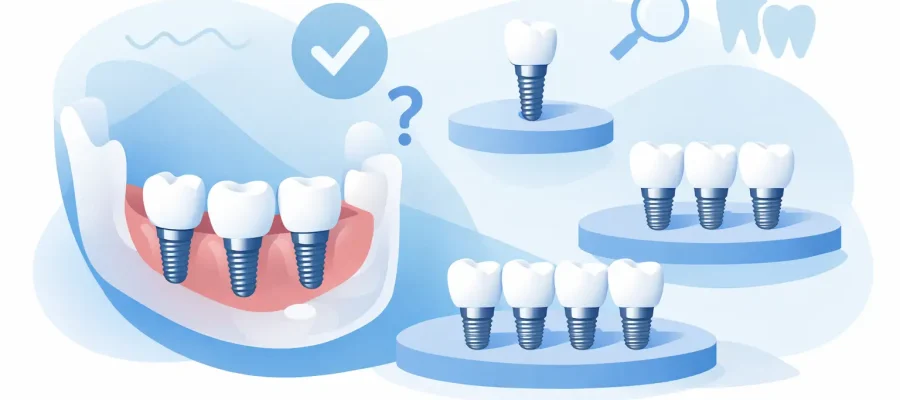
A missing tooth can change more than your bite. It can make you hide in photos, avoid certain foods, or feel less like yourself when you speak. But when you start researching treatment, one question quickly becomes confusing: how many dental implants do you really need?
The answer is rarely one-size-fits-all. Some patients need one implant to replace one tooth. Others can restore an entire upper or lower arch with four or six precisely placed implants. The goal is not to place as many implants as possible. It is to create a stable, natural-looking, long-lasting smile with the fewest procedures necessary for your anatomy, bite, and aesthetic goals.
At DRGO Smile Clinic, implant planning begins with the final result: fixed teeth that look refined, feel secure, and support a confident smile. The number of implants comes after a detailed assessment, not before.
How Many Dental Implants Do You Really Need for One Missing Tooth?
For a single missing tooth, the standard solution is usually one dental implant topped with one custom crown. The implant replaces the root beneath the gum line, while the crown restores the visible tooth. This approach preserves the neighboring natural teeth because they do not need to be filed down to support a traditional bridge.
A single implant can be an excellent choice for a front tooth, where aesthetics are especially demanding, or for a back tooth, where chewing pressure is greater. The exact placement angle, gum contour, crown shade, and bite contact all matter. A beautiful implant crown should blend into your smile rather than look like a separate restoration.
In some cases, immediate implant placement may be possible. This means the tooth is carefully removed and the implant is placed during the same appointment. It can shorten the treatment pathway, but it is not appropriate for every patient. Active infection, insufficient bone, uncontrolled gum disease, or certain bite forces may call for a more staged plan.
Replacing Several Missing Teeth Without One Implant Per Tooth
If two or more teeth are missing next to each other, you may not need an implant for every gap. Two implants can often support a fixed bridge that replaces three or sometimes more teeth, depending on location and the forces placed on the restoration.
For example, if three neighboring teeth are missing, placing an implant at each end of the space and connecting them with a custom bridge may provide the right balance of strength, function, and value. The implants act as anchors, while the bridge fills the space between them.
This is where careful engineering matters. A bridge must be planned around your chewing pattern, jawbone density, facial proportions, and the condition of the teeth beside it. A shortcut can create uneven pressure, loosen screws, damage porcelain, or place too much force on the implants over time. The best plan is designed for longevity, not simply speed.
When individual implants may be the better option
Separate implants may be recommended when the missing teeth are in different areas of the mouth, when there is enough healthy bone for each implant, or when individual tooth contours are critical to the final smile. Individual restorations are also easier to repair or adjust if one tooth is damaged in the future.
The trade-off is that more implants can mean a higher initial investment and, in some cases, more surgical planning. That is why a 3D scan and full smile evaluation are essential before committing to a number.
Full-Arch Teeth: Why Four or Six Implants Can Be Enough
Patients with many failing, severely damaged, or missing teeth often assume they need an implant for every tooth. They do not. A full fixed arch can typically be supported by four, five, or six strategically placed implants.
All-on-4 uses four implants placed at calculated angles to support a full bridge of teeth. The rear implants are often tilted to take advantage of available bone and avoid anatomical structures, such as the sinus in the upper jaw. This can reduce the need for grafting in suitable cases and allow a full-arch restoration with fewer implants.
All-on-6 follows the same full-mouth concept with two additional implants. Those extra anchors can distribute bite forces more broadly and may be preferable for patients with stronger chewing muscles, more available bone, a wider arch, or a desire for added support under a larger final bridge.
Neither option is automatically “better.” All-on-4 can be highly effective for the right patient, while All-on-6 may offer a stronger foundation in other cases. The deciding factors are clinical, not promotional.
What about same-day fixed teeth?
Many eligible full-arch patients can receive immediate fixed provisional teeth on the day of implant surgery. This is often called immediate loading. You leave with a secure, natural-looking temporary bridge rather than a removable denture.
The permanent bridge is created after healing and integration, once the implants have bonded with the jawbone. During this period, you follow a controlled diet and care routine to protect the healing foundation. Immediate teeth are a major confidence upgrade, but they still require discipline. Biting hard foods too soon can compromise the result.
The Factors That Decide Your Implant Number
A premium implant plan should never begin with a package label alone. It should begin with diagnostics. Digital scans, X-rays or CBCT imaging, bite analysis, gum evaluation, and smile design reveal what is possible and what is predictable.
Your treatment team will assess several connected factors:
- Bone volume and density: Implants need enough healthy bone for stable placement. Areas with bone loss may require grafting, a sinus lift, angled implants, or a different implant distribution.
- Gum health: Untreated periodontal disease can threaten implants just as it threatens natural teeth. Healthy gums are part of a stable, attractive result.
- Bite force: Grinding, clenching, and strong jaw muscles place more pressure on restorations. This may affect implant number, bridge design, material selection, and the need for a protective night guard.
- Teeth that can be saved: Not every damaged tooth should be extracted. When a natural tooth has a predictable long-term prognosis, preserving it can be the most conservative choice.
- Your final smile design: Implant treatment is not only about filling gaps. Tooth length, lip support, gum symmetry, facial balance, and the shade and shape of the final teeth all influence the plan.
For international patients, this planning should happen before travel whenever possible. Sharing current X-rays, photographs, and dental history allows the clinical team to provide an initial direction. A full in-clinic examination and 3D imaging then confirm the final approach.
More Implants Are Not Always a Better Investment
It is understandable to think that more implants equal more security. Sometimes they do. But placing unnecessary implants can add surgery, healing demands, cost, and complexity without improving the result.
Too few implants can also create problems. A long bridge supported by an insufficient foundation may flex under pressure, increasing the risk of mechanical complications. The right number sits in the middle: enough support for a durable fixed restoration, without overtreating the jaw.
That balance matters even more in the smile zone. A technically stable implant is not enough if the final teeth look bulky, the gumline appears uneven, or the smile does not suit your face. Digital Smile Design helps patients preview the direction of their transformation, aligning implant planning with the visible result they want to see in the mirror and in photographs.
A Clear Path From Scan to Fixed Smile
Your implant journey usually follows a straightforward sequence. First comes consultation and diagnostic imaging. Next, the team determines whether teeth can be preserved, whether grafting is needed, and how many implants will support the planned restoration.
If surgery is indicated, implants are placed according to a digitally guided plan. Eligible patients may receive temporary fixed teeth immediately. After the healing phase, the final zirconium or ceramic bridge or crown is designed for strength, comfort, and a polished, natural appearance.
For patients traveling to Istanbul, the experience should feel organized from the moment you arrive. Coordinated appointments, multilingual support, and clear timelines remove the uncertainty that often surrounds complex dental care. The clinical decision, however, remains the center of everything: a smile designed around what your mouth genuinely needs.
The right implant plan is not the one with the biggest number. It is the one that gives you stable function, healthy tissues, and a signature smile you feel ready to show without thinking twice.