


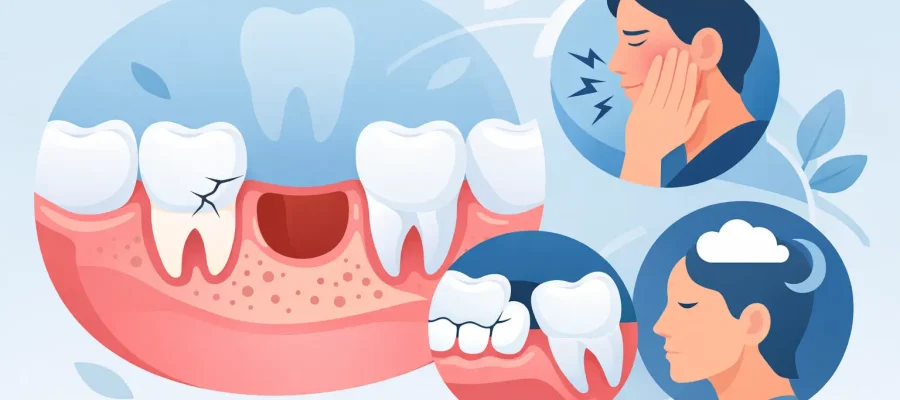
A missing tooth can feel easy to postpone when it is not painful or visible in photos. But what happens if you ignore a missing tooth? The space rarely stays neutral. Your bite is a connected system, and an unfilled gap can gradually affect nearby teeth, jawbone support, chewing comfort, and the balance of your smile.
For patients who value a polished, confident appearance, the concern is not simply replacing one tooth. It is protecting the structure that keeps the rest of the smile looking natural, functioning comfortably, and aging well.
What happens if you ignore a missing tooth over time?
Once a tooth is lost, the surrounding teeth no longer have the same support and contact points. The body also receives less chewing stimulation in that area of the jaw. These changes may be subtle at first, but they can become more complex to correct as months or years pass.
Nearby teeth may move into the gap
Teeth are not fixed in place like tiles. They can slowly drift, tip, or rotate toward an open space. The tooth opposite the gap may also begin to move down or up in search of contact. This process can change how your upper and lower teeth meet.
A shifted bite may create areas that are harder to clean, trap food more easily, or place extra pressure on certain teeth. Some patients begin noticing a rough edge, uneven wear, or a bite that no longer feels as effortless as it once did. Others do not notice the movement until a dentist compares scans or digital records over time.
The jawbone can lose volume
Your tooth roots stimulate the jawbone every time you bite and chew. After a tooth is removed, that stimulation disappears. The bone in that specific area can begin to remodel and lose volume.
The pace varies from person to person. It depends on the tooth location, gum health, bone quality, smoking status, medical history, and how long the tooth has been missing. Still, waiting can mean there is less bone available for an implant later. In some cases, a bone graft or sinus lift may be recommended before implant placement can be considered.
This is particularly relevant in the front of the smile, where bone and gum support help shape the final aesthetic result. A replacement tooth may look beautiful, but it needs a stable foundation to achieve a natural profile and lifelike gumline.
Chewing can become less balanced
Many people unconsciously avoid chewing on the side with the missing tooth. That may seem like a practical adjustment, yet it can overload the teeth and jaw muscles on the other side. If a back tooth is missing, the effect may be more noticeable because molars carry much of the force used to break down food.
Over time, uneven chewing can contribute to sensitivity, wear, cracked restorations, or muscle fatigue. It is not guaranteed that every missing tooth will cause jaw pain, but a changed bite can be one factor worth investigating when discomfort appears.
Your smile and facial support may change
A single missing tooth does not automatically alter your face. The effect depends on where the gap is and how much bone is lost. However, several missing teeth or a long-standing gap can reduce support for the lips and cheeks, particularly when bone loss is significant.
For image-conscious patients, the visible changes often matter just as much as function. A gap in the smile line may affect how freely you laugh, speak, or show your teeth in close-up photos. A missing tooth at the back may be less visible, but it can still influence the long-term stability of the smile you see from the front.
Is every missing tooth equally urgent?
Not exactly. A missing front tooth usually demands faster attention because it affects appearance, speech, and the support of the front smile. A missing molar may be easier to hide, but it plays a major role in chewing and can allow neighboring teeth to drift.
The reason for tooth loss also matters. If the tooth was removed because of advanced gum disease, infection, trauma, or decay, the surrounding tissue must be assessed before choosing a replacement. Placing a new tooth without addressing the underlying issue risks repeating the same cycle.
There are situations where immediate replacement is not appropriate. Active infection may need treatment first. A healing period may be advised after an extraction, depending on the bone, gums, and planned restoration. The right timing is not about rushing treatment. It is about preserving options while planning the result properly.
The modern ways to replace a missing tooth
A dental examination, X-rays or 3D imaging, and a bite assessment determine which solution fits your smile. The best choice depends on the location of the missing tooth, the health of adjacent teeth, available bone, budget, timeline, and aesthetic expectations.
A single dental implant
A dental implant replaces the root of a missing tooth with a small titanium post placed in the jawbone. After healing and integration, a custom crown is attached. Because the implant stands independently, it does not require reshaping the neighboring teeth.
For many patients, an implant is the closest option to replacing a natural tooth in both appearance and function. It may also help preserve bone by restoring chewing stimulation. However, implant treatment requires adequate bone, healthy gums, and careful planning. It is a surgical procedure, not a one-size-fits-all cosmetic fix.
In selected cases, an immediate implant and temporary tooth may be possible on the day of extraction. This can be valuable when a front tooth must be replaced without leaving a visible gap, but suitability depends on bone stability, infection control, bite forces, and gum conditions.
A fixed dental bridge
A bridge fills the space with a replacement tooth supported by crowns on the teeth beside it. It can be an effective option when adjacent teeth already need crowns or when an implant is not suitable.
The trade-off is that the supporting teeth usually need preparation. A bridge also does not stimulate the bone beneath the missing tooth in the same way an implant can. With excellent design, material selection, and hygiene, it can still deliver a refined, natural-looking result.
Removable options
A removable partial denture can replace one or more missing teeth without surgery. It may be used as a temporary solution during healing or as a long-term option for patients who are not candidates for fixed treatment.
Modern removable restorations can look far more discreet than many people expect. Still, they may feel less stable than an implant or bridge and require daily removal and cleaning. Your dentist should explain this honestly, especially if your goal is the confidence of fixed teeth.
Full-arch solutions for multiple missing teeth
When many teeth are missing or failing, individual replacements may not be the most efficient path. Full-arch implant solutions such as All-on-4 or All-on-6 use strategically placed implants to support a fixed full smile.
For qualified patients, this approach can provide fixed teeth immediately with a temporary bridge, followed by a final restoration after healing. It is a major treatment decision that requires comprehensive digital planning, gum evaluation, bone analysis, and clear expectations about healing and maintenance.
A precise plan protects the final result
Replacing a missing tooth is not just about filling a space with something white. The restoration must match the neighboring teeth in shape, shade, translucency, and bite position. It also needs to work with your gumline and facial proportions.
Digital Smile Design and 3D imaging make this planning more predictable. They allow the clinical team to assess bone, simulate the ideal tooth position, and design a restoration that supports the wider smile rather than looking separate from it. For patients traveling for treatment, this level of planning is especially valuable because it helps organize the timeline before the journey begins.
At DRGO Smile Clinic, implant and restorative planning can be coordinated around the complete patient experience, from diagnostic review and treatment scheduling to comfort-focused care during an Istanbul stay. The priority should always be a clinically sound plan first, with aesthetics built on top of it.
Do not wait for a gap to become a bigger restoration
If you have recently lost a tooth, the most useful next step is a professional assessment while the surrounding teeth, bone, and gums are easier to evaluate. You do not need to commit to treatment on the spot, but you do deserve to understand what your smile needs and what waiting could change.
A well-planned replacement can restore more than a tooth. It can protect your bite, preserve future treatment options, and let you smile without calculating which angle hides the gap.