


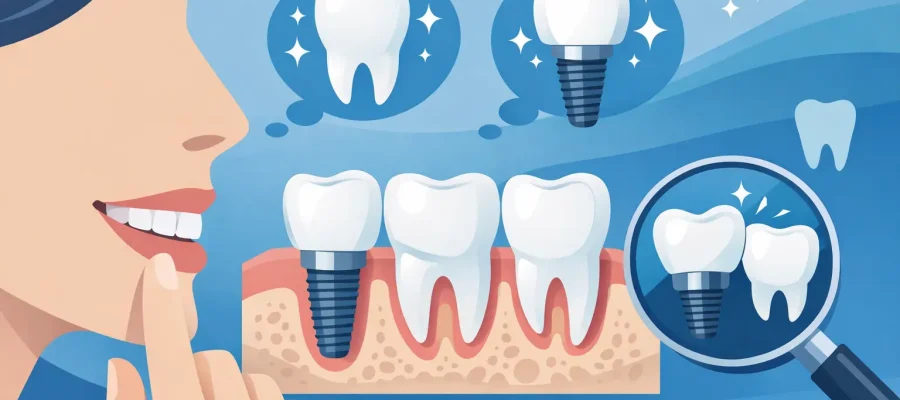
A dental implant should not feel like a foreign object every time you speak, smile, or eat. It should become part of your everyday life: stable during a client dinner, comfortable in photos, and dependable when you bite into the foods you enjoy. So, can dental implants feel like real teeth? For many patients, yes – especially after proper healing and a precisely designed final crown or full-arch bridge.
The honest answer is more nuanced than a simple yes. An implant does not recreate every biological sensation of a natural tooth. But a well-planned implant restoration can look, function, and feel remarkably natural in daily life. The difference comes down to surgical placement, bone support, healing, bite calibration, and the quality of the final restoration.
What Makes a Dental Implant Feel Natural?
A natural tooth is held in the jaw by a periodontal ligament, a fine network of fibers and nerves that provides subtle feedback when you bite. A dental implant is different. Its titanium post integrates directly with the jawbone through a process called osseointegration. This direct connection is what gives implants their exceptional stability.
Because implants do not have a periodontal ligament, they do not transmit pressure in exactly the same way as a natural tooth. You may not sense the tiniest grain of food or the first hint of excessive pressure quite as precisely. Yet your jaw, surrounding gums, muscles, and neighboring teeth still provide sensory feedback. Over time, your brain adapts to this new pattern.
For most patients, that adaptation is fast enough that the implant stops being something they actively notice. The restoration feels secure, the bite becomes familiar, and eating and speaking return to feeling natural. The goal is not merely to place a titanium post. It is to create a tooth that belongs in your smile, your bite, and your lifestyle.
Can Dental Implants Feel Like Real Teeth When You Eat?
This is usually the question behind the question. Patients want to know whether they can enjoy steak, apples, nuts, crusty bread, or a meal at a restaurant without worrying that a tooth will move, click, or come loose.
Once the implant has fully integrated and the final crown is correctly fitted, it is designed to handle normal chewing forces. Unlike a removable denture, an implant does not sit on top of the gums. It is anchored in the bone, which means there should be no slipping while speaking or eating.
The final bite matters enormously. If a crown is even slightly too high, it can feel strange immediately and may place excess force on the implant. A skilled dentist checks how your upper and lower teeth meet in several jaw positions, then makes fine adjustments until the contact feels balanced. This is a small detail with a major effect on comfort.
Single implants often become nearly invisible to the patient in daily use. Full-arch implant restorations such as All-on-4 or All-on-6 can also feel highly stable and natural, although the adjustment period may be more noticeable because a larger area of the mouth is being restored at once. Your tongue, speech patterns, and chewing muscles need time to learn the shape of a new arch.
The Five Details That Shape Comfort
A premium result is engineered long before the final teeth are attached. Several clinical decisions determine whether implants feel refined or merely functional.
1. Implant position
An implant needs to be placed at the correct angle, depth, and location in the available bone. This allows the final tooth to emerge naturally through the gumline and receive chewing forces in a healthy direction. Digital scans, 3D imaging, and guided surgical planning help make this placement more predictable.
2. Healthy bone and gums
Bone is the foundation of an implant. If bone volume is insufficient, a bone graft or sinus lift may be recommended before or alongside treatment. This can add time to the plan, but it may create a safer, stronger foundation for the final result.
Healthy gum contours matter, too. Especially in the smile zone, the gumline frames the crown. Careful gum management helps the implant look like it grew from the mouth rather than being placed into it.
3. A natural crown shape
The visible tooth is not an afterthought. It is the part you see, feel with your tongue, and use every day. A high-quality zirconium or ceramic crown is designed around proportion, color, texture, and the way light reflects from nearby teeth.
Shape affects comfort as much as aesthetics. A crown that is too bulky can crowd the tongue or trap food. One that is too narrow may create visible gaps and affect chewing. Digital Smile Design can help preview the intended proportions before the final restoration is made.
4. Precise bite balance
Every implant crown must work with the rest of your mouth. This is especially critical for patients who clench or grind their teeth, have a deep bite, or are restoring multiple teeth. A restoration can look flawless in a photograph yet feel wrong if the bite has not been calibrated carefully.
For patients with bruxism, a custom night guard may be part of protecting the investment. In some cases, treatment for heavy masseter muscle activity may also be considered as part of a broader plan. The right solution depends on your bite, muscle strength, and clinical examination.
5. Enough healing time
Immediate implants and fixed teeth on the same day can be transformative for eligible patients. They allow you to leave with a fixed provisional tooth or temporary full arch rather than a visible gap. But the immediate restoration is usually not the final version.
During healing, the implant bonds with the bone and the gums settle into their new contours. The final crown or bridge is made after the clinical team confirms that the foundation is stable. Rushing this phase can compromise comfort, fit, and long-term predictability.
What the Adjustment Period Really Feels Like
After implant surgery, tenderness and swelling are normal for a short period. Your clinician will provide detailed aftercare instructions, including dietary guidance and oral hygiene steps. Soft foods are often recommended at first, particularly after full-arch treatment or grafting.
When a new crown is fitted, many patients notice it with their tongue for the first few days. This is normal. Your mouth is highly sensitive to small changes in shape. If the crown is properly designed, that awareness usually fades as your tongue and jaw adapt.
There are a few signs you should not ignore: persistent pain after the initial healing period, pressure when biting, a crown that feels loose, gum swelling, or food trapping that does not improve. These are not issues to simply tolerate. They should be assessed so the bite, restoration, or gum health can be addressed early.
Implants Versus Other Tooth Replacement Options
A removable denture can replace missing teeth at a lower initial cost, but it may shift during meals and can reduce biting confidence. A traditional bridge can look natural, yet it requires support from adjacent teeth, which may need to be reshaped.
Dental implants stand apart because they replace the tooth root as well as the visible tooth. They help preserve jawbone stimulation and do not rely on neighboring teeth for support. The trade-off is that implant treatment is a surgical process and may require more planning, healing, and investment upfront.
For the right candidate, that investment often pays off in stability. Patients commonly describe the experience not as having a “replacement tooth,” but as getting back a part of their normal routine.
How to Get the Most Natural Implant Result
The best implant outcomes begin with complete information. Before committing to treatment, ask how the clinic evaluates bone volume, gum health, bite forces, and aesthetic proportions. Ask whether you will receive a temporary restoration, when the final restoration is planned, and what happens if grafting or additional healing is needed.
For international patients, coordination matters just as much as clinical technique. A plan should clearly explain the number of visits, expected time in Istanbul, healing intervals, and how follow-up will be managed once you return home. Fast treatment is valuable, but only when the clinical timeline supports safe, stable results.
At DRGO Smile Clinic, implant planning combines 3D diagnostics, digital smile planning, surgical expertise, and carefully crafted final restorations. The aim is a fixed result that looks camera-ready while feeling comfortable enough to forget about in real life.
The most convincing implant is not the one that simply fills a space. It is the one that lets you laugh, eat, speak, and show up with confidence without thinking about your teeth at all.