


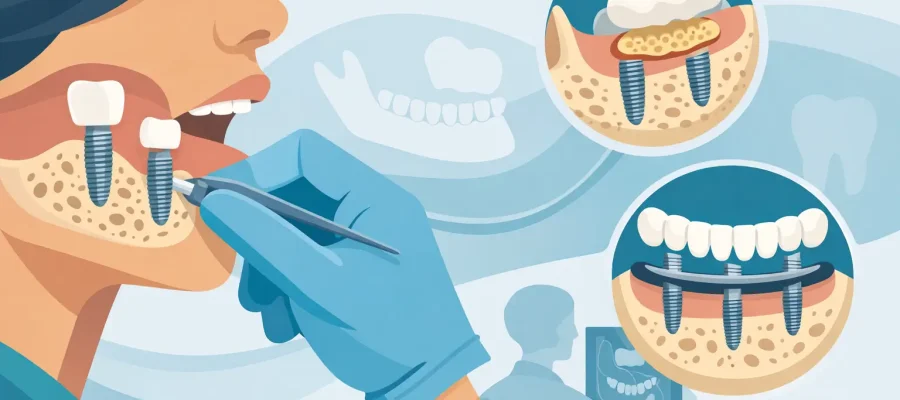
A missing tooth can change more than your smile. Over time, the jawbone in that area can shrink, neighboring teeth may shift, and the idea of implants can start to feel out of reach. But can you get implants with bone loss? In many cases, yes. The right solution depends on where bone has been lost, how much remains, your bite, your health history, and the result you want from your final smile.
Bone loss does not automatically disqualify you from dental implants. It simply changes the treatment plan. With precise 3D imaging and the right surgical approach, many patients who were told they did not have enough bone can still move forward with stable, fixed teeth.
Why Bone Loss Changes Implant Planning
A dental implant is a small titanium post placed into the jaw to replace a tooth root. For it to integrate successfully, it needs enough healthy bone around it for long-term support. When a tooth has been missing for years, the body no longer receives chewing pressure in that area. The jaw begins to resorb, meaning it gradually loses width and height.
Gum disease, untreated infection, trauma, ill-fitting dentures, and certain medical conditions can accelerate this process. In the upper back jaw, the maxillary sinus may also expand downward after tooth loss, leaving limited space for an implant.
This is why a quick visual exam is not enough. A high-quality implant plan begins with a CBCT 3D scan. It shows the exact quantity and quality of bone, the position of nerves and sinus cavities, your gum contours, and the ideal angle for each implant. The goal is not merely to place an implant. It is to create a foundation that supports comfort, function, and a natural-looking final result.
Can You Get Implants With Bone Loss Without a Graft?
Sometimes, yes. Not every patient with bone loss needs grafting. Modern implant systems come in different lengths and diameters, and experienced surgeons can often use the strongest available bone strategically. The answer is highly individual.
For a single missing tooth, there may be enough bone to place a narrower or shorter implant safely. If the bone is insufficient in one direction only, a minor augmentation may be all that is needed. For patients replacing a full arch, angled implants can sometimes avoid areas of severe bone loss and make a fixed solution possible without extensive grafting.
The trade-off is simple: skipping grafting is only a good decision when it does not compromise implant stability, bite design, gum aesthetics, or long-term predictability. A lower upfront treatment burden is not a win if the result is poorly positioned or difficult to maintain. Proper planning protects both your health and your investment.
The Main Implant Options for Bone Loss
Bone Grafting for Lost Jawbone Volume
Bone grafting rebuilds the jaw where bone has been lost. The graft material may be placed in the extraction socket immediately after a tooth is removed, along the side of a thin ridge, or beneath the gum to restore volume before implant placement.
Smaller grafts can sometimes be completed at the same visit as implant surgery. More significant reconstruction may need a healing period before the implant is placed. This adds time, but it can give the surgeon a stronger and more precise foundation, especially in visible areas where gum shape and tooth position matter as much as strength.
For a front tooth, this extra step can be the difference between an implant that simply fills a gap and a restoration that blends naturally into your smile line.
Sinus Lift for the Upper Back Jaw
If you need implants in the upper molar region, a sinus lift may be recommended. This procedure gently raises the sinus membrane and adds grafting material below it, creating the vertical bone height needed for a secure implant.
A sinus lift sounds intimidating, but it is a routine solution when planned with 3D imaging and performed by a trained surgical team. Depending on the existing bone height, the implant may be placed during the same appointment or after the graft has healed. The decision comes down to stability, not speed alone.
Immediate Implants After Extraction
When a failing tooth must be removed, placing an implant immediately can help preserve the surrounding bone and shorten the overall journey. It is not suitable for every extraction site. Active infection, damaged socket walls, thin gum tissue, and limited bone can affect whether immediate placement is wise.
When conditions are favorable, immediate implant treatment can reduce the number of surgeries and help maintain natural contours. A temporary tooth may also be possible during healing, so you do not have to live with a visible gap.
Full-Arch All-on-4 or All-on-6 Solutions
For patients with multiple missing or failing teeth, All-on-4 and All-on-6 are often the most efficient answers to advanced bone loss. Rather than replacing every tooth with an individual implant, a full fixed bridge is supported by four or six precisely positioned implants.
The rear implants can be angled to engage denser available bone and avoid the sinus cavity or lower-jaw nerve. This technique often reduces the need for extensive grafting. In suitable cases, patients can receive fixed temporary teeth shortly after surgery, then return for their final bridge once healing is complete.
All-on-4 can be an excellent solution when anatomy and budget call for a streamlined approach. All-on-6 offers additional support and can be preferable for certain bite forces, bone conditions, or long-term design goals. Neither option is automatically better. The right choice follows your scan, bite analysis, and aesthetic plan.
Your Treatment Timeline: Fast Where It Is Safe
International patients often ask whether bone loss means multiple long trips. It can, but not always. A well-organized plan begins before travel, with a review of your X-rays, photographs, health information, and smile goals. Your in-clinic assessment then confirms the final surgical plan using 3D diagnostics.
If your anatomy allows immediate implants or an All-on-4 approach, surgery and fixed temporary teeth may be completed within the same treatment visit. This gives you an immediate transformation while the implants integrate beneath the gum.
If major grafting is needed before implants, healing time is part of the treatment, not a delay to be ignored. Bone needs time to mature. Rushing this stage can put the final result at risk. Your surgeon should give you a clear schedule for surgery, healing, temporary teeth if needed, and final restorations before you commit.
At DRGO Smile Clinic, this planning is designed around both clinical precision and the realities of international travel, so your treatment stages, accommodation, transfers, and appointment schedule are coordinated with clarity.
What Determines Whether You Are a Candidate?
Bone volume is only one part of implant candidacy. Gum health, smoking or vaping habits, diabetes control, clenching, medications, oral hygiene, and bite pressure all influence healing and long-term success. A history of periodontal disease does not rule out implants, but the disease must be controlled before treatment.
Aesthetic expectations matter too. If you are replacing front teeth or planning a complete smile makeover, implant positions must support the final tooth design, gum line, and facial proportions. This is where digital smile planning adds real value. You should be able to see the intended direction of your new smile before irreversible treatment begins.
Be cautious of any clinic that promises an implant solution without a CBCT scan or offers the same package to every patient. Bone loss is not a one-size-fits-all condition. The most beautiful results come from individualized engineering, not a rushed template.
How to Protect Your Implant Result Long Term
Once implants and final crowns or bridges are in place, care matters. Implants cannot develop cavities, but the surrounding gum and bone can still become inflamed. This condition, called peri-implant disease, can threaten implant stability if ignored.
Daily brushing, cleaning between teeth or beneath bridges as instructed, routine professional maintenance, and a night guard for clenching patients protect the result. If you smoke, stopping or reducing tobacco use is one of the most meaningful choices you can make for healing and long-term gum health.
Bone loss may change your route to implants, but it does not have to end the journey. The next step is a detailed 3D assessment that replaces guesswork with a treatment plan built for your anatomy, your timeline, and the confident, fixed smile you want to wear every day.