


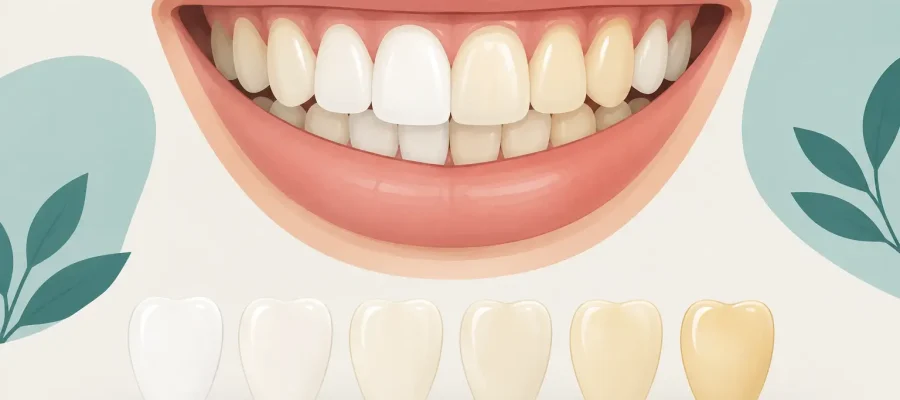
A smile in which every tooth is the exact same bright, opaque white can look striking in a photo, but it rarely looks like natural enamel. Understanding why natural teeth are not all the same color is the difference between asking for a lighter smile and designing one that still looks convincingly yours. For veneers, crowns, whitening, and full smile makeovers, this detail is where aesthetic dentistry becomes a matter of precision rather than a single shade choice.
Why Natural Teeth Are Not All the Same Color
Natural teeth have dimension. The enamel on each tooth varies in thickness, the underlying dentin has its own warm tone, and light moves through those layers differently depending on the tooth’s shape and position. Even in a healthy smile, the central front teeth, side teeth, canines, and molars do not reflect light in identical ways.
The front central incisors often appear brightest because they have broad, flat surfaces that catch more light. Lateral incisors may look slightly softer or more translucent. Canines commonly carry a little more warmth because they contain more dentin and have a naturally denser structure. Premolars and molars may appear darker simply because they sit farther back, receive less direct light, and have more grooves and texture.
This variation is not a flaw. It is one of the visual cues that makes a smile feel alive. A well-designed cosmetic result does not try to erase every difference. It controls those differences so the smile looks clean, balanced, and elevated from conversational distance, in photos, and under bright event lighting.
Enamel is translucent, not paint
Many people think of teeth as naturally white objects. In reality, enamel is partly translucent. It works more like a clear, light-filtering layer over dentin, the more opaque tissue beneath it. Dentin ranges from yellowish to warm ivory, and that underlying color contributes substantially to the shade you see.
Where enamel is thicker, teeth can look cooler, brighter, or slightly bluish at the edges. Where enamel is thinner, particularly near the gumline or on worn areas, the warmer dentin tone becomes more visible. This is why the biting edge of a youthful tooth can look almost glass-like while the center has more body and warmth.
Natural enamel also has tiny surface irregularities. These microscopic textures scatter light instead of reflecting it in one flat direction. Premium veneers and ceramic crowns can be layered, textured, and polished to recreate this effect. A perfectly smooth, uniformly opaque restoration may look white, but it can look artificial beside untouched teeth.
Tooth anatomy changes the way light behaves
Shape and thickness affect color perception. A narrow lateral incisor does not catch light like a wide central incisor. A pointed canine has different contours than a square front tooth. Teeth that sit slightly behind or in front of the smile line may appear deeper or lighter even when they share a similar base shade.
The mouth itself also changes what the eye sees. Lip color, skin tone, gum health, lighting, camera flash, and surrounding teeth all influence how bright a tooth appears. A shade selected under one overhead light can feel very different outdoors or on a phone camera.
That is why a single shade tab is only the beginning of professional shade planning. The final result should consider value, meaning how light or dark the tooth looks; chroma, meaning color intensity; and hue, the family of color that leans warmer or cooler. It also needs to account for translucency, surface texture, and the patient’s face as a whole.
What Makes Teeth Become Uneven in Color
Some color variation is completely normal. Other changes can point to staining, wear, old dental work, or a condition that needs treatment before cosmetic work begins. The right approach depends on the cause.
External stains sit on or near the surface of enamel. Coffee, tea, red wine, tobacco, deeply pigmented foods, and some mouth rinses can gradually create yellow or brown discoloration. Professional cleaning and whitening can improve many of these cases, although whitening does not change the color of existing fillings, crowns, or veneers.
Internal color comes from within the tooth. Aging naturally thins enamel and exposes more of the dentin’s warmth. A tooth that has experienced trauma may darken over time. Certain medications, developmental conditions, and previous root canal treatment can also create a gray, brown, or uneven tone that surface whitening alone may not correct.
White spots are another common concern. They can be linked to early enamel changes, past orthodontic treatment, fluorosis, or variations in enamel development. Sometimes they become more visible immediately after whitening because the surrounding enamel lightens faster. In those situations, a clinician may recommend remineralization, resin infiltration, bonding, or carefully planned veneers depending on the severity and the patient’s aesthetic goal.
A single tooth that suddenly becomes darker, gray, or painful deserves a dental assessment before any whitening appointment. Cosmetic treatment should never mask a problem that needs clinical care.
Why “One White Shade” Can Look Less Natural
A high-impact Hollywood Smile can absolutely be bright. The difference between a premium result and a flat result is not whether the teeth are white. It is whether the brightness has depth.
When every tooth is made in one dense, opaque shade, the smile can lose the subtle transitions found in natural enamel. This is especially noticeable in close-up video, daylight, and professional photography. The teeth may appear too solid, too uniform, or disconnected from the face.
That does not mean everyone should choose a highly natural shade. Some patients want a noticeably bright, camera-ready smile for media work, weddings, or a major personal transformation. That preference is valid. The goal is to design brightness deliberately: a clean overall value, slight variation between tooth groups, carefully controlled translucency at the edges, and a shape that complements the lips and facial proportions.
There is also a practical trade-off. The brighter and more opaque the ceramic, the better it may hide dark underlying tooth color or old restorations. But increasing opacity can reduce the depth that makes ceramics resemble enamel. An experienced cosmetic dentist balances masking power with light transmission instead of applying the same material recipe to every case.
How a Natural-Looking Smile Makeover Is Planned
For veneers, zirconium crowns, E-Max restorations, or a full-arch rehabilitation, shade selection should happen after the foundation is stable. Gum inflammation, tartar, untreated decay, bite issues, and uneven whitening can all distort the starting point. Healthy gums create the frame for every smile, so gum aesthetics may be part of the plan before final ceramics are placed.
At DRGO Smile Clinic, a Digital Smile Design process can map tooth proportions, gumline balance, facial features, and the desired brightness before treatment is finalized. A 3D preview gives patients a clearer basis for decisions than choosing from a color chart alone. It also lets the clinical team discuss whether the goal is a soft, natural enhancement or a brighter signature smile with stronger visual impact.
The treatment sequence often begins with diagnostics and digital planning. If whitening is part of the treatment, it is usually completed before final shade matching so the restorations can be made to the stabilized, brighter tooth color. Then the dentist prepares the teeth conservatively where appropriate, creates a temporary or trial smile when indicated, and assesses the shape, length, bite, and appearance before the final placement.
For a few front veneers, matching neighboring natural teeth is the central challenge. For a full smile makeover, the dentist has more freedom to create a unified result, but subtle translucency and contour still matter. For implant crowns, matching the tooth color is only one part of the equation. The gumline, emergence profile, and texture of the surrounding teeth are equally visible.
Choosing Your Best Shade, Not Someone Else’s
The best shade is personal. A natural-looking result may be a soft ivory for one patient and a bright, cool white for another. Skin undertone, lip tone, age, facial features, existing teeth, and lifestyle all influence what looks harmonious.
Bring reference photos if you have them, but use them as a conversation starter rather than a fixed prescription. Filters, studio lighting, and edited celebrity images can make shades look whiter than they are. It is more useful to explain how you want your smile to read: discreetly refreshed, bright and polished, or visibly transformative.
Ask to see the proposed design in different lighting and from different angles. Confirm which teeth will remain natural and which will be restored. If only a few restorations are planned, ask how the ceramic will be layered to blend with the neighboring enamel. If you want whitening first, ask how long to wait before final shade selection so the color has time to settle.
A beautiful smile does not need to look identical tooth by tooth. It needs to look intentional, healthy, and right for your face. The most compelling results preserve the quiet details of natural enamel while giving you the brightness and confidence that make you want to smile without thinking twice.