


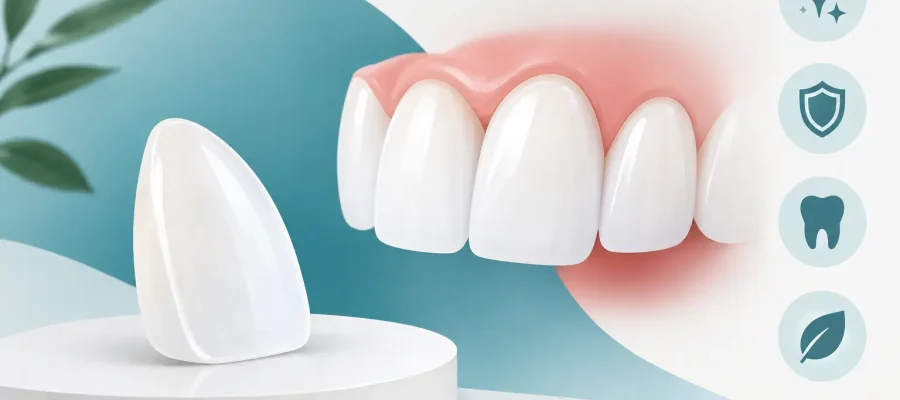
A veneer can look white without looking believable. The difference is often in how the material handles light, how precisely it fits, and how little natural tooth structure needs to be altered to achieve the result. That is what makes E-Max a popular veneer material for patients who want a brighter, more refined smile without the opaque appearance sometimes associated with older cosmetic restorations.
For a Hollywood Smile, the goal is not simply to make every tooth identical. It is to create balance: the right brightness for your complexion, a shape that complements your face, and enough natural texture and translucency for the smile to look polished in person, on camera, and in close-up conversation. E-Max lithium disilicate veneers have become a leading choice because they give skilled dentists an exceptional level of control over that balance.
What Makes E-Max a Popular Veneer Material?
E-Max is a premium glass-ceramic material made from lithium disilicate. In practical terms, it is designed to combine lifelike optical qualities with dependable strength. It can be milled with CAD/CAM technology or crafted by a dental laboratory, then bonded precisely to the front surface of a prepared tooth.
Its popularity comes from the combination, not one isolated feature. E-Max can transmit and reflect light in a way that resembles natural enamel. It is strong enough for many cosmetic veneer cases. It also allows for conservative, detail-led smile design when the underlying teeth and bite are suitable.
For international patients planning a full smile makeover, that combination matters. You are not traveling for a generic result. You want a smile that photographs beautifully, feels comfortable, and has been engineered around your facial proportions rather than chosen from a one-size-fits-all shade guide.
Natural Translucency Creates a More Convincing Smile
Natural teeth are not flat blocks of white. Light enters the enamel, scatters through layers of the tooth, and returns with subtle depth. That is why healthy enamel has dimension even when it is very bright.
E-Max is valued for its translucency. Depending on the selected ingot, shade, thickness, and staining technique, it can be tailored to create a soft, enamel-like effect. The result can range from a highly polished celebrity-style smile to a more understated enhancement that preserves natural character.
This is especially useful when the patient wants lightness without a chalky finish. A skilled clinician can adjust brightness, edge translucency, surface texture, and tooth-to-tooth variation so the final veneers look intentional rather than artificial.
There is a trade-off. Highly translucent ceramic does not hide every underlying tooth color equally well. If teeth are very dark, severely stained, or have metal restorations beneath them, a more masking material or a different restoration design may be required. Premium cosmetic dentistry is not about forcing one material into every case. It is about selecting the material that gives you the most predictable aesthetic outcome.
Shade Is Designed, Not Chosen in Isolation
The whitest possible shade is not always the most flattering one. Skin tone, lip color, facial features, neighboring teeth, and how much tooth shows when you smile all influence the ideal result. With Digital Smile Design, patients can preview the direction of their new smile before finalizing the plan.
That planning stage is where an E-Max case becomes personal. The team can discuss whether you prefer a natural bright smile, a glamorous Hollywood Smile, or a bold camera-ready finish, then build the veneer shapes and shade around that decision.
Strength for Everyday Function
Beauty alone is not enough. Veneers must manage normal daily forces from biting, speaking, and eating. Lithium disilicate is known for its strength among glass-ceramic materials, which makes it a trusted choice for veneers and many other aesthetic restorations.
Still, “strong” does not mean indestructible. Veneers can chip or fracture if exposed to excessive force, especially in patients who clench or grind their teeth. Biting fingernails, opening packaging with teeth, chewing ice, and using teeth as tools create risks for any cosmetic restoration.
Your bite must be assessed before treatment. If you have bruxism, a night guard may be recommended after veneer placement. If the back teeth need rehabilitation, orthodontic correction, or additional restorations to create a stable bite, those factors should be addressed as part of the wider treatment plan. Long-term veneer success depends as much on function and bonding as it does on the ceramic itself.
Conservative Preparation Protects What Matters
One reason patients ask about E-Max veneers is the possibility of a more conservative approach. Because this ceramic can be used at relatively thin dimensions in appropriate cases, it may allow less reduction of natural tooth structure than a full-coverage crown.
That distinction is important. A veneer covers the visible front and edge of a tooth, while a crown covers the entire tooth. If your teeth are generally healthy and you are looking to improve shape, spacing, mild alignment concerns, surface defects, or color, veneers may be the right route. If a tooth is heavily filled, cracked, root canal-treated, or significantly weakened, a crown may offer better protection.
Minimal preparation is not automatically better in every case. Very thin or no-prep veneers can look bulky if the natural teeth already project forward. The most refined result comes from planning enough space for the ceramic to sit naturally, with smooth contours at the gumline and no overbuilt appearance.
Precision Bonding Supports the Final Result
E-Max veneers are bonded, not simply cemented in place. The bonding process creates a strong connection between the prepared enamel, adhesive system, and ceramic veneer. This is one reason accurate preparation, isolation, and fit are non-negotiable.
At DRGO Smile Clinic, digital planning helps bring control to every stage. Intraoral scans capture the teeth in detail, Digital Smile Design guides proportions, and the proposed smile can be reviewed before the final restorations are placed. This reduces guesswork and gives patients a clearer view of what they are approving.
A precise fit matters aesthetically and biologically. Properly designed margins support easier cleaning and help veneers blend naturally with the gumline. Good oral hygiene, regular professional care, and a stable gum condition remain essential after treatment. Veneers do not decay, but the natural tooth structure around them still can.
E-Max Veneers Work Best for the Right Candidate
E-Max is popular because it is versatile, but candidacy still depends on your teeth, gums, bite, and goals. It is often an excellent option for people with worn edges, small gaps, uneven shape, mild discoloration, chipped teeth, or a smile that lacks symmetry.
It may be less suitable when untreated gum disease is present, tooth decay is active, enamel is extremely limited, or severe grinding is unmanaged. Patients with major crowding may benefit from orthodontic treatment first, while teeth with extensive structural damage may need crowns instead of veneers.
A credible consultation should include more than a photo and a price. It should evaluate gum health, X-rays where needed, tooth structure, bite forces, existing restorations, and the amount of enamel available for bonding. The best smile makeovers are built on healthy foundations.
What the E-Max Veneer Journey Can Look Like
For patients traveling to Istanbul, treatment needs to be efficient without being rushed. A well-organized veneer journey begins with remote consultation and smile goals, followed by detailed in-clinic diagnostics once you arrive.
Your dentist reviews the digital plan, prepares the teeth conservatively where needed, and captures precise records for the final veneers. A mock-up or temporary stage may be used to test the proposed length, shape, and bite. This is your opportunity to assess how the smile feels when you speak and how it looks across different expressions.
Once the final E-Max veneers are ready, each one is checked for fit, shade, contact points, and smile harmony before bonding. Final adjustments are made only after the dentist confirms that aesthetics and function are working together. This disciplined sequence is what turns a beautiful material into a durable, signature result.
The Real Advantage Is Controlled Aesthetics
E-Max is not popular because it is a shortcut to a perfect smile. It is popular because it gives cosmetic dentists a highly aesthetic material that responds well to careful planning. Its enamel-like translucency, reliable strength, conservative potential, and compatibility with digital workflows make it a powerful option for the right veneer case.
If you are considering a smile makeover, focus less on the material name alone and more on the plan behind it. Ask to see how your tooth shape, smile line, bite, gum contours, and desired shade will be evaluated. The most confident results come from a design that respects your natural features while delivering the transformation you came for.
A great veneer should never feel like a mask. It should feel like the version of your smile that was always waiting to be seen.