


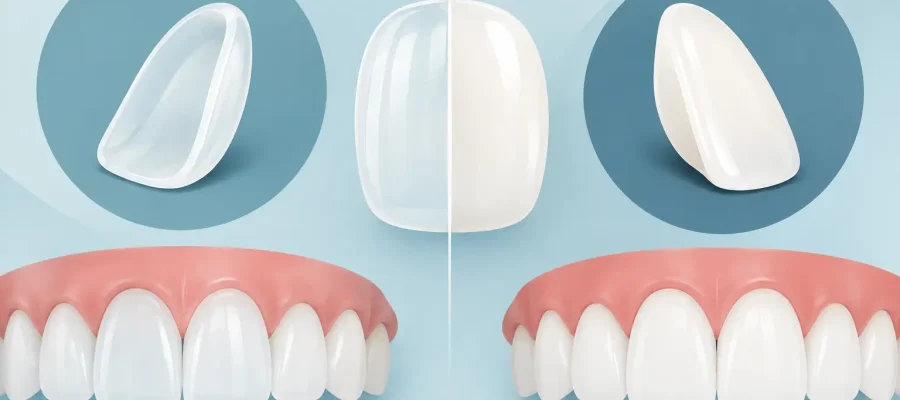
A veneer may be thinner than a contact lens, but the material behind it shapes how your new smile catches light, handles bite pressure, and ages over time. So, how are E-Max veneers different from porcelain? The clearest answer is that E-Max is a specific premium ceramic, while “porcelain veneers” is a broad category that can include several ceramic materials. The right choice is not about choosing the more fashionable name. It is about engineering the right result for your teeth, facial features, bite, and smile goals.
E-Max Is Porcelain, but Not Every Porcelain Veneer Is E-Max
Patients often hear “E-Max” and “porcelain” presented as two completely separate choices. Technically, that is not quite accurate. E-Max is made from lithium disilicate, a high-strength glass-ceramic. It belongs to the porcelain family, but its composition and manufacturing process differ from traditional feldspathic porcelain veneers.
Traditional porcelain veneers are often made from layered feldspathic ceramic. This material has a long history in cosmetic dentistry because a skilled ceramist can create remarkable depth, translucency, and natural color variation. It is highly artistic and can be an excellent choice when the goal is an ultra-customized, natural-looking enhancement.
E-Max veneers begin as lithium disilicate ceramic blocks or ingots. They can be digitally designed, milled with CAD/CAM technology, and then customized with staining, glazing, or ceramic layering. That creates a controlled combination of precision, durability, and lifelike appearance. For international patients who value a highly planned, efficient treatment timeline, this digital workflow can be a meaningful advantage.
How Are E-Max Veneers Different From Porcelain in Appearance?
Both options can create a refined, camera-ready smile. The difference is in how the material manages light and how much customization is needed to achieve a particular effect.
E-Max has a natural translucency that can closely mimic enamel, especially when the teeth underneath are relatively healthy and light in color. It reflects light in a way that helps the veneer look like part of the tooth rather than a flat shell placed over it. This makes E-Max a strong option for patients who want a bright, polished Hollywood Smile that still looks believable in daylight, close-up photos, and video.
Feldspathic porcelain is often prized for its artistic flexibility. Because it can be layered by hand, a ceramist can build subtle details into the veneer: the gentle shift from translucent edges to warmer centers, slight surface texture, or the individual character seen in natural teeth. For a patient requesting a very delicate, highly individualized result, traditional layered porcelain may offer more artistic control.
That said, the final appearance is never determined by the material name alone. The shade selection, veneer thickness, tooth color beneath the veneer, gum symmetry, facial proportions, and the skill of the dentist and dental technician all matter. A poorly planned E-Max smile will not outperform a precisely designed porcelain smile. The reverse is also true.
Strength and Durability: The Practical Difference
One of the most discussed E-Max advantages is strength. Lithium disilicate is generally stronger than feldspathic porcelain, which is why it is also used for certain crowns and restorations. For veneers, that added strength can provide confidence when treating teeth exposed to moderate bite forces or when a patient needs a slightly more substantial correction in shape, edge length, or alignment.
Traditional feldspathic porcelain is less strong, but strength is only one part of a successful veneer. When a veneer is conservatively prepared, properly bonded to healthy enamel, and designed around the patient’s bite, feldspathic porcelain can perform beautifully for many years.
Neither material is indestructible. Veneers can chip or fracture if you bite ice, open packaging with your teeth, chew pens, or grind heavily at night. Patients with bruxism may still be candidates for veneers, but they need a detailed bite evaluation and usually a protective night guard. In some cases, a different restorative plan may be safer than placing ultra-thin cosmetic veneers on teeth under significant pressure.
Tooth Preparation and Veneer Thickness
The amount of tooth preparation depends on the desired change, the starting position of your teeth, and the selected material. It should never be treated as a one-size-fits-all rule.
E-Max veneers can often be produced in conservative thicknesses while maintaining reliable strength. This can be useful when correcting small chips, uneven edges, mild gaps, worn enamel, or moderate discoloration. If teeth are already positioned favorably, minimal-prep or no-prep approaches may sometimes be possible. But “no-prep” is not automatically better. Adding material without sufficient space can make teeth look bulky and disrupt lip support or bite function.
Feldspathic porcelain can be made exceptionally thin, which may suit cases requiring minimal changes. However, thin veneers are not a shortcut around careful planning. If a tooth is dark, severely rotated, heavily filled, or positioned forward, an ultra-thin veneer may not hide the underlying color or create a balanced contour. More preparation, a different ceramic, orthodontic treatment, whitening, or a crown may be the more predictable choice.
When E-Max Is Often the Better Fit
E-Max is commonly selected for patients seeking a strong, bright, polished aesthetic with efficient digital precision. It can be particularly effective for front teeth with mild to moderate cosmetic concerns, including uneven shape, chips, worn edges, spacing, and color that does not respond well enough to whitening.
It may also suit patients who want a coordinated smile makeover completed within a carefully organized travel schedule. With Digital Smile Design, the dentist can assess facial proportions, plan tooth length and symmetry, preview the intended result, and guide the laboratory process with greater consistency. At DRGO Smile Clinic, planning is built around this level of visual and functional control, not simply choosing the whitest possible shade.
E-Max is not automatically the answer for every tooth. If a tooth has a large existing filling, extensive decay, prior root canal treatment, or major structural loss, a veneer may not offer sufficient coverage. A ceramic crown, potentially in another material depending on the case, may be clinically more appropriate.
When Traditional Porcelain May Be the Better Choice
A traditional layered porcelain veneer can be an exceptional choice when micro-level artistry is the priority. Patients with naturally beautiful teeth who want subtle refinements rather than a more uniform makeover may benefit from the nuanced optical effects a master ceramist can achieve through layered porcelain.
It can also be appropriate when the treatment plan calls for extremely thin veneers and there is enough healthy enamel, ideal tooth position, and limited discoloration. These conditions matter. A naturally translucent material placed over a dark tooth can allow unwanted shadowing to show through, regardless of how beautiful the ceramic is in isolation.
For many smile makeovers, the decision is not strictly E-Max versus feldspathic porcelain across every tooth. A dentist may recommend different materials in different areas of the mouth, or combine veneers with gum contouring, whitening, bonding, orthodontics, or crowns to produce a result that looks cohesive rather than artificially uniform.
The Process Should Decide the Material, Not the Marketing
Premium veneers start with diagnosis, not a material menu. Before preparation begins, your dentist should evaluate your bite, gum health, enamel volume, tooth position, existing restorations, smile line, and the way your lips frame your teeth. Photos, digital scans, X-rays when needed, and a 3D smile preview create a more reliable foundation for the final decision.
The next stage is smile design. This is where “natural” becomes specific: tooth shape, edge contour, brightness, symmetry, and the amount of tooth display when you speak and smile. A trial smile or mock-up may be used to help you assess the planned look before final ceramics are created.
After preparation, the veneers are designed and fabricated to the approved plan. At the final visit, each veneer is checked for fit, shade, contact points, bite, and overall harmony before bonding. This detail matters because the finest material cannot compensate for poor margins, an unstable bite, or a smile design that does not suit the face.
Choosing the Smile That Will Still Look Right Years From Now
E-Max veneers offer strength, precision, and enamel-like translucency. Traditional porcelain veneers offer extraordinary artistic layering and can be ideal for highly subtle cases. Neither is universally superior, and that is good news: the best option can be selected around your actual teeth instead of forcing your smile into a preset package.
Ask to see a clear visual plan, understand how much tooth preparation is expected, and discuss what happens if you clench, grind, or have older dental work. A signature smile should look exceptional on your arrival photos, but it should also feel comfortable, function naturally, and remain unmistakably yours long after the trip home.