


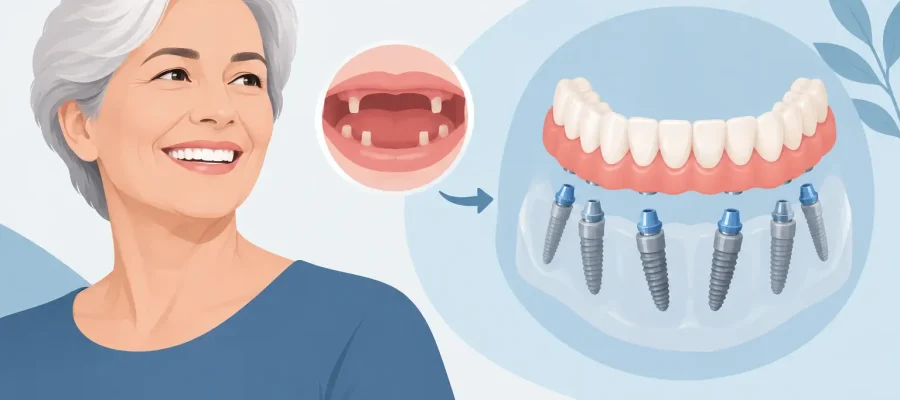
Losing most or all of your teeth changes more than your ability to chew. It can alter facial support, speech, confidence, and the way you show up in photos, meetings, and life. So, can All-on-6 be used for severe tooth loss? Often, yes. For the right candidate, six strategically placed implants can support a fixed full-arch bridge designed to restore both function and a natural-looking smile.
The key is not simply how many teeth are missing. It is the quality and volume of the jawbone, the condition of the gums, your bite, medical history, and the level of precision behind the treatment plan. Severe tooth loss can be treated decisively, but it should never be treated casually.
Can All-on-6 Be Used for Severe Tooth Loss?
All-on-6 is specifically designed for people who have lost an entire upper or lower arch, have failing teeth that cannot be predictably saved, or are tired of removable dentures. The treatment uses six dental implants to anchor a custom full-arch restoration. Unlike a denture, the bridge is fixed in place by your dental team, giving it far greater stability for eating, speaking, and smiling.
For many patients with advanced tooth loss, six implants create a strong distribution of support across the arch. That extra support can be particularly valuable when bite forces are high, when the jaw anatomy allows ideal implant placement, or when the final bridge is planned for long-term durability and refined esthetics.
However, severe tooth loss often comes with bone loss. After teeth are lost, the jaw no longer receives the stimulation created by chewing. Over time, the bone can shrink in height and width. This does not automatically rule out All-on-6, but it changes the planning process.
A high-quality plan starts with 3D imaging, not guesswork. A CBCT scan maps the available bone, sinus position in the upper jaw, nerve pathways in the lower jaw, and the exact angles available for implant placement. From there, the clinical team can determine whether six implants can be placed safely and whether grafting or a sinus lift would improve the outcome.
When Severe Bone Loss Changes the Plan
The best result is not always the procedure a patient initially requests. If the bone is dense and plentiful enough, All-on-6 may be completed with immediate implant placement and a fixed temporary bridge on the same day. For someone arriving with loose, infected, or damaged teeth, that can mean leaving the clinic with fixed teeth rather than a removable denture.
But immediate loading is not a promise made before surgery. It depends on whether each implant achieves enough primary stability at placement. Bone density, implant torque, infection levels, and bite pressure all matter. A responsible implant team confirms these details in real time.
When bone loss is more advanced, there are several possible pathways. Bone grafting may rebuild areas that are too thin or too low to hold implants predictably. In the upper jaw, a sinus lift may create the space needed for implants in the back of the mouth. In other cases, implant positions can be adjusted toward stronger bone, or a staged approach may be safer than forcing an immediate fixed bridge.
This is the trade-off patients should understand: faster is valuable only when it remains biologically sound. A carefully staged treatment can add time, but it may protect the stability, facial support, and long-term appearance of your new smile.
All-on-6 vs. All-on-4 for Advanced Tooth Loss
Both treatments replace a complete dental arch with fixed implant-supported teeth. All-on-4 uses four implants, often angled to take advantage of available bone and avoid major anatomical structures. This can make it an excellent option for patients with moderate bone loss who want to avoid grafting where clinically appropriate.
All-on-6 uses two additional implants. In suitable bone, that can provide a broader foundation for the final bridge and may reduce stress on each implant. It can also offer more flexibility in restorative design, especially for patients with stronger bite forces or a preference for a highly stable, premium full-arch solution.
Neither option is automatically better. An All-on-6 plan is not superior simply because it uses more implants, and All-on-4 is not a shortcut when it is carefully designed. The right choice is the one that respects your anatomy, supports the planned restoration, and gives you the most predictable path forward.
What the All-on-6 Journey Looks Like
For international patients, clarity matters before travel is booked. At DRGO Smile Clinic, the process is built around detailed planning, visible previews, and a tightly managed treatment schedule, so you understand the route to your new smile before arriving in Istanbul.
1. Digital assessment and smile planning
Your journey begins with a review of dental records, photos, medical information, and, when available, 3D scans. Once you are in clinic, comprehensive imaging and an in-person examination confirm the final plan. The team evaluates gum health, bone levels, facial proportions, lip support, bite relationship, and the shade and shape that suit your features.
This is where full-arch dentistry becomes more than replacing teeth. A well-designed bridge can restore lost vertical dimension, soften the collapsed look that may follow years of tooth loss, and create a smile that looks proportional rather than oversized or artificial.
2. Removal of failing teeth and implant placement
If remaining teeth are infected, fractured, mobile, or beyond predictable restoration, they may be removed during the surgical visit. The implant sites are prepared according to the digital plan, and six implants are placed at precise positions and angles.
Comfort is central to the experience. Local anesthesia is standard, and additional sedation options may be discussed when appropriate. After placement, the team checks implant stability before deciding whether immediate fixed provisional teeth are advisable.
3. Fixed temporary teeth or healing phase
When the implants are stable enough, a temporary full-arch bridge can be fitted soon after surgery. This lets you leave with teeth that are fixed, presentable, and designed around a controlled healing bite. You will still need to follow a soft-food diet because the implants are integrating with the bone beneath the bridge.
If immediate loading is not the safest choice, a healing solution is provided while the implants integrate. This may feel less dramatic than same-day fixed teeth, but it can be the right decision for compromised bone, complex grafting, or lower initial implant stability.
4. Final full-arch restoration
After healing, the temporary is replaced with the final bridge. This stage is where color, translucency, tooth shape, gum detail, speech, and bite are refined. Depending on the clinical plan, the final restoration may use high-strength zirconia or another carefully selected material that balances esthetics with the demands of full-arch function.
The final bridge should not just look impressive in a close-up photo. It must be designed to clean properly, distribute bite forces well, and remain comfortable in daily life.
Who May Need a Different Solution?
All-on-6 can be highly effective for severe tooth loss, but certain factors may require a modified approach. Uncontrolled diabetes, heavy smoking, untreated gum disease, severe teeth grinding, active oral infection, and medications that affect bone healing all require careful review. These factors do not always eliminate implant treatment, but they can affect timing, materials, healing protocols, and long-term maintenance.
Patients with major bone loss may also need grafting before implants, rather than during the same visit. Others may be better suited to All-on-4, especially if it allows secure placement in the strongest available bone. A removable implant-supported denture can also be a sensible option when budget, anatomy, or health considerations make a fixed bridge less appropriate.
The strongest treatment plan is the one that tells the truth about what your mouth needs. Be cautious of any provider who guarantees immediate full-arch teeth without reviewing a CBCT scan, discussing your health history, or explaining what happens if implant stability is lower than expected.
Protecting Your Investment After Treatment
Fixed teeth do not mean maintenance-free teeth. The bridge and implants need professional review, regular hygiene visits, and daily cleaning beneath the restoration. A water flosser, implant-safe brushes, and the cleaning tools recommended by your dentist help control plaque around the implant sites.
If you clench or grind, a night guard may be recommended to protect the restoration. Smoking reduction or cessation, routine checkups, and quick attention to any looseness, discomfort, or bite change all help preserve the result. The goal is not simply to get fixed teeth quickly. It is to keep them healthy, stable, and beautiful for years.
If severe tooth loss has made you hide your smile or avoid the foods you enjoy, a detailed 3D assessment can show whether All-on-6 is the right foundation for your next chapter. The right plan gives you more than new teeth – it gives you a smile designed to feel like it belongs to you.