


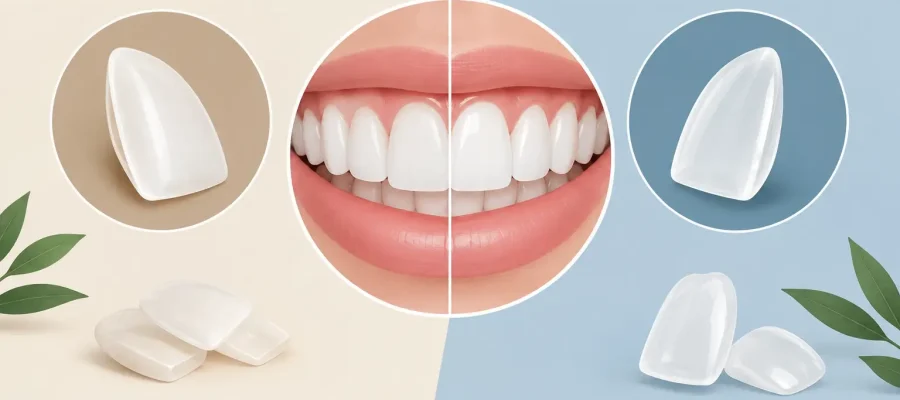
A brighter, straighter smile can look effortless in a final photo, but the material choice behind it is highly specific. When patients ask, “laminate veneers vs e-max veneers: how are they different?” they are often comparing two terms that do not sit in exactly the same category. One generally describes a type of cosmetic restoration, while the other describes a high-performance ceramic material.
That distinction matters when you want a smile that looks refined up close, photographs beautifully, and holds up to real life. The best option is not simply the thinnest or strongest veneer. It is the restoration that fits your enamel, bite, tooth color, facial features, and long-term goals.
Laminate Veneers vs E-Max Veneers: The Core Difference
A laminate veneer is a thin, custom-made porcelain shell bonded to the front surface of a tooth. It is designed to improve visible concerns such as discoloration, small gaps, uneven edges, minor crowding, or teeth that appear short or worn. “Laminate” usually refers to the conservative veneer technique: a very thin restoration with minimal tooth preparation when the case allows it.
E-Max is a brand of lithium disilicate ceramic. It is a material known for its balance of strength and light transmission. An E-Max restoration can be made as a veneer, but it can also be made as a crown, inlay, onlay, or other ceramic restoration. In other words, an E-Max veneer may be a type of laminate veneer, depending on its design and thickness.
This is why the comparison can be misleading. The real clinical question is often: should your smile use ultra-thin porcelain laminates, lithium disilicate E-Max veneers, or a combination of veneer and crown restorations tailored to each tooth?
How the Materials Look in Natural Light
For a premium smile makeover, color alone is not enough. Natural teeth reflect, absorb, and transmit light in layers. A restoration must recreate that depth or it can look flat, opaque, or overly uniform.
Traditional porcelain laminates can deliver exceptional translucency and fine surface detail. In the hands of a skilled dental laboratory and cosmetic dentist, they can mimic the subtle texture, incisal glow, and gentle color variation of natural enamel. This makes them an attractive option for patients whose underlying teeth are already a favorable shade and position.
E-Max ceramic is also highly esthetic. Its lithium disilicate structure allows light to pass through more naturally than more opaque restorative materials. E-Max is often an excellent choice when a patient wants bright, clean color without sacrificing dimension. It is particularly valuable when more strength is needed than an ultra-thin veneer can provide.
Neither option should create a row of identical, glowing-white rectangles. A signature smile should be designed around your face, lip movement, skin tone, and the amount of tooth shown when you speak and smile. Digital Smile Design and a 3D preview can make these decisions visible before treatment begins.
Tooth Preparation: Less Is Not Always Better
Laminate veneers are often associated with minimal preparation. In suitable cases, only a very thin layer of enamel is reshaped to make space for the veneer and create a natural transition at the edges. Some patients may qualify for no-prep or near-no-prep veneers.
However, minimal preparation is not automatically the most aesthetic or healthiest choice. If teeth are prominent, severely discolored, rotated, or unevenly positioned, placing a veneer without enough space can create bulk. The result may look too thick near the gumline or feel unnatural against the lips.
E-Max veneers can also be conservative, but their preparation requirements depend on the thickness needed for strength and color control. When a dark tooth must be masked or a worn edge needs rebuilding, a slightly more substantial E-Max design may be the safer, more predictable solution.
The goal is controlled preparation, not a one-size-fits-all promise. Whenever possible, preserving healthy enamel supports a strong bond and long-term stability. But creating enough room for the right ceramic is equally important for a polished final result.
Strength, Bite Force, and Daily Wear
E-Max is widely chosen for its strength. Lithium disilicate is durable enough for many cosmetic veneer cases and can also support single crowns in appropriate areas of the mouth. This makes it especially useful for teeth that need more than a surface-level correction, such as a chipped front tooth or a tooth with significant wear.
Fine porcelain laminate veneers can also be long-lasting when properly designed and bonded to strong enamel. Their success depends heavily on case selection. A thin veneer placed on a stable tooth with a balanced bite can perform beautifully for years. A thin veneer placed on a heavily worn tooth or in a patient with untreated grinding may be at higher risk of chipping or debonding.
If you clench or grind your teeth, the answer is not always to avoid veneers. Your dentist may adjust the design, select a stronger ceramic, recommend a protective night guard, or treat bite-related concerns first. Patients who want a Hollywood Smile should expect a proper bite assessment, not just a shade selection.
When Laminate Veneers May Be the Better Choice
Thin laminate veneers are often ideal for patients who have healthy front teeth and want a subtle but high-impact refinement. They can be especially effective for closing small spaces, smoothing minor edge irregularities, correcting mild asymmetry, or refreshing teeth that have yellowed but are not deeply dark.
They also suit patients who value the most conservative approach possible. When teeth have good alignment, adequate enamel, and no major structural damage, an ultra-thin ceramic design may preserve more natural tooth structure while creating a dramatic visual improvement.
That said, the word “laminate” should never be used as a shortcut for “better.” A veneer can be thin and still be the wrong answer if it cannot correct the underlying issue predictably.
When E-Max Veneers May Be the Better Choice
E-Max veneers are often the stronger choice when more shape, support, or masking ability is required. They can be highly effective for worn edges, slightly larger gaps, more visible discoloration, or teeth that need a more substantial change in contour.
They are also useful in smile makeovers where the dentist needs to blend veneers with E-Max crowns. For example, one front tooth may have a large old filling or previous root canal treatment and require a crown, while surrounding teeth only need veneers. Using compatible ceramic systems can help create a consistent color, texture, and light effect across the smile.
An E-Max crown should not be placed simply because it is strong if a veneer would adequately restore the tooth. Crowns require more reduction because they cover the entire tooth. The right treatment protects healthy structure while delivering the desired aesthetic outcome.
The Treatment Journey for International Patients
A cosmetic veneer journey should begin before you travel. Your initial assessment typically reviews clear photos, X-rays when available, your smile goals, and any concerns about tooth sensitivity, grinding, or prior dental work. A preliminary plan can then identify whether veneers, crowns, whitening, gum contouring, or alignment treatment may be needed.
After your in-person examination, the clinical team confirms the plan, prepares the teeth conservatively, and takes precise digital scans. A smile preview or mock-up may be used to evaluate length, shape, and proportions before the final ceramic work is placed. This is the moment to discuss whether you want a softer natural look, a brighter celebrity-inspired finish, or something between the two.
Final placement is not just about bonding restorations into place. Each veneer is evaluated for fit, color, bite contacts, and symmetry. A beautiful result should feel comfortable when you speak, chew, and close your teeth. At DRGO Smile Clinic, this planning-first approach helps international patients arrive with clarity and leave with a smile designed for their real life, not just their travel photos.
Choose the Design, Not Just the Label
The most useful question is not whether laminate or E-Max veneers are universally better. Ask what your teeth need to look natural, stay comfortable, and remain stable under your bite. A clinical examination can reveal whether your ideal result calls for ultra-conservative laminates, E-Max veneers, a few E-Max crowns, or a carefully planned combination.
Bring photos of smiles you like, but also be open about how you use your teeth, whether you grind at night, and how bright you want your final shade to be. The right veneer plan should give you more than a dramatic first reveal. It should give you the confidence to smile without thinking about your teeth at all.