


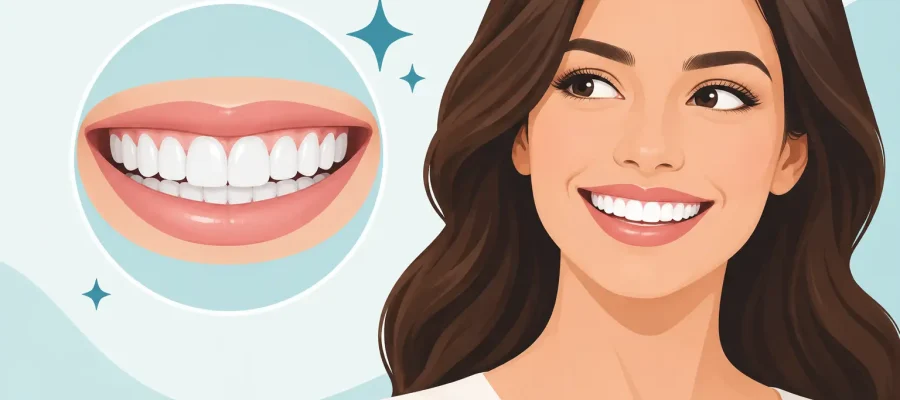
A Hollywood Smile is not designed by picking a random number of veneers or crowns. The question, “how many teeth are usually included in a hollywood smile?” matters because the right number determines whether your new smile looks beautifully balanced from every angle or stops abruptly when you laugh.
For most patients, a Hollywood Smile includes 8 to 10 upper teeth and often 8 to 10 lower teeth. That means a full smile makeover commonly treats 16 to 20 teeth. But a premium result is never one-size-fits-all. Your lip line, facial proportions, natural tooth position, bite, and the width of your smile all affect the final plan.
How Many Teeth Are Included in a Hollywood Smile?
The upper teeth are typically the priority because they are the most visible when you speak, smile, and pose for photos. A standard upper smile design often covers the front 8 teeth, from the first premolar on one side to the first premolar on the other. For patients with a broader smile, 10 upper teeth may be needed so the restorations extend naturally into the visible side teeth.
Lower teeth may be included when they show clearly in speech or smiling, when their color does not match the upper arch, or when the bite needs a complete aesthetic correction. Treating both arches creates a more consistent shade, shape, and overall finish. It also avoids the contrast that can happen when bright, refined upper teeth sit above untreated lower teeth.
Some patients need only 6 upper veneers for a focused improvement. Others need 20 restorations for a full, camera-ready transformation. The best number is the one that gives you a harmonious smile without treating healthy teeth unnecessarily.
Why 8 to 10 Teeth Is So Common
The visible smile zone is wider than the six front teeth. While the central incisors and canines do most of the visual work, the premolars often appear at the corners of the smile, especially in photos and video. If only the front six teeth are restored, the natural teeth at the sides can look darker, shorter, or less polished beside the new veneers or crowns.
Eight to 10 upper teeth usually allows a dentist to create a smooth transition from the center of the smile to its edges. The result is more believable in close-up and more impressive at a distance. This is particularly valuable for professionals, creators, brides and grooms, and anyone who wants their smile to hold up under flash photography.
That said, more teeth does not automatically mean a better result. A narrow smile may look exceptional with eight upper restorations. A wider smile may require 10. The goal is not to reach a number. It is to create proportion, symmetry, and continuity.
The Factors That Determine Your Ideal Tooth Count
Your Smile Width and Lip Movement
Some people show only the front teeth when smiling. Others reveal teeth much farther back, including the premolars. A broad smile needs restorations that extend far enough to prevent visible shade differences at the corners.
Lip movement also changes the plan. A high lip line can reveal more of the upper teeth and gum tissue, which may make gum contouring part of the treatment. A lower lip line may allow a more conservative design while still delivering a dramatic improvement.
Your Existing Tooth Color and Shape
If your natural teeth are already close to your desired shade, a smaller veneer case may blend well. If you want a significantly brighter Hollywood white, more visible teeth generally need treatment to keep the color uniform.
Tooth shape matters too. Small, worn, uneven, chipped, or spaced teeth may need a broader design approach to create a consistent rhythm across the smile. E-Max veneers are often selected for highly aesthetic cases with healthy underlying teeth, while zirconium crowns can be appropriate when more coverage and strength are needed.
Your Bite and Dental Health
Cosmetic dentistry has to function as well as it looks. If you grind your teeth, have an uneven bite, old fillings, decay, or fractured teeth, your treatment plan may include crowns, bite adjustments, or protective night guards. When teeth are missing, dental implants may be needed before the aesthetic stage can begin.
A Hollywood Smile is not a cosmetic mask placed over unresolved dental issues. The most predictable outcomes start with a healthy foundation and a treatment plan that protects your investment.
Veneers, Crowns, or a Combination?
The number of teeth in your makeover and the type of restoration are related, but they are not the same decision. Veneers are thin, custom ceramic shells bonded to the front surface of teeth. They are ideal for changing color, shape, minor alignment, and small gaps when the tooth structure is healthy.
Crowns cover the entire tooth and are usually recommended when teeth are heavily filled, weakened, fractured, severely worn, or already crowned. Modern zirconium crowns can deliver strength with a refined, natural-looking finish. Many full smile makeovers use a combination of veneers and crowns, chosen tooth by tooth rather than forcing every tooth into one treatment category.
The premium approach is to preserve healthy enamel where possible and use full-coverage restorations only where clinically indicated.
How Digital Smile Design Decides the Right Number
A high-level smile makeover should begin before any tooth preparation. Digital Smile Design uses photos, facial analysis, scans, and bite records to plan the proportions of each visible tooth in relation to your face. You can see the intended direction of your smile before the final restorations are made.
This planning stage answers practical questions: How wide should the new smile be? Which teeth are visible in a full smile? Should the lower teeth be included? Does the gum line need refinement? Will 8 upper teeth create enough balance, or is a 10-tooth design better?
At DRGO Smile Clinic, the design can be supported by 3D previews and CAD/CAM workflows, helping international patients move from consultation to a clear treatment roadmap with less uncertainty. A temporary try-in may also be used to assess shape, length, and phonetics before the final ceramic work is placed.
What a Typical Hollywood Smile Journey Looks Like
For international patients, the process is planned around both clinical precision and a realistic travel schedule. It starts with an online consultation, where you share photos, X-rays if available, and your aesthetic goals. The clinical team can then provide an initial recommendation on the likely number of teeth, restoration type, timeline, and package details.
Once in Istanbul, the in-person examination confirms the plan. Digital scans, shade selection, facial analysis, and smile design come first. If preparation is needed, it is completed conservatively and comfortably. Temporary restorations allow you to preview the new look while the final veneers or crowns are crafted.
At the final appointment, each restoration is checked for fit, bite, color, symmetry, and comfort before bonding or cementation. The aim is not simply white teeth. It is a signature smile that looks intentional, photographs beautifully, and feels natural when you speak and eat.
Is It Better to Treat Upper Teeth Only?
Upper-only treatment can be the right choice when your lower teeth are healthy, straight, and close enough in color to blend with the new upper restorations. It can reduce the scope of treatment while still creating a visible transformation.
However, lower teeth are worth including when they are crowded, worn, dark, uneven, or highly visible. This is especially true if you choose a very bright shade for the upper arch. A smile design consultation makes this decision much easier because you can see how the arches work together before committing.
A Smile That Fits Your Face, Not a Fixed Formula
The usual Hollywood Smile includes 8 to 10 upper teeth and, for many patients, 8 to 10 lower teeth. But the most striking results come from personalized planning, not copying someone else’s tooth count or shade.
Before choosing a package, ask to see your smile design and understand exactly which teeth are being treated and why. When the plan is built around your face, bite, and natural smile width, the final result feels less like a dental procedure and more like the version of your smile you were always meant to have.