


If you are comparing all on 4 vs all on 6, you are already asking the right question. Both treatments replace a full arch of missing or failing teeth with a fixed bridge on dental implants, but they are not interchangeable. The better option depends on your bone volume, bite force, smile goals, timeline, and how much long-term support your case needs.
For many patients, this decision is not just about teeth. It is about getting back a confident smile, eating comfortably, speaking naturally, and doing it with a treatment plan that feels predictable from day one. That is why the implant count matters – not as a marketing label, but as part of the engineering behind your final result.
What all on 4 and all on 6 actually mean
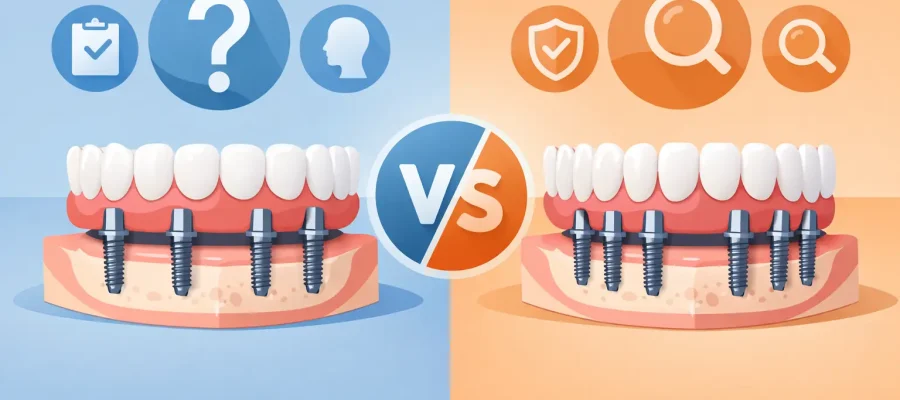
All-on-4 and All-on-6 are both full-arch implant solutions. Instead of placing one implant for every missing tooth, your dentist places four or six implants in the jaw and attaches a full fixed prosthetic arch on top.
In an All-on-4 plan, two implants are usually placed toward the front and two toward the back at an angle. That angled placement helps use available bone and often reduces the need for bone grafting. In an All-on-6 plan, six implants are distributed across the arch, creating more support points for the bridge.
From the patient side, both can look similar once the teeth are in place. The difference is under the surface. More implants can mean better load distribution, stronger support for the prosthesis, and in some cases a more conservative approach to long-term stress on each implant.
All on 4 vs all on 6: the real difference
The simplest difference is support. All-on-4 uses four implants to hold the full arch. All-on-6 uses six. But what matters clinically is how those implants carry pressure over time.
With All-on-4, the system is designed to work efficiently with fewer implants. It is often an excellent solution for patients who have reduced bone in the back of the jaw, want to avoid additional grafting, or need a faster and more streamlined path to fixed teeth. It can be especially useful in the upper jaw when anatomy limits implant placement options.
With All-on-6, the extra two implants create a broader base. That usually improves stability and spreads chewing forces more evenly across the arch. For patients with stronger bite pressure, wider arches, or better available bone, six implants can provide an added level of security.
This does not mean All-on-6 is automatically better. It means it can be better in the right anatomy. A well-planned All-on-4 case is far better than an unnecessary All-on-6 plan in bone that cannot support it properly.
Who is a better fit for All-on-4
All-on-4 is often chosen for patients who want a fixed full-arch solution with fewer implants and fewer surgical demands. It can be ideal when bone is limited, especially in the posterior jaw, because the rear implants can be angled to avoid anatomical structures and maximize existing bone.
It is also a strong option when speed matters. Many patients travel specifically to receive immediate function treatment, where implants are placed and a temporary fixed set of teeth is attached the same day or within a very short window. A four-implant design can make that process more efficient when the case is properly selected.
Patients who have been wearing dentures and have experienced bone loss are often strong candidates for All-on-4. So are patients who want a premium fixed result while keeping surgery as conservative as possible.
Who is a better fit for All-on-6
All-on-6 usually suits patients with enough bone to support six implants without compromising placement quality. If you have good jawbone volume, a stronger chewing pattern, or want additional support under a full-arch bridge, six implants may be the smarter long-term platform.
This can be particularly relevant for younger full-arch patients, patients with heavier bite forces, or those who want maximum prosthetic stability where anatomy allows it. More implants may also give your restorative team greater flexibility in bridge design.
In some cases, All-on-6 is chosen simply because the bone and spacing make it possible to build a more balanced arch. That extra support can be valuable, especially for the upper jaw where bone quality is often softer than the lower jaw.
Bone quality changes the answer
If there is one factor that decides all on 4 vs all on 6 more than anything else, it is bone. Not just how much bone you have, but where it is, how dense it is, and whether it can hold implants with enough primary stability for immediate loading.
A patient may assume that six implants are always the premium choice, but if the back jaw has limited bone height or poor density, forcing additional implants can complicate the surgery without improving the result. On the other hand, if the bone is healthy and well distributed, placing six implants may create a stronger foundation.
This is why a 3D scan matters. Full-arch treatment should never be chosen from photos alone. A proper digital plan shows bone availability, sinus position, nerve location, bite relationship, and implant angulation before treatment begins.
Cost, healing, and treatment timeline
Cost is part of the conversation, and realistically, All-on-6 is usually more expensive than All-on-4 because it involves more implants, more components, and often more surgical time. But the price difference only matters after clinical fit is confirmed. The wrong treatment is always more expensive in the long run.
Healing can also differ slightly. More implants can mean a more involved surgery, although this depends on the complexity of extraction, bone shaping, and whether grafting is required. In many immediate-load cases, both treatments allow patients to leave with fixed temporary teeth quickly, then return later for the final bridge after healing.
For international patients, the timeline often matters as much as the technique. A treatment plan built around digital scans, guided surgery, and immediate provisional teeth can reduce time in the chair and make travel more practical. At clinics such as DRGO Smile Clinic, this is where planning becomes part of the luxury – fewer unknowns, faster execution, and a smile journey that feels managed rather than improvised.
What about durability and long-term success?
Both All-on-4 and All-on-6 can deliver excellent long-term outcomes when the diagnosis, surgery, bite design, and maintenance are done properly. The key phrase is when done properly.
All-on-6 may reduce the load carried by each individual implant, which can be an advantage over years of function. That does not mean All-on-4 is fragile. It means each design has different biomechanical demands. Prosthetic material, bite balance, night grinding, oral hygiene, and follow-up care all influence longevity.
Patients sometimes focus only on implant number and ignore bridge quality. That is a mistake. The strength, fit, and design of the prosthetic arch matter just as much as the number of implants underneath it.
Questions to ask before choosing
A better consultation does not start with, “Which package is cheaper?” It starts with sharper clinical questions. Ask whether your bone supports immediate loading, whether grafting is likely, how your bite force affects implant planning, and what type of temporary and final teeth are included.
You should also ask how the smile is designed. Full-arch treatment is not just a surgical fix. It is a visible aesthetic restoration. Tooth shape, gum line, lip support, smile width, and speech all need to be planned with the final look in mind, not treated as afterthoughts.
If a clinic recommends All-on-4 or All-on-6 without a CBCT scan and restorative plan, you are not seeing real treatment planning. You are seeing a shortcut.
So which one should you choose?
Choose the option that best matches your anatomy, not the one that sounds more advanced. All-on-4 is often the right answer when bone is limited, surgery needs to stay efficient, and immediate fixed teeth are the priority. All-on-6 can be the better answer when your bone allows for more implant support and your case would benefit from broader force distribution.
The best full-arch result comes from disciplined planning, precise implant placement, and a bridge designed for both beauty and function. If you are investing in a new smile, choose the system that fits your mouth, your lifestyle, and the level of stability you want to live with every day.
A great full-arch treatment should feel simple to you, even when the planning behind it is highly technical. That is usually the sign you are in the right hands.