


A missing tooth changes more than a photograph. It can make you chew on one side, avoid certain foods, cover your mouth when you laugh, or feel like your smile no longer matches the version of you you want the world to see. An implant bridge for missing teeth replaces several teeth with a fixed solution designed to look natural, feel secure, and protect the shape of your bite.
For patients who want visible, lasting results without a removable appliance, this treatment can be one of the most effective ways to rebuild a confident smile. The right plan is not simply about filling a gap. It is about matching your facial aesthetics, gum line, bite forces, bone condition, and timeline with precision.
What Is an Implant Bridge for Missing Teeth?
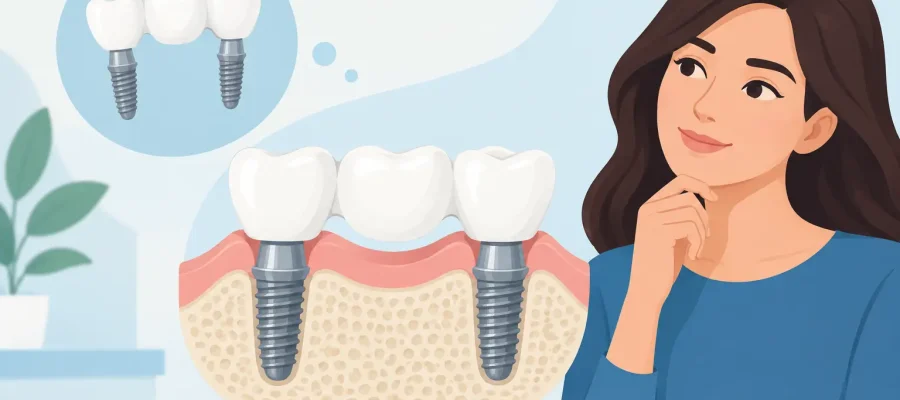
An implant bridge is a custom restoration supported by dental implants rather than by neighboring natural teeth. Small titanium implant posts are placed in the jawbone, where they act like replacement tooth roots. Once the implants are stable, a bridge of connected crowns is secured to them.
For example, if three adjacent teeth are missing, a dentist may place two implants and attach a three-unit bridge. The implants support the teeth at each end, while the center crown fills the space without needing its own implant. The number of implants depends on the location of the gap, the quality of your bone, your bite, and the length of the bridge.
This differs from a conventional bridge, which is attached to crowns placed over the teeth beside the gap. An implant-supported bridge does not require healthy neighboring teeth to be reshaped. That is a major advantage for patients who want to preserve as much natural tooth structure as possible.
Why Patients Choose an Implant-Supported Bridge
The appeal is straightforward: fixed teeth that do not move when you speak, smile, or eat. A well-designed bridge can restore both function and visual balance, especially in the smile zone where even one missing tooth can be highly noticeable.
Implants also help maintain the jawbone. After a tooth is lost, the bone in that area can gradually shrink because it no longer receives chewing pressure through a tooth root. Implant placement transfers force into the bone, helping to support the facial structure over time. It does not stop every biological change, but it is the closest replacement to a natural root.
For aesthetic cases, the bridge is designed around more than tooth color. Shape, translucency, surface texture, gum contours, and the way the teeth appear during speech all matter. At DRGO Smile Clinic, digital planning can help patients preview the proposed smile direction before final restorations are made, creating more certainty before treatment begins.
Who Is a Good Candidate?
A strong candidate has one or more missing teeth, healthy enough gums, and adequate bone to support implants. Many patients who have worn a removable partial denture for years are also candidates, although they may need bone grafting first if bone volume has reduced.
Your dentist will assess the area with a clinical exam and 3D imaging. This planning stage reveals details that cannot be judged from a standard photo alone: bone height and width, sinus position in the upper jaw, nerve location in the lower jaw, infection around old tooth roots, and the available space for natural-looking crowns.
Smoking, uncontrolled diabetes, active gum disease, heavy teeth grinding, and certain medical conditions can affect healing or long-term success. These factors do not automatically rule out treatment, but they change the plan. A patient who grinds heavily, for instance, may need a stronger bridge material and a protective night guard. Precision means planning for how you actually use your teeth, not just how they look on day one.
When Bone Grafting or a Sinus Lift Is Needed
If a tooth has been missing for a long time, the bone may not be deep or wide enough for a stable implant. Bone grafting can rebuild the foundation before implant placement. In the upper back jaw, a sinus lift may create sufficient vertical space when the sinus cavity sits close to the available bone.
These procedures can add healing time, which matters for international patients booking flights around a treatment schedule. However, some patients are suitable for immediate implant placement after a tooth extraction, reducing the number of stages. The deciding factor is clinical stability, not convenience alone.
The Implant Bridge Treatment Process
A premium result begins with a detailed plan, then moves through carefully controlled stages.
1. Digital consultation and smile planning
The first step is understanding your goals. Are you replacing back teeth for chewing strength, restoring front teeth for a camera-ready smile, or rebuilding a larger section after years of dental problems? Digital scans, photographs, X-rays, and 3D imaging are used to map the treatment.
Your clinician also considers the teeth visible when you smile and the amount of gum shown. A bridge can be technically strong but still look wrong if it is too opaque, too long, too square, or poorly aligned with your natural smile line.
2. Implant placement
The implants are placed into the jawbone under local anesthesia, with sedation options available when appropriate. If a failing tooth must be removed, extraction and implant placement may sometimes be completed in the same visit. In selected cases, a temporary fixed bridge can be placed quickly, so you do not leave with an obvious gap.
Immediate teeth are not always final teeth. They are designed to protect your appearance and guide healing while the implants integrate with the bone. The final bridge is placed only when the foundation is ready.
3. Healing and provisional phase
Osseointegration is the process in which the implant and surrounding bone become stable together. Healing often takes several months, though the exact timeline varies by implant site, bone quality, grafting needs, and whether an immediate protocol was used.
During this period, you may wear a temporary restoration. It lets you smile with confidence while your dentist evaluates healing, gum shaping, bite comfort, and the final aesthetic direction. This stage is especially valuable for front teeth, where small refinements can make the final result look more natural.
4. Final bridge design and placement
Once healing is complete, the final bridge is created from high-quality materials such as zirconia or layered ceramic, depending on the location and desired appearance. Back teeth may prioritize strength, while visible front teeth often require more translucency and fine color characterization.
Your dentist checks the bridge from every angle: how it meets the gums, how it contacts neighboring teeth, how it closes against the opposite bite, and how it looks in motion. The goal is not simply a white bridge. It is a believable, balanced smile built for daily life.
How Long Does Treatment Take for International Patients?
There is no single timeline because bone biology sets the pace. If you need only the final bridge after implants have already healed, treatment may be completed within a shorter visit. If implants are being placed for the first time, you may have an initial trip for surgery and a later trip for final crowns after healing.
Some eligible patients can receive immediate temporary teeth following implant surgery. This can be ideal for travelers who cannot return home with visible gaps. Still, immediate loading is only recommended when implant stability and bite conditions meet strict requirements. A fast plan should never override a stable plan.
International treatment works best when logistics are coordinated around the clinical schedule. Clear pre-travel imaging, a realistic stay length, accommodation support, transfers, and multilingual communication reduce unnecessary stress. Your trip should feel organized, but your treatment decisions should remain clinically led.
Implant Bridge vs. Other Tooth Replacement Options
fA removable partial denture is usually the most affordable initial option, but it can shift, feel bulky, and place pressure on neighboring teeth. It does not prevent bone loss in the missing-tooth area.
A traditional tooth-supported bridge can be an excellent solution when the neighboring teeth already need crowns or when implant surgery is not appropriate. Its trade-off is that adjacent teeth are prepared to carry the restoration.
Individual implants may be ideal when each missing tooth has sufficient bone and space. An implant bridge can reduce the number of implants required across a larger gap, making it a strategic option for restoring several teeth while still delivering fixed support. The best choice depends on your anatomy, long-term goals, budget, and the condition of the teeth you still have.
Caring for Your New Bridge
An implant bridge is durable, but it needs disciplined maintenance. Brush twice daily, clean around and beneath the bridge with tools recommended by your dentist, and attend professional hygiene visits. The bridge itself cannot decay, yet plaque can still cause inflammation around the implants and gums.
Avoid using your teeth to open packaging or bite hard objects. If you clench or grind, wear your prescribed night guard. With careful design, good hygiene, and regular follow-up, an implant-supported bridge can be a long-term investment in your smile and comfort.
The most valuable next step is a personalized assessment, not a generic quote. Bring your goals, your timeline, and your current dental records to a consultation. A bridge should give you more than replacement teeth – it should give you a smile that feels composed, natural, and fully yours.