


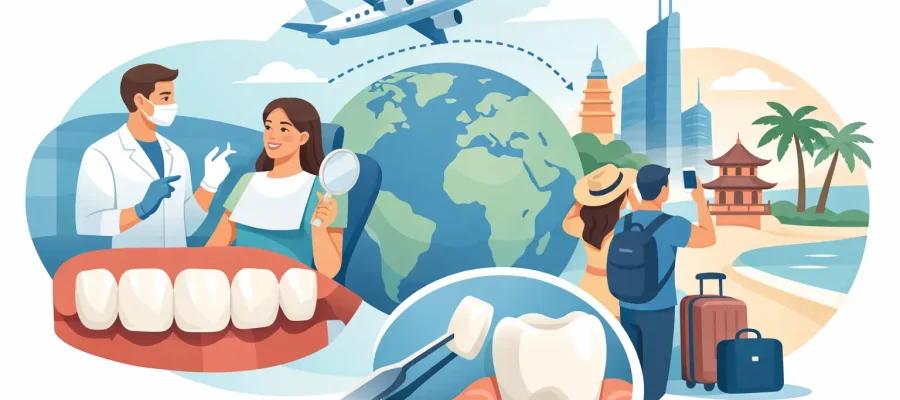
Booking veneers abroad is not really about flying in for thinner porcelain. It is about compressing months of research, trust, design decisions, travel logistics, and visible aesthetic change into one tightly managed experience. That is why an international patient veneer journey review matters so much. The best outcomes come from clinics that treat the smile design and the travel plan with the same level of precision.
For image-conscious patients, veneers are rarely a casual purchase. They are usually tied to something specific – a wedding, a career move, a public-facing role, a major birthday, a content shoot, or simply the point where old bonding, worn enamel, or uneven shapes no longer match the way you want to present yourself. When you add international travel, the decision becomes less about price alone and more about predictability. You want to know what happens before you land, what happens in the chair, and what happens after you go home.
What an international patient veneer journey review should actually cover
A useful review is not just a happy selfie with bright teeth. It should explain the full sequence. That starts with remote consultation, moves into digital planning, then local arrival, preparation, temporaries if needed, final fitting, bite checks, and post-treatment guidance. If any of those pieces feel vague, the overall experience usually feels riskier than it needs to.
The strongest veneer journeys are built around clear case selection. Not every patient is a veneer-only case. Some need whitening first. Others need gum contouring to improve symmetry. Some are better suited to crowns because of existing restorations or heavier structural loss. A premium clinic will not force every smile into the same package. It will explain why veneers are the right choice – or why they are not.
That is one of the biggest differences between a polished sales pitch and a serious cosmetic treatment pathway. Veneers can look exceptional, but only when the planning respects facial proportions, lip dynamics, bite function, and the amount of natural tooth available.
The pre-travel phase decides more than most patients realize
The international veneer experience starts long before the flight. Good clinics collect photos, videos, dental history, and sometimes X-rays in advance. The goal is not to guess the final result from a few selfies. The goal is to pre-qualify the case, identify limitations, and create a realistic treatment map.
This stage is where patients should ask sharper questions. How many veneers are actually recommended? What material is being used? Is it E-Max or another ceramic? Will the treatment be no-prep, minimal-prep, or conventional prep? How many visits are required on-site? If the smile shown in the mock-up changes during clinical evaluation, what happens next?
That last question matters because digital previews are powerful, but they are still planning tools. They help align expectations, not replace clinical judgment. A premium clinic uses 3D smile planning to create confidence, but it also explains that the final design may be refined once the teeth, gums, bite, and facial movements are assessed in person.
For international patients, speed is attractive, but speed without structure is where disappointment starts. If a clinic promises instant perfection without detailed pre-screening, that is not efficiency. That is compression without control.
Arrival day is part clinical, part concierge
An international veneer journey review should also talk about logistics, because comfort affects perception. When a clinic organizes airport pickup, hotel coordination, scheduling, and language support well, patients stay focused on the result instead of the friction. That matters more than people think, especially after a long-haul flight.
The first in-person consultation is where the plan becomes real. Photos are taken under professional lighting. The dentist evaluates tooth position, old restorations, gum levels, and occlusion. The smile design is discussed in practical terms – shape, brightness, edge length, femininity or masculinity of the contours, and how natural or high-impact the final look should be.
This is where experienced cosmetic teams stand out. Many patients say they want a Hollywood smile, but that phrase can mean very different things. Some want ultra-bright, camera-ready symmetry. Others want a polished version of their natural smile with softer translucency and less obvious change. A good veneer journey is not about giving every patient the same white template. It is about engineering the right version of confidence for that face.
Tooth preparation and try-in are the turning points
Most veneer anxiety centers on preparation. Patients want to know how much tooth structure is removed, whether it hurts, and whether the process is reversible. The honest answer is that it depends on the starting point. Minimal-prep cases preserve more enamel and are often ideal when alignment and size corrections are modest. More complex smile changes may require greater reshaping. Cases with heavy fillings, fractures, or previous dentistry may also shift the recommendation.
That is why blanket promises can be misleading. “No shaving” sounds attractive, but it is not always the best route for esthetics or long-term fit. Bulky veneers can look artificial and feel wrong in the bite. Precision matters more than slogans.
Once preparation is complete, the try-in stage becomes crucial. This is when shape, proportion, phonetics, and general harmony are tested before final bonding. Patients often focus only on color, but edge position and tooth width are just as important. A veneer that is too long can change speech. A design that is too square or too rounded can alter the entire character of the smile.
At high-performing clinics, this stage is collaborative but guided. Patients should absolutely give feedback, but they also benefit from expert direction. The best cosmetic dentists know when a requested change will improve the result and when it will compromise balance.
Final bonding is where beauty meets discipline
The final placement appointment can feel dramatic because the transformation becomes visible all at once. But behind that reveal is a very technical process. Isolation, bonding protocol, fit verification, contact points, and bite calibration all matter. Veneers are esthetic restorations, but they still live in a functional system.
A strong international patient veneer journey review should mention this because glamour alone is not quality control. Beautiful veneers that are too high in the bite or poorly contoured at the gumline can create problems later. Premium dentistry means the smile photographs well and performs well.
This is one reason many international patients choose clinics built around digital workflows and same-stay efficiency. When CAD/CAM systems, lab communication, and smile design are tightly integrated, turnaround can be fast without feeling rushed. That combination – speed with discipline – is what premium travelers are really paying for.
What patients love, and what they sometimes underestimate
The biggest upside of going abroad for veneers is obvious: a high-impact cosmetic result delivered within a short, organized timeline, often with a clearer package cost than in the US. For busy professionals, creators, and event-driven patients, that time compression is a major advantage.
The second upside is focus. International treatment trips create a dedicated window where the smile becomes the priority. There are no work commutes between appointments, no delayed lab stages spread over months, and no fragmented communication between providers. In the best cases, everything is designed around momentum.
Still, there are trade-offs. Travel adds pressure to decision-making. If you are jet-lagged, anxious, or undecided about the final style, the process can feel intense. Veneers also require commitment. Even beautifully done ceramic restorations are not a casual experiment. They need maintenance, smart habits, and occasional future replacement over the long term.
Patients also sometimes underestimate adaptation. New veneers may feel slightly unfamiliar for a short period, especially if length or contour has changed. That does not mean something is wrong. It usually means your lips, tongue, and bite are adjusting to a new architecture.
A realistic international patient veneer journey review
A realistic international patient veneer journey review is positive without pretending every case is identical. The best experiences usually share the same pattern: detailed remote planning, a clinic that communicates clearly, a design process that balances patient preference with professional judgment, and a final result that looks intentional rather than generic.
When those elements are missing, patients tend to describe the same problems. The preview looked better than the final smile. The color was discussed more than the shape. The treatment moved quickly, but not confidently. Or the clinic handled the dentistry but not the travel stress around it.
That is why premium international veneer care works best inside a full-service model. When clinical planning, on-site comfort, and timeline control are managed together, the patient experience feels elevated rather than improvised. Clinics such as DRGO Smile have built their appeal around exactly that expectation: a signature smile supported by disciplined design, fast execution, and concierge-level coordination.
If you are considering veneers abroad, review the journey as carefully as the before-and-after photos. Ask how the smile is designed, how the fit is verified, how many days are needed, and what support exists once you return home. The right veneer trip should feel clear before it feels exciting – and that is usually the first sign you are in the right hands.