


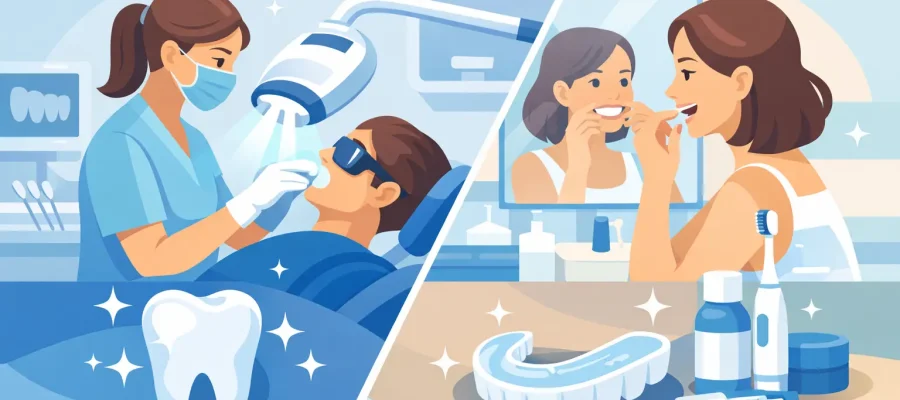
A brighter smile can look simple on Instagram and surprisingly complicated in real life. If you are comparing professional whitening vs home whitening, the real question is not which one is cheaper or easier – it is which option gives you the level of change you want, on the timeline you need, with results that still look clean, healthy, and believable up close.
For some people, a take-home system is enough. For others, especially before a wedding, media appearance, job transition, or smile makeover, waiting weeks for a mild improvement does not feel like a smart trade. Whitening is not one-size-fits-all, and the best option depends on your enamel, your staining pattern, your sensitivity level, and how dramatic you want the final result to be.
Professional whitening vs home whitening: what really changes?
The biggest difference is control. Professional whitening is managed by a dental team that evaluates your teeth first, selects the right whitening strength, protects your gums, and monitors your response during treatment. Home whitening is more self-directed. You choose a product, follow the instructions, and hope the formula, fit, and timing all work in your favor.
That difference in supervision affects almost everything else: speed, comfort, safety, and consistency. Professional treatment usually uses stronger whitening agents and a more precise application process, so the results tend to appear faster and look more even. Home methods can still improve shade, but they often require more patience and come with more variation from person to person.
There is also the issue of diagnosis. Not every dark or yellow tooth will whiten the same way. Surface stains from coffee, tea, red wine, or smoking may respond well. Deeper discoloration from aging, trauma, medications, thin enamel, or prior dental work is a different situation. A professional can spot that early and tell you if whitening will help, if it will only partly help, or if another cosmetic option would create a better finish.
How professional whitening works
In-office whitening is built for visible change in a controlled setting. The appointment usually begins with an exam, because healthy teeth and gums matter before any whitening gel touches the enamel. If there is untreated decay, gum inflammation, exposed roots, or leaking restorations, whitening may need to wait.
Once the teeth are cleared for treatment, the gums and soft tissues are protected and a high-strength whitening gel is applied carefully. Depending on the system, the process may involve timed cycles over one visit. The main advantage is concentration plus precision. You are not guessing how much gel to use, whether a strip is sitting crooked, or whether the product is actually contacting the full tooth surface evenly.
This is why professional whitening is usually chosen by patients who want speed and predictability. It is especially appealing when timing matters. If you are traveling for aesthetic dentistry, or pairing whitening with a broader smile upgrade, professional treatment fits the expectation of an efficient, managed result.
Another advantage is customization. Some patients need a conservative approach because they are prone to sensitivity. Others need a stronger protocol because the staining is heavier. A clinic can adapt the treatment instead of forcing every smile into the same over-the-counter formula.
How home whitening works
Home whitening covers a wide range of products, and that range is exactly why results can feel inconsistent. Whitening strips, paint-on gels, LED kits, trays, and dentist-provided take-home kits all fall into the same broad category, but they are not equal.
Over-the-counter options are designed for convenience and mass use. That often means lower whitening strength and a generic fit. They can be useful for maintenance, for mild staining, or for people who want a gradual improvement rather than a fast transformation. They are also easier to start without scheduling an appointment.
The trade-off is precision. If strips do not adapt well to your tooth shape, some areas may whiten more than others. If trays are not custom-made, gel placement can be uneven or irritating. If you stop early because of sensitivity or impatience, the final result may fall short.
Dentist-supervised take-home whitening sits in a stronger middle ground. You still whiten at home, but the trays are custom-fitted and the formula is chosen more intentionally. This can deliver excellent results for the right patient, especially if you want flexibility with more professional oversight.
Speed, shade, and predictability
If your main priority is fast visible change, professional whitening usually wins. Many patients see a noticeable improvement after one appointment, while home systems typically require days or weeks of regular use. That does not make home whitening ineffective. It simply makes it slower and more dependent on consistency.
Predictability also matters. Some people are not looking for a generic brighter smile. They want a polished, camera-ready result that works with the rest of their features and upcoming plans. In those cases, professional whitening has a stronger advantage because it is easier to control the pace and monitor the outcome in real time.
Still, there are limits. Whitening works on natural tooth structure, not on crowns, veneers, bonding, or fillings. If you have visible restorations on your front teeth, whitening the surrounding enamel may create a mismatch. That is one reason cosmetic clinics evaluate whitening as part of the whole smile, not as an isolated product purchase.
Sensitivity and safety
Sensitivity is one of the first concerns people bring up, and for good reason. Both professional and home whitening can cause temporary tooth sensitivity, especially if you already have enamel wear, gum recession, or naturally reactive teeth.
The difference is how that sensitivity is managed. In a professional setting, the treatment can be adjusted immediately. Exposure times can be modified, protective measures can be used, and the clinician can tell whether the discomfort is expected or a sign that whitening should pause. At home, many patients push through irritation without knowing whether the product is being used correctly.
Safety is not just about sensitivity. It is also about making sure the teeth are suitable for whitening in the first place. A whitening gel on a healthy tooth is one thing. The same gel on a cracked tooth, untreated cavity, or inflamed gumline is another. That is where clinical screening adds real value.
Cost matters, but so does the finish
Home whitening is usually less expensive upfront. That is the main reason many patients start there. If your stains are light and your expectations are realistic, this can be a smart first step.
But price alone can be misleading. If you buy multiple home systems, use them inconsistently, and still end up booking professional treatment before an important event, the bargain can disappear quickly. Professional whitening costs more because it includes evaluation, stronger formulas, tissue protection, and a more controlled result.
For image-conscious patients, the finish matters. Even whitening, cleaner shade lift, and reduced patchiness often matter more than the lowest possible cost. The right choice is not just about spending less. It is about reaching the result you actually want without wasting time on half-measures.
Who should choose professional whitening?
Professional whitening is usually the better fit if you want a fast upgrade, if your timeline is fixed, if you have moderate to heavy staining, or if you want expert guidance before investing in cosmetic work. It is also the stronger option for patients who are planning veneers, crowns, or a larger smile design, because the whitening can be coordinated with the overall aesthetic plan.
At a clinic like DRGO Smile Clinic, that planning mindset matters. Cosmetic dentistry works best when every detail is engineered together – tooth shade, smile line, proportions, materials, and the level of brightness that looks premium rather than artificial.
Who should choose home whitening?
Home whitening makes sense if your staining is mild, your budget is tighter, and you are comfortable waiting for gradual improvement. It can also be a useful maintenance strategy after professional whitening, assuming your dentist confirms the products and timing are appropriate.
The key is choosing with realistic expectations. Home whitening can freshen a smile. It does not always deliver the kind of high-impact change that patients imagine when they are preparing for a major milestone or trying to upgrade their overall image.
The smartest way to decide
The best whitening choice starts with a clear answer to three questions: how white do you want your teeth to be, how quickly do you need the result, and are your teeth actually good candidates for whitening? If your answer is brighter, soon, and with minimal guesswork, professional care usually makes more sense. If your answer is modest improvement over time, home whitening may be enough.
A brighter smile should not look rushed, patchy, or overdone. It should look intentional, healthy, and proportionate to your face. That is why the smartest whitening decision is rarely about the product alone – it is about choosing the level of precision your smile deserves.