


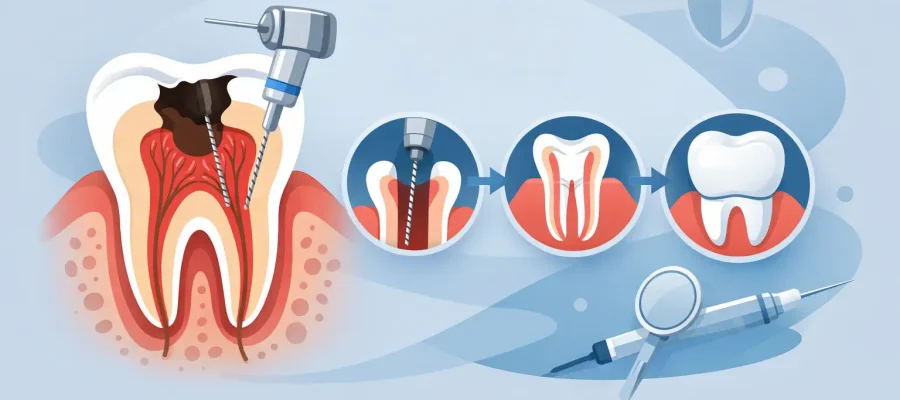
A tooth that throbs when you drink coffee, wakes you up at night, or flares when you bite down usually does not need guesswork – it needs a precise plan. Understanding root canal treatment steps makes the process feel far more manageable, especially if you are balancing pain, travel, and a schedule that does not leave room for drawn-out treatment.
For many patients, a root canal sounds more intimidating than it actually is. In reality, the procedure is designed to remove infection, stop pain at the source, and preserve your natural tooth. When done with modern imaging, careful isolation, and a well-planned restoration, it is one of the most predictable ways to save a damaged tooth.
What a root canal is actually treating
Inside each tooth is a soft tissue called the pulp. This area contains nerves and blood vessels. If decay, trauma, repeated dental work, or a crack allows bacteria to enter the pulp, the tissue can become inflamed or infected. That is when you may notice lingering sensitivity, swelling, pressure, or severe pain.
The goal of root canal therapy is not just to “clean the nerve.” It is to remove infected tissue, disinfect the internal canals, seal the space, and protect the outer tooth so it can function normally again. If the final restoration is delayed or poorly fitted, the tooth may remain structurally vulnerable even if the infection is gone.
Root canal treatment steps from start to finish
The best way to understand the procedure is to see it as a sequence, not a single event. Each stage supports the next.
1. Diagnosis and imaging
The first step is confirming that the pulp is damaged and that root canal treatment is the right option. Your dentist will review your symptoms, examine the tooth, and usually take digital X-rays. In some cases, 3D imaging is helpful, especially when root anatomy is complex, a previous root canal has failed, or there may be a hidden crack.
This stage matters more than patients often realize. Not every painful tooth needs a root canal, and not every tooth that needs one is painful. Accurate diagnosis is what separates efficient treatment from expensive delay.
2. Local anesthesia and comfort setup
Once the tooth is confirmed for treatment, the area is numbed with local anesthesia. Most patients are surprised by how comfortable the procedure feels after this point. The pain associated with a root canal usually comes from the infection before treatment, not from the treatment itself.
If you are especially anxious, comfort planning becomes part of the clinical plan. A modern clinic should make the experience controlled and calm, not rushed.
3. Isolation of the tooth
A rubber dam is typically placed around the tooth. This is a small protective barrier that keeps the area dry and prevents saliva and bacteria from entering the canal system during treatment.
It may seem like a minor detail, but it is a quality marker. Proper isolation improves precision and supports a cleaner, safer result.
4. Access opening
The dentist creates a small opening in the top of the tooth to reach the pulp chamber and root canals. This is the entry point that allows infected tissue to be removed.
The shape and size of this opening depend on the tooth. Front teeth usually have simpler anatomy, while molars often have more canals and can be more technically demanding.
5. Cleaning and shaping the canals
This is the core of the procedure. Tiny instruments are used to remove infected or dead pulp tissue from inside the canals. The canals are then shaped so they can be disinfected and filled properly.
At the same time, antimicrobial solutions are used to flush out bacteria and debris. Precision matters here. If cleaning is incomplete, bacteria can remain. If too much structure is removed, the tooth can weaken. Good endodontic treatment is a balance of thorough disinfection and tissue preservation.
6. Measuring the canal length
Your dentist needs to know the exact working length of each canal to clean and seal it completely. This is done with digital imaging, electronic apex locators, or both.
It is one of the reasons root canal treatment today is more predictable than it was years ago. Better measurement supports better sealing, and better sealing lowers the risk of reinfection.
7. Medication between visits, if needed
Some teeth can be completed in one visit. Others benefit from a two-visit approach, especially when infection is extensive, there is swelling, or the tooth is particularly difficult to dry and disinfect.
In those cases, medication may be placed inside the canals before a temporary filling is used to close the tooth. This is not a sign that something is wrong. It is often the smarter approach when the goal is a cleaner and more stable outcome.
8. Filling the canals
Once the canals are fully cleaned and dry, they are filled with a biocompatible material called gutta-percha, along with a sealing cement. This closes the internal space and helps prevent bacteria from re-entering.
A well-sealed canal system is essential, but it is only part of the finish. The outer tooth still needs to be restored correctly.
9. Temporary or permanent restoration
After the canal is sealed, the access opening is closed with a filling. In some cases, that restoration may be temporary until the tooth receives its final protection.
For back teeth in particular, a crown is often recommended after root canal treatment. Molars and premolars handle heavy bite forces. Once the pulp is removed and the tooth has been drilled and cleaned internally, it can become more brittle over time. A crown helps distribute pressure and reduce the risk of fracture.
10. Final crown, if indicated
This final stage is where function, longevity, and aesthetics come together. If a large portion of the tooth is missing, a custom crown is usually the safest next move.
For international patients or anyone on a tight schedule, the timing of this step matters. Some clinics can streamline the process with digital scanning and CAD/CAM workflows, which may reduce the number of appointments needed. That depends on the tooth, the amount of remaining structure, and whether the area has settled enough for final restoration.
How long the process takes
One of the most common questions about root canal treatment steps is whether everything happens in a single appointment. The answer is: sometimes.
A straightforward front tooth may be treated in one visit. A molar with curved canals, active infection, or retreatment needs may require two or more appointments. The final crown may also happen separately, depending on the clinical situation.
If you are planning treatment while traveling, this is where upfront assessment becomes valuable. The ideal schedule depends on complexity, not just preference.
What recovery usually feels like
Most patients feel relief once the infected tissue is removed. It is still normal to have some tenderness for a few days, especially when chewing. That soreness is usually manageable with the medications your dentist recommends.
Pain that worsens instead of improving, visible swelling, or a bite that feels too high should be reviewed promptly. Recovery is usually smooth, but follow-up matters when something feels off.
When root canal treatment may not be enough
Saving the natural tooth is usually the first choice, but there are limits. If the tooth has a vertical root fracture, extreme structural damage, or not enough healthy tooth left to support a restoration, extraction may be the better long-term decision.
That is where honest planning matters. A root canal should not be sold as a default solution if the tooth cannot be restored predictably. In a high-level clinic, the decision is based on long-term function and esthetics, not just keeping the tooth for the sake of it.
Why the restoration matters as much as the root canal
Patients often think the root canal is the entire treatment. Clinically, it is only the infection-control phase. The long-term success of the tooth depends heavily on what happens after – how well the tooth is sealed, whether it needs a crown, how the bite is adjusted, and whether the remaining structure can handle daily force.
That is why comprehensive clinics tend to produce stronger outcomes. Endodontic treatment, restorative design, and bite management work best when they are planned together.
At a clinic like DRGO Smile Clinic, where treatment planning is built around speed, precision, and high-value outcomes, that kind of coordinated workflow is especially important for patients traveling on a timeline.
If you have been told you need a root canal, the right next step is not to panic – it is to get a clear diagnosis, understand the sequence, and make sure the final restoration is part of the plan from day one.