


You do not want to fly to another country, sit in a dental chair, and hope your new smile looks good at the end. If you are investing in veneers, crowns, implants, or a full Hollywood Smile, you want to see the direction before treatment starts. That is exactly why the digital smile design 3d preview process matters.
For patients planning cosmetic dentistry abroad, a 3D smile preview is not just a nice extra. It is part of how a clinic proves precision, reduces surprises, and turns aesthetic goals into a treatment plan you can actually evaluate. When done well, it gives you a realistic view of tooth shape, symmetry, proportions, and how your smile will sit within your face – not just on a model.
What the digital smile design 3d preview process is
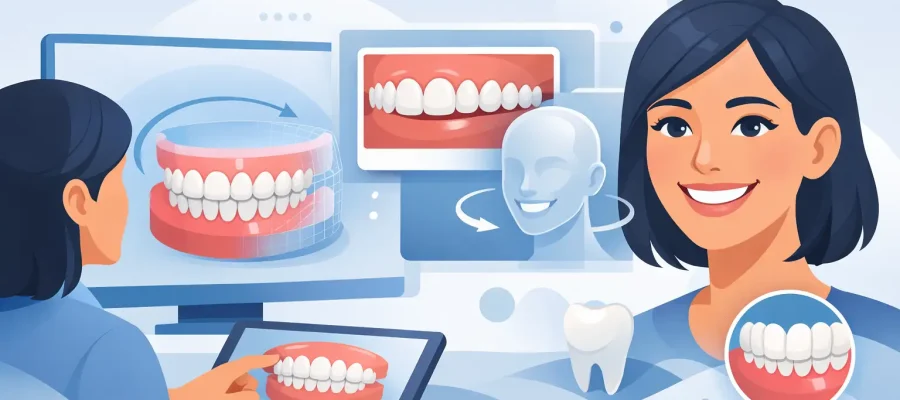
The digital smile design 3d preview process is a planning system that combines facial analysis, dental scans, photos, videos, and software-based design to map your future smile before final restorations are made. Instead of choosing a shade and hoping for the best, your dentist builds a smile around your facial features, bite, lip line, and treatment goals.
That matters because beautiful dentistry is not only about white teeth. A smile can look expensive and still look wrong if the teeth are too long, too flat, too bulky, or out of balance with the patient’s face. Digital planning brings aesthetics and function into the same conversation early.
For international patients, this is also a trust issue. You want to know what is being proposed, how much change is realistic, and whether your treatment timeline fits your travel schedule. A 3D preview helps answer those questions before the final work begins.
Why patients ask for a preview before booking
Most smile makeover patients already know what they do not like. They may mention short teeth, dark crowns, gaps, worn edges, gummy smile, or old dental work that looks artificial on camera. What they usually cannot judge on their own is how those issues should be corrected without overdoing the result.
A preview gives you a visual reference point. That can make the decision easier, especially if you are comparing clinics and want more than generic before-and-after photos. It also helps event-driven patients – people preparing for weddings, business launches, public appearances, or content shoots – because it supports a faster, more predictable workflow.
There is a practical benefit too. If the preview reveals that your ideal result requires gum contouring, bite adjustment, whitening, or implant planning first, that is better to know upfront than halfway through treatment.
Step 1 – Records are taken with the face in mind
Every strong smile design starts with data. This usually includes high-resolution photos, intraoral scans, bite records, and short videos of your face while speaking and smiling. In some cases, X-rays or CBCT imaging are added if implants, bone levels, root positions, or jaw relationships need to be evaluated.
The key detail here is that your dentist is not only scanning teeth. They are studying how your teeth relate to your lips, facial midline, smile arc, and overall expression. A smile that looks perfect on a screen grab of the mouth alone may look unnatural when the full face is moving.
This is one reason high-end clinics place so much emphasis on photography and digital records. The more accurate the input, the more useful the preview.
Step 2 – Your ideal smile is designed on screen
Once the records are collected, the design phase begins. Your dentist or design team uses software to build the proposed smile shape and position. They assess tooth width, length, contour, incisal edge position, symmetry, gingival levels, and how bright the final shade should appear against your complexion.
This is where patient preference matters. Some people want a very polished Hollywood Smile with brighter, more uniform shapes. Others want a softer, more natural luxury look that still feels refined but not overly done. The right design depends on your face, age, style, and what kind of presence you want your smile to create.
There is always a balance to manage. Ultra-white teeth can look striking in photos, but if the shapes are too square or too large, the result can lose elegance. A natural-looking design can age beautifully, but if the patient wanted dramatic change, it may feel too conservative. Good smile design is not about copying a celebrity photo. It is about engineering a result that suits you.
Step 3 – The 3D preview turns design into something tangible
This is the stage patients care about most. The digital plan is translated into a 3D model or printed mock-up so you can preview the proposed outcome more realistically. Depending on the case, that preview may be shown digitally on screen, transferred into a temporary in-mouth mock-up, or both.
Seeing the design in the mouth changes everything. It lets you judge length, fullness, edge position, and speech impact far better than a flat image ever could. You can smile, talk, and get a sense of whether the design feels like you at your best.
At this point, small refinements are common. A patient may want slightly softer corners, less length in the front teeth, or a more natural transition in shape from central incisors to canines. That does not mean the design failed. It means the process is doing its job before permanent restorations are made.
What a 3D smile preview can and cannot promise
A preview is a planning tool, not a magic guarantee. It is highly useful, but it still depends on the underlying oral condition, materials chosen, and how your tissues respond during treatment.
For veneers and crowns, previews are usually very accurate in showing the intended style and proportion. For implant cases, especially full-arch restorations, the design is equally valuable but the final result may require more clinical adaptation because bone support, implant positioning, and bite mechanics play a larger role.
Soft tissue also matters. If your gums are inflamed, uneven, or healing from a surgical stage, the final look may evolve slightly as tissues settle. That is why experienced clinics present the preview as a disciplined projection rather than a sales animation.
How this affects treatment speed
Patients often assume that more planning means slower treatment. In reality, the opposite is often true. When the smile is designed properly in advance, tooth preparation, temporaries, CAD/CAM production, and final placement become more efficient.
That is especially valuable for international patients working within a tight travel window. The preview allows clinical and lab teams to move with purpose instead of making aesthetic decisions late in the process. It reduces chairside guesswork and shortens the path to a result that looks intentional.
At clinics built around same-day workflows, this planning can support one-visit crowns, immediate smile makeovers, and faster approvals because the visual direction has already been established.
Who benefits most from the digital smile design 3d preview process
The digital smile design 3d preview process is especially valuable for patients making major visible changes. If you are getting multiple veneers or crowns, replacing old cosmetic work, correcting worn teeth, or combining implants with aesthetic restorations, previewing the result is smart.
It is also ideal for people who are highly image-aware. If your work includes meetings, media, content creation, sales, performance, or public-facing events, your smile is part of your presence. You are not only buying dental treatment. You are buying confidence, consistency, and camera-ready detail.
Patients traveling for care benefit even more because they need clarity before they commit to flights, hotel time, and a treatment calendar. That is one reason premium clinics such as DRGO Smile Clinic build digital smile planning into a more controlled patient journey.
Questions to ask before you rely on a preview
Not every preview has the same value. Some clinics show a quick cosmetic simulation that looks attractive but is not closely tied to function or manufacturable restorations. Others use the preview as a true blueprint for treatment.
Before moving forward, ask how the design is created, whether it is based on scans and facial analysis, whether you will see an in-mouth mock-up, and how much room there is for revisions before the final restorations are produced. You should also ask whether the proposed result matches the material being used, such as E-Max veneers or zirconium crowns, because materials affect thickness, translucency, and edge design.
A serious clinic will explain the limitations clearly. That is usually a good sign.
Why this process changes the patient experience
The biggest advantage of a 3D smile preview is not only visual. It changes the psychology of treatment. Instead of feeling talked into a makeover, you feel involved in a controlled design process. That lowers anxiety and raises confidence.
For many patients, that shift is what finally gets them to move forward. They stop thinking, “I hope this works,” and start thinking, “Yes, this is the direction I want.” That is a very different kind of decision.
If you are considering cosmetic dentistry or implant treatment abroad, ask to see how the clinic approaches smile design before anything irreversible begins. A premium result should feel engineered, not improvised. And when you can preview your future smile with clarity, the journey starts to feel a lot closer to certain.