


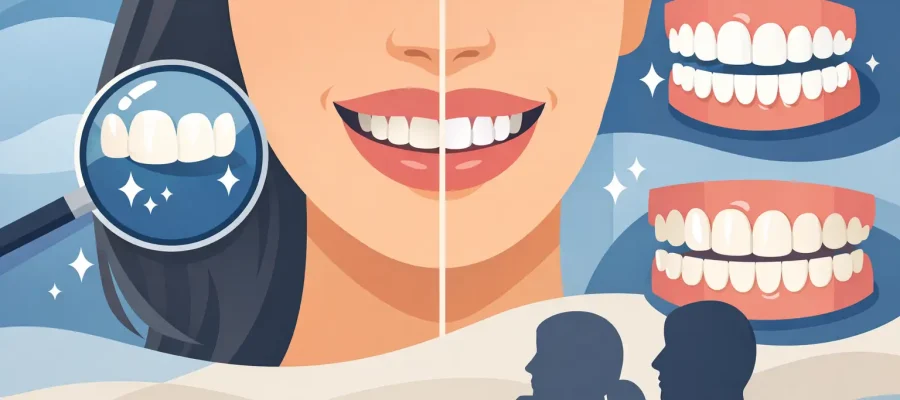
You can spot bad veneers in seconds – teeth that are too white, too flat, too bulky, or identical from corner to corner. That is usually what people mean when they ask, why do veneers look fake? The short answer is not that veneers are the problem. Poor planning is. When veneers are designed without respect for facial features, gum shape, bite, light reflection, and tooth proportions, the result can look obvious instead of elevated.
The good news is that natural-looking veneers are absolutely possible. In the right hands, they do not announce themselves. They simply make your smile look cleaner, more balanced, and more photogenic.
Why do veneers look fake on some people?
Fake-looking veneers usually come from one of two mistakes: overdesign or underdiagnosis. Overdesign happens when the teeth are made too perfect in a way that does not match the face. Underdiagnosis happens when a clinic focuses only on the front view of the teeth and ignores the bigger picture – lip movement, gum display, speech, bite forces, facial symmetry, age, and skin tone.
A smile is not a row of identical tiles. Natural teeth have small variations in length, translucency, texture, and edge shape. They reflect light differently from the neck of the tooth to the tip. They also sit in a relationship with the lips and gums. If veneers erase all of that character, the eye reads them as artificial, even if the workmanship is technically clean.
This is why some celebrity smiles get criticized online. The issue is rarely the concept of veneers itself. It is usually a mismatch between the restoration and the person wearing it.
The biggest reasons veneers look unnatural
The most common cause is choosing a shade that is too bright. Many patients ask for the whitest possible result because they want a dramatic transformation. That can work for some faces and some personal brands, especially on camera. But a very opaque white with no depth can make teeth look like plastic. Natural enamel has dimension. It is not a flat block of white.
Shape is another major factor. Teeth that are too square, too long, or too wide can make the smile feel heavy. If every tooth has the same outline and the same incisal edge, the result loses the subtle asymmetry that real teeth have. A natural smile still feels refined, but not cloned.
Thickness matters more than most patients realize. Veneers that are too bulky can push the lips outward, affect speech, and create a stiff appearance. This often happens when teeth are not prepared properly or when the treatment plan tries to mask major alignment issues without correcting the foundation first.
Gum architecture also plays a huge role. Even beautifully made veneers can look fake if the gum levels are uneven or if too much gum shows when smiling. Sometimes the fix is not a different veneer. It is gum contouring, better proportion planning, or a more complete smile design approach.
Then there is material choice. Lower-quality materials or poorly layered restorations can look flat under daylight or flash photography. High-end ceramics such as E-Max Veneers are popular for a reason – they can mimic the way natural enamel carries light. That does not mean every patient needs the same material, but it does mean material selection is aesthetic strategy, not a minor technical detail.
Veneers should match the face, not just the photo reference
A common mistake in cosmetic dentistry is designing a smile from inspiration photos instead of the patient in the chair. A photo of a celebrity smile may look incredible on one face and completely wrong on another. Veneers should be built around facial proportions, lip line, age, and the way a person actually speaks and smiles.
For example, a younger patient may suit slightly softer edge contours and a brighter shade with lively translucency. A mature patient may need a more elegant balance that does not look over-polished against their facial features. Someone with a broad smile line may need different width and length ratios than someone whose lips reveal less tooth structure.
This is where digital planning changes the outcome. When a clinic uses 3D smile design and preview-based planning, the patient can see how the smile will sit within the whole face before final treatment begins. That removes guesswork. It also prevents the classic problem of getting technically nice veneers that still do not feel like you.
Why do veneers look fake when crowns are used instead?
Patients often use the word veneers loosely, but many unnatural smile makeovers are actually full crowns placed across the visible teeth. Crowns are not bad treatment when they are indicated. In some cases they are the right option because the teeth are heavily restored, structurally weak, or require more full-coverage correction.
The problem appears when crowns are used where more conservative veneer planning would have created a lighter, more enamel-like result. Crowns can look beautiful, but they require a different design philosophy. If they are made too opaque or too uniform, the smile can lose the fine detail that makes it believable.
That is why the first question should never be, veneers or crowns? The first question should be, what does this specific smile need to look natural and last well?
The role of bite and function in a natural look
A smile can look fake not only because of color or shape, but because it moves unnaturally. If veneers are placed without properly evaluating the bite, the patient may start chipping edges, clenching harder, or speaking differently. The restorations may feel awkward, and awkward often reads as artificial.
Functional planning protects aesthetics. The front teeth must look elegant, but they also have to guide speech, support the lips, and work with the back teeth. If that relationship is ignored, even a beautiful result can lose its polish quickly.
This is one of the trade-offs patients should understand. Ultra-fast treatment is appealing, especially for international travelers, but speed only works when it is backed by disciplined diagnostics, digital design, and precise lab communication. Fast without planning is where many fake-looking outcomes begin.
How expert clinics keep veneers from looking fake
The best veneer work starts before any tooth is touched. It begins with photos, video, digital scans, facial analysis, bite evaluation, and a conversation about how the patient wants to be seen. Not everyone wants the same level of brightness or drama. Some want a camera-ready Hollywood Smile. Others want people to notice that they look better without realizing why.
A strong clinic translates that goal into design decisions. Tooth length is calibrated to the face. Width ratios are adjusted so the smile looks balanced from the front and natural in motion. Shade is chosen in context with skin tone, eye color, and the patient’s preference for a softer or more striking finish. Surface texture and translucency are added so the teeth do not look flat.
Try-ins matter too. Temporary mock-ups let patients test the smile in real life – while talking, smiling, and being photographed. This stage catches problems early. A veneer case should not feel like a reveal with fingers crossed. It should feel engineered.
That is the standard at clinics that specialize in aesthetic dentistry at a high level. At DRGO Smile Clinic, for example, digital smile planning and preview-led workflows are built to reduce surprises and create a signature smile that looks intentional, not obvious.
What patients should ask before getting veneers
If you are worried about fake-looking veneers, ask to see results that match your age group, face shape, and aesthetic goals – not just the brightest before-and-after cases. Ask what material will be used and why. Ask whether your gums, bite, and lip line are being evaluated as part of the plan. Ask whether you will preview the design before final placement.
Also ask a less glamorous question: how much tooth preparation is actually needed? The most natural result is not always the most aggressive makeover. In many cases, restraint is what creates sophistication.
The right smile makeover should look expensive in the best way – polished, confident, and completely at home on your face. If veneers ever look fake, it is usually because someone chased whiteness or uniformity instead of harmony. A great cosmetic result does not erase character. It refines it.
If you are considering veneers, the smartest move is not asking for the whitest smile in the room. It is asking for the one that looks like it was always meant to be yours.