


Losing teeth changes more than your smile. It changes how you eat, how you speak, how your face is supported, and how confident you feel in photos, meetings, and everyday life. When patients compare dental implants vs dentures, they are usually not just choosing a treatment. They are choosing how they want to live over the next 5, 10, or 20 years.
For some people, dentures are the quickest route back to a complete smile. For others, implants are the upgrade that feels closest to having natural teeth again. The right answer depends on your bone support, your budget, your timeline, and how much stability you want from your final result.
Dental implants vs dentures: the core difference
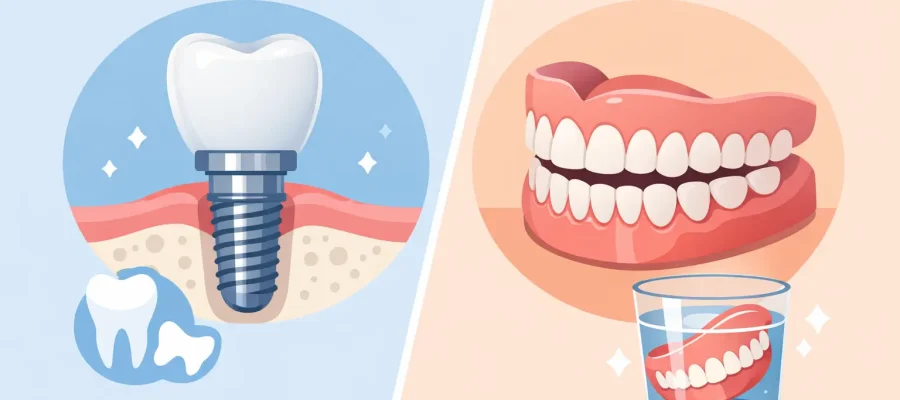
Dentures are removable prosthetic teeth. They sit on top of the gums and replace missing teeth visually and functionally, but they do not fuse with the jawbone. Full dentures replace an entire arch, while partial dentures fill gaps when some natural teeth remain.
Dental implants are titanium posts placed into the jawbone to act like artificial tooth roots. Once healed, they support crowns, bridges, or full-arch restorations. In practical terms, implants are fixed, while traditional dentures are removable.
That one distinction affects almost everything else – comfort, bite strength, maintenance, speech, bone preservation, and the overall sense of security.
How they feel day to day
This is often the deciding factor.
Dentures can restore appearance quickly, but they move more than most patients expect. Even well-made dentures may shift slightly when talking or eating. Adhesives can help, and fit can be improved with adjustments, but the experience is still different from having fixed teeth. Some patients adapt well. Others never fully relax with them.
Implants feel more stable because they are anchored in the bone. That stability matters when you bite into firmer foods, laugh without thinking about movement, or want your teeth to feel like part of you instead of a device you wear. Patients choosing full-arch implant solutions such as All-on-4 or All-on-6 usually do so because they want fixed teeth immediately and a stronger sense of normal life.
If your priority is maximum confidence in social and professional settings, implants usually have the advantage.
Appearance and facial support
Both options can look attractive when planned well, but the quality of the result depends heavily on design.
Dentures can replace lost tooth structure and add lip support, which is helpful when significant volume has been lost. However, because they rest on the gums, they can sometimes look less natural in motion, especially if the fit changes over time.
Implants support restorations in a way that tends to create a more stable, natural-looking smile. They also help preserve the jawbone, which matters for long-term facial shape. Bone loss after tooth removal can create a sunken appearance around the mouth and lower face. Dentures do not stop that process. Implants help slow it because they stimulate the bone in a way dentures cannot.
For image-conscious patients planning around weddings, public appearances, business visibility, or a full smile makeover, that long-term facial support is a major benefit.
Eating, speaking, and comfort
A removable denture can improve chewing compared with having no teeth at all, but it does not restore the same bite force as implants. Harder foods, chewy textures, and certain meats or raw vegetables may still be frustrating. Lower dentures are usually more challenging than upper dentures because they have less natural suction.
Implants create a more powerful and controlled bite. That means more freedom with food and less mental effort while eating. You are not planning around what might dislodge a denture.
Speech matters too. Dentures can affect pronunciation at first, especially if they feel bulky or move during conversation. Many patients adapt, but there is often a learning curve. Fixed implant restorations usually feel more secure during speech, which is a real advantage for anyone in client-facing work, content creation, leadership, or media.
Comfort is more nuanced. Dentures avoid surgery, so they may seem simpler at first. But gum irritation, sore spots, pressure areas, and loosening over time are common. Implants involve a surgical phase, yet once integrated successfully, they often deliver more everyday comfort because there is less friction on the gums.
Cost now vs value later
Dentures usually cost less upfront. That is why they remain a valid option, especially for patients who need a faster, lower-entry solution.
But upfront price is only part of the picture. Dentures often need relines, repairs, adjustments, and eventual replacement as the jaw changes shape. Because they do not preserve bone, fit tends to decline over time.
Implants require a higher initial investment, particularly in full-arch cases or when bone grafting is needed. However, they often offer better long-term value because they are more stable, preserve bone more effectively, and reduce the cycle of repeated remakes and fit issues.
This is where honest treatment planning matters. If a patient wants the lowest immediate cost, dentures may make sense. If a patient wants a premium, fixed result with stronger long-term performance, implants are usually the better strategic choice.
Who is a better candidate for dentures?
Dentures can be a smart solution for patients who want to restore a full smile quickly without surgery, who have significant medical limitations, or who are not ready for the investment required for implants. They can also work well as a temporary phase while a more advanced treatment plan is being staged.
They are not a compromise in every case. A well-crafted denture can restore confidence and improve quality of life dramatically. But it is important to choose dentures with realistic expectations. They replace teeth visually and functionally to a degree, not biologically.
Who is a better candidate for implants?
Implants are ideal for patients who want fixed teeth, stronger chewing power, better long-term bone support, and a result that feels closer to natural teeth. They are especially appealing to people who do not want the daily removal and maintenance that dentures require.
Candidacy depends on bone volume, gum health, general health, smoking habits, and whether any preparatory treatment is needed. Some patients need bone grafting or sinus lift procedures before implants. Others qualify for immediate implant protocols or full-arch systems that shorten the treatment timeline significantly.
This is where advanced planning changes the experience. With digital diagnostics and prosthetic design done before surgery, treatment becomes far more predictable. At DRGO Smile Clinic, this kind of planning is central to delivering fixed, aesthetic outcomes with speed and control.
Dental implants vs dentures for international patients
If you are traveling for treatment, the decision is not only clinical. It is logistical.
Dentures may require fewer surgical steps, but implants can still be highly practical for international patients when the clinic is set up for coordinated care. Immediate-load full-arch treatments, digital smile planning, and tightly managed appointment schedules can compress what used to take months into a more efficient travel pathway.
That matters if you are flying in for a transformation and want clarity before you book. You want to know what happens first, how long you stay, whether temporary fixed teeth are possible, and what the final timeline looks like after healing. A premium clinic should make that process feel engineered, not improvised.
What patients often get wrong
The most common mistake is treating dentures and implants as if they solve the same problem in the same way. They do not.
Dentures are a removable replacement. Implants are a structural replacement.
Another mistake is assuming age decides the answer. It does not. Health, anatomy, expectations, and goals matter much more than the number on your passport.
Some patients also assume implants are only for single missing teeth. In reality, implant systems can replace anything from one tooth to a full arch, often with fewer implants than people expect.
How to decide with confidence
Start with the outcome you want, not just the treatment name. Ask yourself whether you want the quickest removable solution or the strongest fixed solution. Think about your work, your confidence on camera, your diet, and how much maintenance you are willing to accept.
Then look at the clinical side. A proper evaluation should include imaging, bite analysis, bone assessment, and a clear restorative plan. The best treatment is not the most expensive one. It is the one that matches your anatomy, your timeline, and the level of result you expect.
If your goal is simply to replace missing teeth at the lowest initial cost, dentures may be enough. If your goal is to rebuild your smile with stability, aesthetics, and a more premium day-to-day experience, implants usually lead.
The real question is not which option is better on paper. It is which option gives you the version of daily life you actually want to return to.