


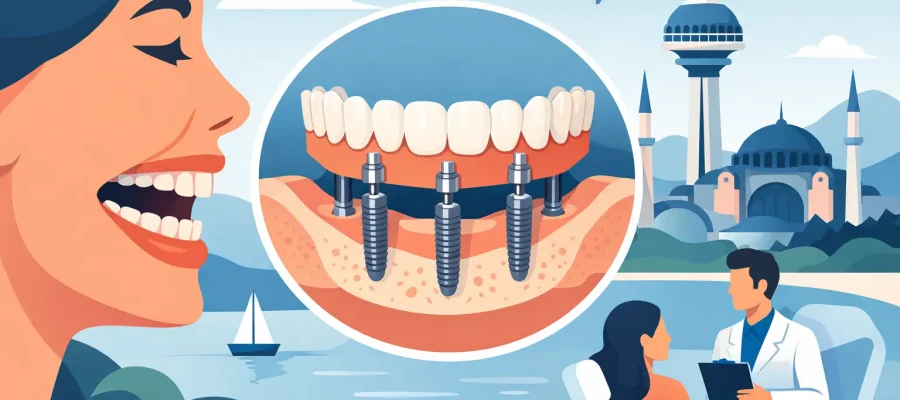
A loose denture can affect far more than meals. It can change how confidently you speak in a meeting, smile in photos, or plan a trip. That is why all-on-4 dental implants in Turkey explained is not simply a question about a lower price abroad. It is a question about whether you can leave with a stable, natural-looking fixed smile, a clear treatment plan, and the right clinical support around it.
All-on-4 is designed for people who have lost most or all teeth in one jaw, or whose remaining teeth cannot be predictably saved. Instead of placing an implant for every missing tooth, a dentist uses four strategically positioned implants to support a full-arch bridge. The result can be a fixed set of teeth that looks, feels, and functions much closer to natural teeth than a removable denture.
What All-on-4 Actually Means
The name describes the foundation, not a one-size-fits-all final result. Four implants are placed in the jawbone: usually two toward the front and two at an angle toward the back. Angling the rear implants can use available bone more effectively and may reduce the need for bone grafting in suitable cases.
A full-arch prosthesis is then attached to those implants. Depending on your clinical condition and treatment plan, this may begin with an immediate temporary fixed bridge and later be replaced with a stronger, more refined final bridge after healing.
That distinction matters. “Fixed teeth immediately” often means you receive a carefully designed temporary bridge on the day of surgery or shortly after, not necessarily the final zirconia or ceramic teeth. A responsible clinic explains what is temporary, what is final, and when each stage happens before you travel.
All-on-4 is commonly used for both upper and lower arches. Some patients are better candidates for All-on-6, which uses six implants for added support where bone volume, bite force, and long-term design call for it. More implants are not automatically better. The right number depends on your scan, bone quality, bite, jaw anatomy, and the type of restoration planned.
Who Is a Good Candidate?
You may be a candidate if you have failing teeth, advanced gum disease, multiple missing teeth, a loose full denture, or extensive dental work that is no longer stable. Patients often choose full-arch implants because they want a permanent-feeling alternative to removable teeth and a more youthful facial support profile.
The first decision is not whether you want four implants. It is whether your mouth is ready for implants. Active infection, uncontrolled diabetes, heavy smoking, untreated gum disease, severe grinding, and certain medications can affect healing and long-term success. These factors do not always rule treatment out, but they can change the timing, implant design, or aftercare requirements.
A credible treatment plan starts with records. Most clinics can provide an initial indication from panoramic X-rays and clear photos, but a final decision should be based on a 3D CBCT scan taken during your visit. This scan shows bone volume, sinus position, nerve pathways, and anatomical details that cannot be safely guessed from a standard X-ray.
All-on-4 Dental Implants in Turkey: The Treatment Journey
For international patients, the appeal is not only access to advanced implant dentistry. It is the ability to combine surgical treatment, digital planning, and organized travel into a tightly managed visit. Still, speed should never replace diagnostic discipline.
1. Remote consultation and preliminary planning
Before booking, you should send your dental X-rays if available, recent mouth photos, medical history, and a short description of your goals. Do you want a brighter smile? Are you concerned about facial collapse from missing teeth? Do you want to replace a denture that moves when you eat?
The clinic should respond with a preliminary plan, not an absolute promise. Ask what the quoted package includes: scans, extractions, sedation options, temporary teeth, final teeth, hotel, transfers, medications, and follow-up appointments. Clarify whether bone grafting, sinus lift procedures, or additional implants would be extra if they become necessary after the CBCT scan.
2. Digital diagnostics in Istanbul
Once you arrive, the clinical team completes the in-person examination. This is where the preliminary plan becomes a precise surgical plan. The dentist evaluates your gums, bite, jawbone, existing teeth, facial proportions, and smile line.
Digital Smile Design can be especially valuable for full-arch cases because the final teeth need to do more than fill space. They need to support your lips, balance your facial features, create a natural tooth proportion, and work comfortably when you speak and chew. A high-end result is engineered, not selected from a generic tooth shade chart.
3. Extractions and implant placement
If damaged teeth remain, they may be removed during the same visit. The implant surgeon then places four implants at planned angles and depths. Where conditions are favorable and implant stability is strong enough, an immediate fixed temporary bridge may be fitted soon after surgery.
Not every patient should receive immediate loading. If bone is soft, an infection is extensive, or the implants do not achieve adequate stability, the safer plan may involve a different temporary solution while the implants integrate. This is not a failure of the process. It is a clinical decision made to protect your final outcome.
4. Your immediate temporary smile
An immediate temporary bridge gives many patients the emotional turning point they came for: they do not leave without teeth. It is designed for appearance, speech, and controlled function during healing.
For the first weeks, you will need a soft-food diet and strict hygiene. Even a fixed bridge needs care. You will brush it with the recommended tools, clean beneath it as instructed, and attend any scheduled checks. Patients who treat the temporary bridge like final teeth too soon risk overloading the healing implants.
5. Healing and the final bridge
Osseointegration is the process in which bone bonds with the implant surface. Healing commonly takes several months, though the exact timeline differs by patient, jaw, bone quality, and medical history.
After healing, the final bridge is designed with greater strength and aesthetic refinement. Materials may include monolithic zirconia or layered ceramics, depending on the smile design and bite. Zirconia is often chosen for full-arch restorations because it is highly durable and can be shaped for a polished, realistic appearance.
The final stage should include a bite check, speech assessment, shade review, and a close look at the gum transition area. These details determine whether your new smile feels like a premium restoration rather than a set of teeth that merely looks good in one photo.
Why Turkey Is a Popular Choice for Full-Arch Implants
Turkey has become a major destination for dental travel because patients can access experienced clinicians, modern digital systems, and comprehensive packages at prices that are often more approachable than comparable private treatment in the United States.
The cost difference should not be interpreted as a reason to compromise on diagnosis, materials, or surgical standards. The value comes from a different operating environment and the ability of high-volume clinics to coordinate dental care, accommodation, airport transfers, interpreters, and appointment schedules efficiently.
For patients traveling from the US, the experience works best when the logistics are handled as carefully as the dentistry. You should know who meets you at the airport, where you will stay, how many clinic visits are expected, and what support is available if you feel uncomfortable after surgery. At DRGO Smile Clinic, the treatment pathway can be paired with VIP transfers, hotel arrangements, and multilingual guidance so your focus stays on recovery and your result.
Questions That Protect Your Investment
Before committing to All-on-4 treatment in Turkey, ask direct questions. Who will perform the implant surgery, and what is their implant experience? Which implant system and final bridge material will be used? Will you receive a temporary bridge first? How is the final bridge delivered if healing requires a return visit? What written warranty and aftercare guidance are provided?
Also ask to see cases similar to yours. A patient replacing a lower denture has different clinical needs from someone rebuilding both arches after years of gum disease. Before-and-after photos should show more than bright teeth. Look for facial balance, gum appearance, bridge proportions, and realistic results across different patient types.
The Result Is Built Before It Is Placed
All-on-4 can be life-changing, but it is not an impulse procedure or a cosmetic shortcut. It is a full reconstruction of how you bite, smile, speak, and care for your teeth. The strongest outcomes come from careful diagnostics, skilled implant placement, disciplined healing, and a final bridge designed around your face and lifestyle.
If you are considering treatment abroad, begin with your records, your health history, and the questions that matter most to you. A clear plan should make you feel informed before you travel and confident long after you return home.