


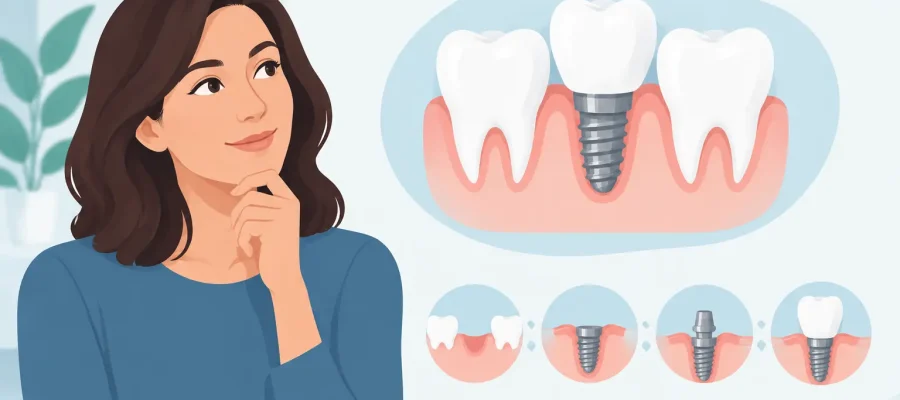
A missing tooth can feel easy to postpone, especially if it is toward the back of your smile or hidden in photographs. But the space is not static. Neighboring teeth can drift, the opposing tooth can over-erupt, and the jawbone in that area begins to lose stimulation. For anyone asking, when does a missing tooth need an implant?, the real answer depends on location, oral health, bite forces, and the result you want to protect long term.
An implant is not automatically the answer to every missing tooth. It is, however, often the most complete way to replace both the visible tooth and the root beneath it. That distinction matters for patients who want a natural-looking, fixed result without compromising healthy adjacent teeth.
When Does a Missing Tooth Need an Implant?
A dental implant becomes especially valuable when leaving the gap could change how your mouth functions, looks, or ages over time. The strongest candidates are usually adults with a fully developed jawbone, healthy gums, and enough bone to support an implant, or a clear plan to rebuild that bone first.
If you have lost a front tooth, prompt replacement is often a priority. Front teeth shape the smile, support the lip, affect speech, and carry a major share of your confidence in photos and conversations. Even a small shift in the neighboring teeth can make a future restoration more complex. In select cases, an immediate implant can be placed on the same day as extraction, allowing the site to be protected without a long visible gap.
A missing back tooth may not be visible, but it still matters. Molars absorb substantial chewing force. When one is absent, patients commonly shift chewing to the other side, overload surrounding teeth, or experience changes in the way their bite meets. A single missing molar is not always urgent on day one, but it deserves a clinical assessment before the space starts to close or the opposing tooth moves down into it.
Implants are also a strong option when you do not want a traditional bridge. A bridge can be an excellent restoration in the right situation, but it typically requires shaping the teeth on either side of the gap. If those neighboring teeth are healthy and untouched, an implant-supported crown preserves them. It stands independently, like a natural tooth.
The Risks of Waiting Too Long
The body preserves bone when it receives regular chewing stimulation. After a tooth is removed, the bone around that root gradually resorbs because it no longer has that signal. This process is most active in the first months after extraction, although it can continue over time.
For a patient planning a premium smile makeover, this matters beyond function. Bone loss can affect gum contours, the support of the lip, and the proportions of the final smile. It may also turn a straightforward implant into a treatment plan requiring bone grafting or, in the upper back jaw, a sinus lift.
Waiting can create three common problems: less bone for implant placement, teeth that lean into the space, and bite changes that require more restorative work later. None of these outcomes is guaranteed, and some patients remain stable for years. Still, a missing tooth should be evaluated early, even if you decide to delay treatment. A 3D scan gives the clinical team a baseline and shows whether immediate action would preserve options.
Situations Where an Implant May Not Be Needed Right Away
There are exceptions. If a wisdom tooth is missing and the rest of the bite is stable, replacement is usually unnecessary. If a tooth was lost decades ago and the space has already closed, an implant may not be possible or beneficial without orthodontic treatment. In some cases, a removable partial denture or a bridge may better fit the patient’s budget, anatomy, treatment timeline, or medical needs.
An implant may also need to wait when there is active gum disease, untreated infection, uncontrolled diabetes, heavy smoking, or insufficient bone. This does not always rule out implants. It means the foundation must be stabilized first. Successful implant dentistry is not about placing a titanium post as quickly as possible. It is about planning a stable result that can carry a beautiful crown for years.
For younger patients whose facial growth is not complete, clinicians typically delay implant placement. An implant does not move with natural teeth as the jaw develops, so timing is critical.
Implant, Bridge, or Leave the Space?
The decision is not simply about choosing the most advanced procedure. It is about choosing the restoration that protects your smile with the least unnecessary compromise.
An implant replaces the root and the crown. It is fixed, does not depend on adjacent teeth, and helps maintain bone stimulation. Treatment takes longer when healing is required, but the final result can look and feel exceptionally close to a natural tooth.
A bridge is fixed and can often be completed faster. It may be ideal when the teeth beside the gap already need crowns, making the restoration clinically efficient. The trade-off is that healthy neighboring enamel may need preparation, and cleaning beneath the bridge requires a dedicated routine.
Leaving the space can be reasonable in limited cases, particularly when it is a nonfunctional wisdom tooth or when a specialist confirms the bite will remain stable. For a visible tooth or a key chewing tooth, it is usually a decision that should be made deliberately, not by default.
What Makes Someone a Good Implant Candidate?
A confident answer requires more than an X-ray. At DRGO Smile Clinic, planning begins with a detailed examination and digital imaging to assess bone volume, gum health, bite alignment, and the aesthetic demands of the area. For front teeth, the smile line and gum architecture are as important as the implant itself.
A strong candidate generally has healthy periodontal tissues, manageable medical conditions, and a commitment to daily hygiene and maintenance visits. Teeth grinding does not automatically exclude implants, but it can change the design of the crown and may require a night guard to protect the restoration.
Bone quality is equally important. If an extraction happened recently, preserving the socket with grafting material may help maintain future implant options. If bone has already been lost, grafting can rebuild the foundation. In the upper posterior jaw, a sinus lift may create the height needed for safe, stable placement. These are planning tools, not signs of failure.
Can You Get an Implant Immediately After Extraction?
Sometimes, yes. Immediate implant placement means the implant is placed at the time the damaged tooth is removed. For the right patient, this can reduce the number of treatment stages and preserve soft-tissue contours, particularly in the smile zone.
However, immediate does not mean automatic. The extraction site must be free of uncontrolled infection, the surrounding bone must provide enough initial stability, and the bite must allow the area to heal safely. Some patients can receive a temporary tooth on the same day. Others need a healing period before the final crown is made.
This is where digital planning changes the experience. A 3D assessment allows the team to position the implant according to the final crown design, not simply the empty socket. The objective is a crown that is natural in color, shape, and gum integration, with an implant placed in the most biologically sound position.
Your Treatment Timeline Can Be Designed Around Your Life
International patients often ask whether an implant can fit around a wedding, media appearance, or limited travel window. The answer depends on whether the site is suitable for immediate placement and loading. Some patients can complete surgery and receive a temporary restoration during one visit, then return for the final crown after healing. Others may need bone preparation first and a more staged timeline.
A premium result is worth planning correctly. A temporary tooth can protect appearance while the implant integrates with the jawbone. The final crown is then designed with the same attention to proportion, translucency, bite, and facial harmony as the rest of a signature smile.
If you have a missing tooth, the best next move is not to guess how urgent it is from the mirror. Get a precise assessment while your treatment choices are still wide open. The right plan may be an implant now, preservation for an implant later, or another restoration entirely. What matters is protecting the smile you want to keep.